





 Make us preferred on Google
What Is Pi Network?
Pi Network is a cryptocurrency launched in March 2019 that utilizes Proof-of-Work, where users mine Pi coins through their mobile phones. In February 2025, OKX announced that Pi Network's PI will be listed on their spot trading markets, with deposits opening at 2:45AM UTC on February 12, with spot trading opening at 8AM UTC on February 20, with the mainnet slated for launch on the same day.
Key Takeaways
-
Pi Network offers users a mobile mining feature, where they can mine Pi coins on their mobile devices using the Pi mobile application. They take part in block validation and receive rewards in Pi coins.
-
Pi coin is the native token of the Pi Network, and holders can use Pi coin to pay transaction fees and perform transactions within the Pi ecosystem. The Pi Network mainnet supply model has a maximum total supply of 100 billion Pi coins.
-
When interacting with Pi Network, investors are advised to do their own research. Always ensure that you verify information on Pi Network's official accounts.
Introduction to Pi Network
Pi Network is positioned as an attempt to simplify the accessibility and introduce more people to cryptocurrency through a simple crypto mining and management system. It was officially launched on 14 March 2019 by Nicolas Kokkalis and Chengdiao Fan.
Pi Network offers a mobile mining feature, where users can mine Pi coins on their Android and iOS devices using the Pi mobile application. Participation in the mining program was solely by invitation. After installing and setting up the application, users can mine Pi coins on their devices with a single click. Since its launch, the Pi network has garnered a large social media following and has seen incredible growth in participation with over 60 million members as of November 2024.
Develop Pi apps today to create diverse utilities of the Pi cryptocurrency in the Pi ecosystem. Tap into our 60+ million Engaged Pioneer user base — no blockchain experience is needed and build anything you want. Participate in moving the network forward towards Open Network!…
— Pi Network (@PiCoreTeam) November 13, 2024
Members of the Pi network are popularly known as Pioneers, and they can earn Pi coins by playing a number of roles including running a node on their personal computers, referring new members, or mining Pi coins on their mobile devices. The Pi Network mainnet (Open Network) launched at 8AM UTC on February 20 2025, and any remaining Pioneers are required to submit their KYC application and complete the Mainnet Checklist to migrate to mainnet by February 28, 2025.
Pioneers, Open Network will launch at 8am UTC on February 20, 2025! With millions of KYC-verified Pioneers and a thriving utilities-driven ecosystem, Open Network expands available opportunities, which allows Pioneers to connect Pi with external systems for use in real-world… pic.twitter.com/AdpXNhpcUD
— Pi Network (@PiCoreTeam) February 11, 2025
Users can now also sell their PI on supported centralized exchanges, including OKX, Bitget, Gate.io, and MEXC.
How Pi Network Works

For the beta stage of the Pi Network project, the mobile application simulates the mining system which will be properly launched when the mainnet is fully functional. The mobile application users take part in block validation and receive rewards in Pi cryptocurrency.
When active, miners on the mobile app connect to one or more nodes. When connected, mobile miners inquire if the transaction has been recorded on the ledger. They also get the most recent block number and the hash value of that block.
Rewards for mining the block are distributed to the node owners and the mobile miners.
Consensus Algorithm
Pi Network runs the Stellar Consensus protocol (SCP). SCP was developed by David Mazières, Chief scientist at Stellar Development Foundation for the Stellar blockchain. It uses a novel mechanism called Federated Byzantine Agreements to ensure that updates to a distributed ledger are accurate and trustworthy.
The SCP protocol employs a real voting system. Nodes on the network vote on the validity of a block and the next block to be mined. A block is only mined when a majority of the nodes agree that it should be mined next and also confirm its validity. The nodes that participate in this consensus are elected by the creator of the system. The SCP is energy-friendly but is criticized for being centralized.
Tokenomics and Reward System
Pi coin is the native token of the Pi Network. Users on the Pi Network earn Pi coins through mining. Holders can use their Pi coins to pay transaction fees and also perform transactions on applications and marketplaces built in the Pi ecosystem. Pi coin supply system is guided by activities on the network and distributed solely as user rewards.
There was no official pre-mine, but users who participated in the beta mining program can port their tokens to the mainnet. Unlike many other cryptocurrencies, it doesn’t have a fixed total supply.
Each user that joins the Pi Network (by creating a Pi account) is allocated a pre-determined number of Pi coins. This allocated amount is mined over time. That is, the user can only mine this allocated number of tokens throughout their lifetime. This allocation is made only to the first 100 million users on the Pi network. A reward system also exists for users who refer new members to the Pi cryptocurrency project.
The Pi coin mining protocol mints an extra Pi coin for every coin minted for a member or referral reward. This extra coin is reserved for compensating developers on the network. The total Pi coin supply is a sum of the member, referral, and developer reward, and based on their whitepaper, the mainnet supply model has a maximum total supply of 100 billion Pi.
Governance Model
Pi Network operates a ‘Semi-DAO’ governance model. In contrast to the widely known decentralized governance system, Pi Network adopts a governance system that keeps a central team in charge while the community forms a strong force that contributes to the project’s decision-making. The governance model system varies; a two-phase plan that depends on the number of active network users.
If the number of active users on the Pi Network is less than five million, the team directly solicits inputs from the general community on proposals. Through the project’s forum built on the mobile mining application and other engagement media, the project team opens up conversations with the community. Inputs from the rest of the community are considered before making the final decision. The team ultimately decides the next line of action. As the community grows and exceeds five million active participants, the second phase of the governance system is employed. The team sets up a committee consisting of known contributors from the community. The Committee is in charge of developing proposals and organizing community contributions. The Pi Network forum is still open to contributions from the community. The committee proceeds to make a final decision using contributions from the community members.
Testnet and Mainnet System
Pi Network was launched as a research project and operated its beta phase as early as 2018. The Testnet was launched about two years later and allowed developers on the Pi Network to test certain features before they were finally deployed on the mainnet.
After much anticipation, Pi Network has announced the launch of their mainnet for February 20 2025. The mainnet provides a platform for pioneers to create a proper wallet and port their mined Pi cryptocurrency to their wallet and perform peer-to-peer transactions.
Check out this video tutorial to learn how you can create a mainnet wallet and transfer your Pi coins.
The mainnet migration features a KYC verification process and a list of to-dos that qualifies users to own and operate a proper wallet. If Pioneers delay their KYC verification and completion of the Mainnet Checklist post February 28 2025, their Pi will not be transferred to the mainnet and will not be accounted for in the calculation of the Pi Network system's base mining rate. This means their Pi will be reallocated for mining in the same year by other verified Pioneers. Do note that according to the team, the KYC and Mainnet migration are independent of the Pi Open Network launch.
This compulsory KYC is still a topic of popular discussion, and the project has been accused of complete centralization.
Is Pi Network a Scam?
If you have any interest in Pi Network, there’s a high chance that your interest is dashed by negative statements around the value of Pi coins and the questions surrounding the legitimacy of the project. While OKX's announcement that they will be listing PI for spot trading seems to provide the token and network with a measure of legitimacy, Bybit CEO Ben Zhou has declined to list Pi on Bybit, along with reports that Bitget's Chinese pages have also removed all mentions of Pi.
Even after launch, Pi Network is still facing accusations over their legitimacy, with Bybit CEO Ben Zhou emphasizing his concerns about the cryptocurrency.
1. Here is a official police warning of $Pi from Chinese police back in 2023 warning to the public that it’s a scam targeted towards elderly folks https://t.co/LaGJqXSOXR which leaks their personal data and loss of their pension. There are multiple other reports out there… https://t.co/gkEu2wZwfo
— Ben Zhou (@benbybit) February 20, 2025
In the past, due to users’ inability to move their mined Pi coins and the general sentiment on mobile mining, Pi Network was branded a ‘high-level’ marketing scheme and was predicted to end ultimately as a scam – although it is well on its way to proving otherwise. The continuous growth of the Pi Network community and the delay in listing the mined cryptocurrencies on exchanges further intensified these statements.
The Pi crypto team is attempting to prove otherwise with their recent developments. The launch of the mainnet now allows users to spend their Pi cryptocurrency, and several marketplaces are rumored to accept payments in Pi coins.
PCM does not participate in pricing. We also do not interfere with sellers' pricing. However, we will monitor the barter closely. Fraudulent behavior will be punished. You can view the relevant content in the Pi Chain Mall User Agreement. pic.twitter.com/kge0yfLqN1
— PiChain International (@pichainmall) August 25, 2022
According to the Pi team, there are over 27,000 local businesses worldwide using PI as a medium of exchange, with over 950,000 Pioneers using the platform's Map of Pi feature to browse and search for local businesses that accept PI.
What Is the Value of Pi Network's PI?
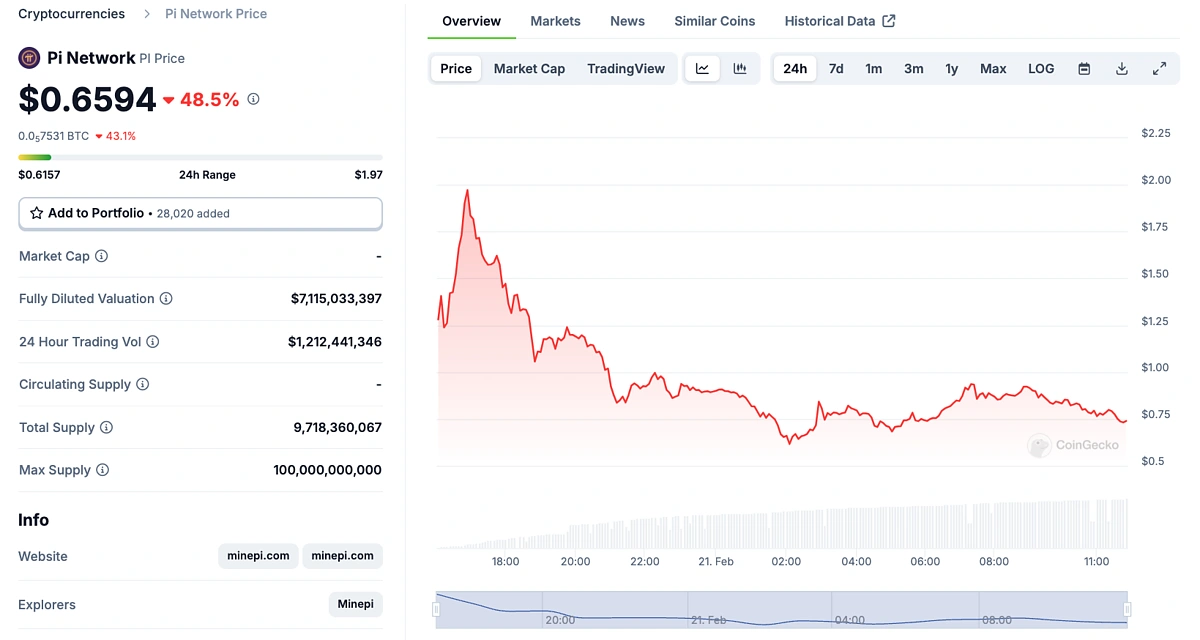
PI was launched on 20 February 2025, climbing to a high of $1.97. At time of writing, the price has since decreased to around $0.65 per token, with reports that exchanges are lacking sufficient liquidity to handle the tokens being traded. At time of writing, spread is ranging from 0.05% to a high of 0.52%, which suggests a high risk of slippage.
With a disparity between buyers and sellers, Pi Network is offering holders a "lock-up" period (up to three years) that will give them higher mining rewards.
Final Thoughts
With the mainnet launch, upcoing listing on exchanges, and the actual utility of Pi in physical world transactions, Pi Network appears to be delivering on its promises. However, there are still concerns around the legitimacy of Pi, with Bybit's CEO declining to list the token on the exchange.
Considering the rigorous computational protocols involved in cryptocurrency mining, Pi Network provides an accessible way to understand cryptocurrency mining for a mainstream audience, and has seen a positive reception from enthusiasts who believe in the idea of earning cryptocurrency with minimal effort through mobile mining.
As in the case of every other cryptocurrency venture, investors are advised to apply caution. Cryptocurrencies are still high-risk investments and Pi coin is no exception.










 Or check it out in the app stores