



 Make us preferred on Google
This article is brought to you by FBS.

The cryptocurrency market is again facing a severe trial in 2025. The main reason is President Donald Trump's new tariffs and harsh economic policies. This forced investors to flee from risky assets, and massive selling caused panic. However, looking back at the past, a similar situation already happened during his first presidential term.
In 2018, the cryptocurrency market has already experienced similar challenges. Bitcoin and other digital assets depreciated sharply after the imposition of tariffs against China. However, a few years later, the market recovered and entered a new bull cycle. Will history repeat itself this time?
What's Happening With Cryptocurrencies Right Now?
The cryptocurrency market is currently in a local downward phase. The price of Bitcoin and altcoins have stagnated and are showing declines as investors prefer to eliminate risky assets for fear of further instability. Main reasons for the decline:
-
Trump's new tariffs and economic policies: This includes the imposition of new trade duties against the EU, Canada, China, and other countries, and the possible escalation of the economic war with China, are causing investors to be apprehensive. In the past, similar situations have led capital to flow into safe assets such as gold and bonds while high-risk assets, including cryptocurrencies, are threatened.
-
Macroeconomic instability: Uncertainty about interest rate decisions and pressure on traditional markets lead to reduced liquidity, which affects the cryptocurrency market.
The Fear and Greed Index indicates the prevalence of panic in the market. A sharp increase in "fear" leads to massive selling, exacerbating the decline.

Cryptocurrency fear and greed graph

BTC falls after Donald Trump's inauguration
Pattern 2018-2020
To assess how the crypto market might react to current events, it is essential to understand what happened in 2018. At that time, the market faced similar challenges related to US economic policies and global instability. Namely, introducing tariffs on Chinese goods in 2018 triggered massive selling in the cryptocurrency market.
2018: Economic Instability and Trade War With China
In 2018 there was an escalating trade war between the US and China. Donald Trump imposed tariffs on Chinese goods, which caused uncertainty in the financial markets as investors began to worry about its possible impact on world trade, and a global economic recession. Moreover, the US started adopting more aggressive trade policies towards China and other countries, affecting the financial markets.
Cryptocurrencies, as high-risk assets, were sensitive to these changes. In 2018, bitcoin (BTC) and other cryptocurrencies sharply declined, from around $20,000 in December 2017 to around $3,000 in December 2018. Several factors caused this decline:
-
Increased uncertainty in the financial markets due to trade wars and sanctions.
-
Falling interest from institutional investors who began to exit high-risk assets.
-
Decreased liquidity in the economy, which also affected the crypto market.

The fall of BTC in 2017-2018
2019-2020: Recovery and the Start of a New Bull Run
After a substantial decline in 2018, the cryptocurrency market started to recover in 2019. The main factor in this recovery was the change in monetary policy by the Federal Reserve (Fed). In 2019, the Fed lowered interest rates, increasing market liquidity. Many investors returned to the cryptocurrency market as risk-on sentiment returned.
Bitcoin and other cryptocurrencies began to surge in 2020 after the Fed continued its stimulus measures and in the face of the COVID-19 pandemic. They began to be seen as “safe haven assets” independent of traditional financial systems. In addition, cryptocurrencies began to attract more attention from large institutional investors and companies, such as Tesla, which announced a $1.5 billion bitcoin purchase in 2021.
By the end of 2020, bitcoin returned to levels above $20,000, and the bull market continued into 2021. This growth was due to several factors:
-
Institutional investment: larger companies began investing in bitcoin to hedge capital preservation.
-
Digitalization of finance: The growing popularity of stablecoins, DeFi, and other cryptocurrency technologies has drawn attention to new opportunities in finance.
-
Global economic stimulus: The Federal Reserve and other central banks' measures to lower interest rates and increased liquidity have boosted demand for alternative assets.
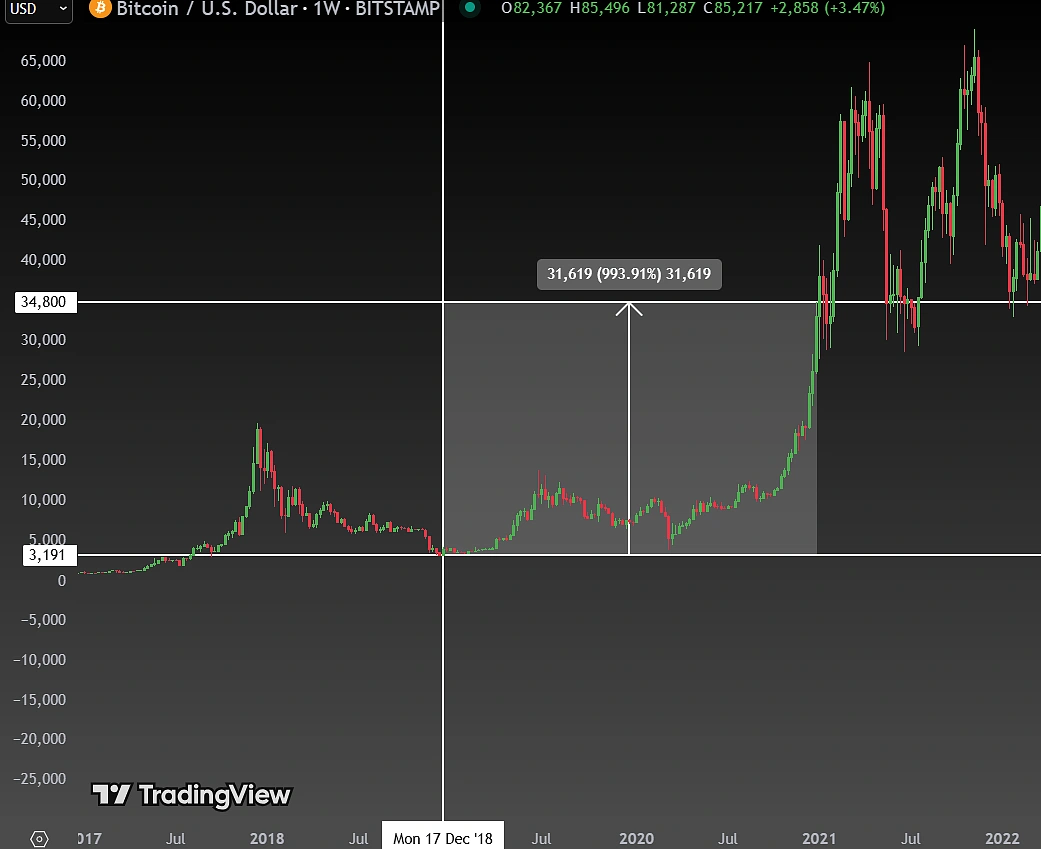
Bitcoin Recovery 2018-2020
What Can be Learned From the 2018-2020 Situation?
-
High volatility. Dips, both now and in 2018, are inevitable with external economic instability, but they create opportunities for market recovery and growth.
-
Market adaptation. As in 2019, cryptocurrencies may recover when the market adapts to new conditions and liquidity and interest increases.
-
Institutional investment. Since 2020, large companies have begun to see bitcoin as a protective asset for hedging, offering long-term growth prospects.
-
Now, in 2025, there will be a more attractive environment. Today, cryptocurrencies are more stable thanks to BTC-ETFs and the growing status of cryptocurrencies as reserve or treasury assets in various countries and companies. This creates a more favorable environment for growth, which was not the case in 2018-2020.
Thus, despite the current decline, past data shows that the cryptocurrency market can recover and continue to grow due to institutional investment and global acceptance of cryptocurrencies.
Will the Market Repeat the Path of 2018-2020?
While the crypto market's current decline has major investors worried, historical parallels point to the possibility of a recovery. What to expect from the market?
-
Short-term: High volatility and possible new lows.
-
Medium-term: Market adaptation and gradual recovery.
-
Long-term: Rebound and potential growth is possible due to Fed monetary easing, increased institutional demand, and the impact of the post-halving BTC cycle.

Possible targets for BTC recovery
After the previous correction, which formed a flag pattern in the center of the chart, the price confidently broke through the resistance. It rushed to the 2.61 Fibonacci level, achieving a significant rise. Now, the market is in the correction phase again, and if history repeats itself, we may see a similar impulse with a potential target of around 143K.
Conclusion
Trump is again causing instability in the financial markets, but this has already happened in 2018. Back then, the cryptocurrency market experienced a severe drop, but a strong bull market began afterward. History does not repeat itself verbatim, but you can often find similar patterns. Key factors to watch out for are Fed policy, the global economic environment, the speed at which the crypto market adapts to new realities, and greater acceptance of cryptocurrency in society. The cryptocurrency market may remain under pressure in the short term, but history shows that a period of instability can be followed by a period of growth.
This article is only for informational purposes and only reflects the opinion of its writer. It does not reflect the opinion of CoinGecko. Users are advised to do their own research before undertaking any investment.









 Or check it out in the app stores