



 Make us preferred on Google
Crypto Perpetual Contracts Overview
What Are Perpetual Contracts (Perps)?
Perpetual futures contracts (perps) are a dynamic financial tool that allows traders to speculate on price changes of an asset without actually owning the underlying asset. It lets them maintain flexibility, stay nimble, and take advantage of a greater degree of leverage.
These contracts are popular in the cryptocurrency space given the significant price changes that can occur in the market. It is commonly used for tokens like Bitcoin and Ethereum, but a new and developing category of protocols are offering synthetic perps for tracking non-crypto assets such as gold.
Perps vs. Traditional Futures Contracts
Traditional futures contracts act as an agreement to buy or sell assets at a predetermined price at a specific time in the future. On the contrary, perps do not implement an expiration date and traders can hold their positions as long as they want.
Here are some other ways that perps and traditional futures contracts are different:
|
Perpetual Futures |
Traditional Futures |
|
|
Price Anchor |
Price is maintained close to spot prices |
Price converges to spot as expiry date approaches |
|
Funding Rate |
Uses a funding rate to keep prices aligned to spot prices |
No funding rate applied |
|
Leverage |
Leverage usually runs as high as 100x |
Lower leverage typically determined by exchange platforms |
|
Market Access |
24/7 access in crypto markets |
Set to traditional market hours |
|
Underlying Market |
Usually references the spot prices of cryptocurrency assets |
References a future delivery price of commodities, indices, or assets |
|
Counterparty Risks |
Managed by crypto exchanges through internal risk engines and liquidation systems |
Managed by clearinghouses that guarantee contract performance |
Perps vs. Spot Trading
Spot trading involves the immediate buying or selling of an asset at the current market price. It offers the most direct way to trade crypto and gives traders ownership of the asset as soon as the transaction is completed.
Another key differentiating factor is real-time pricing. Since crypto prices can swing continuously based on supply and demand, some traders might choose to capitalize on short-term price movements. The speed of spot trading allows them to make decisions and react to market changes.
Spot trading also carries less risks since traders deal with the present value of a token, thus limiting their exposure to current market conditions.
Some other differences between perps and spot trading are:
|
Perpetual Futures |
Spot Trading |
|
|
Expiration Date |
No expiry, positions can be held indefinitely |
No expiry, trader owns the asset outright |
|
Funding Rate |
Periodic fees paid between traders to keep price close to spot |
No funding rate, traders just pay fees once |
|
Leverage |
High leverage usually runs as high as 100x |
No leverage, the full value of the asset must be paid |
|
Market Liquidity |
Typically higher liquidity than spot markets, facilitating quicker transactions |
Varies depending on the asset |
|
Liquidation Risk |
Positions can be liquidated if margin requirements are not met |
No risk of a position being liquidated since traders own the asset outright |
|
Trading Objective |
Often used for speculation or hedging price movements |
Commonly used for investment or ownership purposes |
|
Capital Requirement |
Requires margin (a fraction of total exposure) |
Requires full capital upfront to buy the asset |
How Perpetuals Work
There are a number of mechanisms that support perpetual futures contracts, especially when it needs to be executed in a decentralized manner.
Funding Rate
With traditional futures, the asset converges to the spot price upon expiry. Since perpetuals don’t have an expiration date, another mechanism is needed to keep prices close to the spot market. That is where the funding rate mechanism is applied.

The funding rate is a payment made at regular intervals — usually hourly — between traders to incentivize a balance in demand while ensuring that prices remain close to the asset’s spot price. For example, a negative rate means that there are more traders holding short positions. In this case, short positions will pay the funding fee to those with long positions. The same mechanism is applied in reverse if the rate is positive. Essentially, the funding rate is meant to help perpetual futures prices stay as close to spot prices as possible by incentivizing traders to open positions that are receiving the funding fee.
Leverage and Margin
To open a position, traders need to deposit margin that acts as the collateral. This is typically made up of an initial margin and the maintenance margin which is used to cover losses without the platform liquidating the position.
After depositing margin, traders can choose to go long (betting prices go up) or short (betting prices go down) as well as their leverage. A higher leverage allows them to control a larger trade position with a smaller capital. For example if a trader opens a 10x long BTC perp with a $1,000 margin. They will have control over a $10,000 position, and if the price moves up by 5% then they can gain 50% of their initial capital which comes up to $500.
Leverage lets traders dramatically increase profits but can also do the same to losses. Even small price movements in the opposite direction can lead to quick capital depletion and potential liquidations.
Liquidations
Liquidation occurs when a trader’s position no longer meets the required maintenance margin due to price movements. When this happens, the exchange automatically closes the position to prevent their balance from going negative. Do note that a liquidated position means losing the entire margin.
The same position from the example above could be liquidated if the asset’s price dropped by 10% since that would result in the loss of the entire $1,000 margin.
A position’s leverage and entry price will determine when liquidation happens. The higher the leverage, the smaller the liquidation distance. A 10x leveraged position would be liquidated with a 10% price swing, but a 40x leveraged position would be affected by a 2.5% swing.
Decentralized Perp DEXs
A perpetual decentralized exchange (Perp DEX) uses blockchain technology to enable users to trade perps.
Key Features
Several building blocks are necessary to make perp trading possible.
-
Perpetual Contracts: These are derivatives without an expiry date that let traders hold positions indefinitely.
-
Non-custodial Trading: Users maintain control of their funds and can trade directly from their wallets.
-
Oracles: These provide real-time price feeds to keep contract prices aligned with spot markets.
-
Funding Rates: Periodic payments between traders to ensure perp prices track underlying asset prices.
-
Liquidity Models: Perp DEXs use Automated Market Makers (AMMs), on-chain order books, or hybrid models to manage liquidity.
-
Risk Management: Smart contracts are used to enforce margin rules, liquidation, and occasionally insurance funds.
-
Governance and Tokenomics: Many platforms issue governance tokens to reward users and empower community decision-making.
Perp DEXs vs. Centralized Exchanges
Traders can choose to use decentralized or centralized exchanges to perform perpetual futures transactions. However, there are a few differences in how these platforms work.
|
Decentralized Exchanges |
Centralized Exchanges |
|
|
Trading Infrastructure |
Runs on blockchain smart contracts |
Runs on the exchange’s centralized servers |
|
Custody of Funds |
Users have full control |
Exchange holds user funds |
|
Transparency |
Fully or partially transparent with smart contracts and on-chain oracles handling pricing, funding, and liquidation |
Limited since pricing, funding rates, and liquidation data are managed privately by the exchange |
|
Counterparty Risk |
Lower since trades are executed by code and risk depends on smart contract security |
Higher because users must trust the exchange which faces risks of hacks, insolvency, or manipulation |
|
Leverage |
Typically lower (5x–50x) due to on-chain capital efficiency limits and risk constraints |
Very high (up to 100x+), since CEXs manage collateral internally |
|
Funding Rate Mechanism |
Calculated and applied on-chain |
Calculated and applied off-chain by the exchange every few hours |
|
Regulation |
No KYC requirements |
KYC requirements handled by exchange |
|
Liquidation System |
Managed through smart contracts and on-chain insurance funds |
Managed by the exchange’s algorithms and internal insurance funds |
Perp DEX volumes have been growing in 2025 and successfully reached a new record of $1 trillion in September. Platforms like Hyperliquid have been leading on-chain activities with some newer players throwing their hats in the ring. Meanwhile, futures volumes on centralized exchanges — largely made up of perpetuals — reached $6.9 trillion in September with heavyweights Binance and OKX at the top.
Strategies for Trading Perps
Before you start trading perps, it is best to learn more about the strategies that others might be using.
Beginner Friendly: Follow Market Trends
The simplest method is to identify trends in the market and open positions based on that. This strategy is based on the market’s momentum and traders enter a position in the direction of the trend and exit when the trend reverses. Traders will need to stay updated with market movements and trends.
Intermediate: Hedge Existing Position in the Underlying Asset
Perps can also be used to hedge an existing position in the underlying asset. This strategy is meant to offset any potential losses incurred from another perp position or even a spot market position. For example, if a trader has a Bitcoin long position but anticipates a short-term decline in price, they can open a short position that then gains value if the price of Bitcoin falls. The same can be applied to a trader who holds BTC and wants to offset any losses from their holdings.
This strategy requires an understanding of position sizing and timing but can still be relatively straightforward. Traders need to be more active in anticipating short-term and long-term price movements as well as managing several positions on the same asset.
Advanced: Dynamic Hedging and Arbitrage
Taking that a step further, traders can use dynamic hedging to not only offset losses but to also take advantage of short-term price movements to create profit opportunities. Traders will need to actively adjust their hedges based on market conditions including funding rate changes, volatility spikes, and technical signals to limit downside and capture extra profit. This strategy requires more market awareness, good timing, and better familiarity with perp mechanics.
Advanced traders also use arbitrage strategies to profit from temporary price differences between the perpetual futures market and the spot market. This involves simultaneously buying the asset where it’s priced lower and selling it where it’s higher — often by buying on spot and shorting on perps when the futures market trades at a premium. The goal is to capture the spread as prices eventually align or as funding payments accrue. Since these opportunities can disappear within seconds, successful arbitrage requires large capital, rapid execution, and a deep understanding of market mechanics, funding rates, and exchange risks.
Advanced: Delta Neutral Strategy
Delta-neutral strategies represent an advanced approach where traders open simultaneous long and short positions on the same asset to eliminate directional price exposure. While primarily used by market makers and sophisticated traders, these strategies have become popular among airdrop farmers seeking to generate trading volume and funding rate arbitrageurs capturing periodic payments from perpetual contracts.
The core mechanics involve going long on spot while shorting an equivalent position in perpetuals (or vice versa), profiting from funding rate differentials rather than price movements. However, the October 10, 2025 market crash exposed a critical risk: auto-deleveraging (ADL). When liquidations exceeded $5 billion and overwhelmed insurance funds, exchanges forcibly closed the most profitable positions to maintain solvency. Platforms like Hyperliquid triggered cross-margin ADL for the first time in over two years, while centralized exchanges saw billions in forced closures. This exposed a critical risk of delta neutral strategies that most traders had not considered, in which their short positions would be forcibly closed while their unprofitable longs remained open.
Risks of Perpetual Trading
Perp trading comes with a few layers of risk that can potentially magnify losses quickly.
Liquidation Risk
Liquidation happens when the account balance falls below the maintenance margin. Depending on the trader’s position and capital, this can lead to quickly losing funds. Traders need to be aware of margin requirements and keep track of their positions to ensure it can stay above the maintenance margin.
Leverage
A small price swing against a highly leveraged position can result in instant liquidation leaving the trader with no chance to exit. Since the crypto market can still face periods of substantial price movements, traders need to consider how much leverage they can afford to take.
Funding Rates/Slippage
Holding a position for multiple funding intervals can cause funding rates to rack up. Continuous funding payments may also impact long-term profitability. Traders should account for these costs when holding positions for long periods.
Top Perp DEXs
Now, let's look at some of the most popular perp DEXs in the space.
Hyperliquid

Hyperliquid is a Layer 1 blockchain (L1) and DEX designed for fast perpetual futures and spot trading. It uses a custom system called HyperBFT to process trades quickly and keep fees low. Its native token, HYPE, is used for governance, staking, and rewards on the platform.
Designed to combine speed with decentralization, Hyperliquid lets users trade perps with advanced order types, low fees, and high throughput directly on-chain. It is positioned as one of the first DEXs capable of matching centralized exchanges in performance, though it still carries the usual risks of leveraged trading, smart-contract vulnerabilities, and evolving regulation. Hyperliquid’s total value locked (TVL) is around $4.5 billion at the time of writing with a daily perp volume of $10.7 billion.
Aster
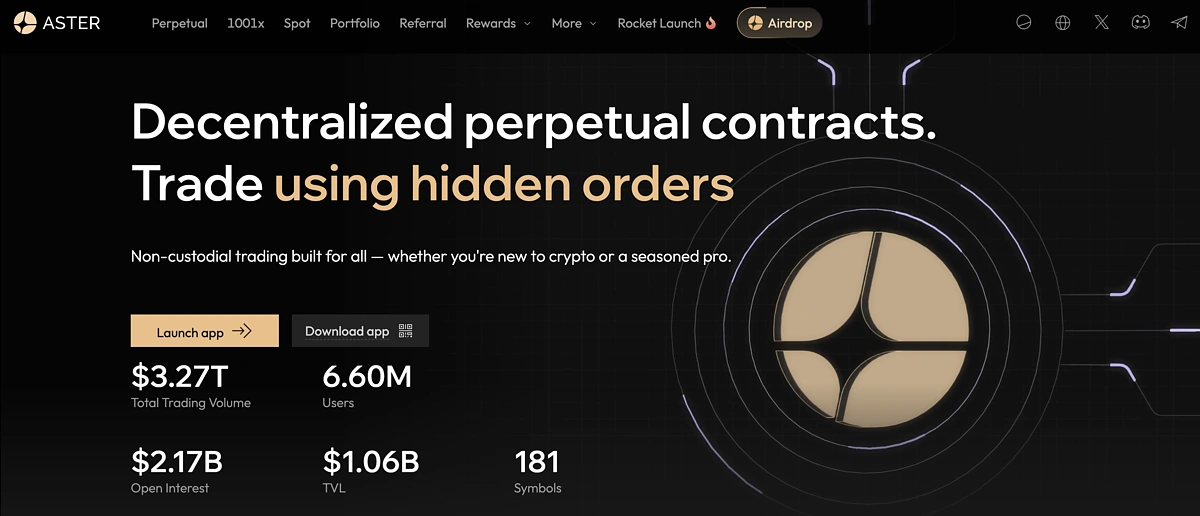
Aster is a next-generation decentralized perpetual exchange built from the merger of Astherus and APX Finance in late 2024, operating across BNB Chain, Ethereum, Solana, and Arbitrum. The platform is powered by Aster Chain, a Layer 1 blockchain that integrates zero-knowledge proofs to enable private yet auditable transactions, enhancing privacy and mitigating risks such as front-running and MEV attacks.
Aster provides dual trading modes: Simple Mode for one-click trading with up to 1001x leverage and MEV protection, and Pro Mode with advanced order book features including hidden orders that remain invisible until execution. One of Aster's key innovations is its yield-optimized collateral system, allowing users to trade with productive assets like asBNB and yield-bearing USDF stablecoin while earning passive returns.
Since its launch, Aster has recorded TVL reaching over $2 billion with daily trading volumes repeatedly exceeding $10 billion. Backed by YZi Labs and closely associated with Binance co-founders, the platform has gained substantial traction in the BNB Chain ecosystem.
Lighter

Lighter is a decentralized perpetual-futures exchange built as a zk-rollup on Ethereum, offering a central-limit order book trading experience with on-chain transparency. By using zero-knowledge proofs for order matching and liquidations, it combines self-custody and verifiability with the speed and efficiency of centralized exchanges.
The platform has rapidly gained traction, reaching a TVL of around $1.2 billion with daily trading volumes hovering near $10 billion at time of writing. While its rapid growth positions it as a serious competitor to Hyperliquid, analysts caution that trading activity may be partially driven by incentive programs and speculation of a token launch.
EdgeX

Another up and coming platform is edgeX, a decentralized perpetual-futures exchange developed by Amber Group. It is built on StarkEx’s zero-knowledge rollup technology to offer high-speed, low-cost, and self-custodial trading on Ethereum. The platform claims it is able to process over 200,000 orders per second while offering the transparency and security of DeFi.
EdgeX provides advanced trading tools like trailing stop-loss orders, up to 100x leverage, and cross-chain support. It’s built on a modular DeFi infrastructure that allows for flexible product design, while using zero-knowledge proofs and Ethereum L1 settlement to ensure security and transparency. EdgeX has been steadily making its way up the board and has a TVL of more than $473 million and a daily perp volume of over $6.6 billion at the time of writing.
Avantis

Avantis is another on-chain perpetuals DEX that has been slowly gaining momentum. The exchange is built on and backed by Base to offer high-leverage trading across cryptocurrencies, forex, commodities, and other real-world assets. Users can take advantage of advanced tools to manage risks including loss protection, positive slippage, and specialized time and risk parameters.
Avantis depends on a steady pool of USDC liquidity to support its perpetual and leveraged trading system. Traders deposit USDC as collateral to open leveraged positions, while liquidity providers add USDC to vaults that power the trading pool. Instead of running its own order book, Avantis uses price oracles to get accurate market data. Avantis has a TVL of just over $110 million and a daily perp volume of more than $150 million at the time of writing.
Conclusion
Perpetual futures have become one of the most important instruments in crypto to give traders flexible tools to speculate, hedge, and manage risk, However, they also demand discipline due to the high leverage and volatility involved. As on-chain platforms continue to evolve and scale, decentralized perpetuals are likely to play an even bigger role in shaping the future of digital asset markets.
This article is only for informational purposes and should not be taken as financial advice. Always do your own research and never invest more than you can afford to lose.










 Or check it out in the app stores