



What Are DualDefense Flash Pools?
DualDefense Flash Pools introduce a novel approach in DeFi by combining real yield with prediction markets, where crypto investors bet on whether critical vulnerabilities will be discovered by independent security researchers, while earning returns of up to 180% APY.
Key Takeaways
-
Hacken, a blockchain security auditor, has introduced DualDefense Flash Pools – an incentivized and gamified system designed to improve the effectiveness of crypto security audits by combining the strengths of traditional audits and community-backed assessments.
-
DualDefense Flash Pools are security prediction markets, where HAI holders stake their tokens to support bug-hunting efforts. Holders are staking their tokens on the assumption that no critical vulnerabilities will be found, and will be liquidated in the event a critical vulnerability is discovered, with their funds going to the bug hunter.
-
Hacken adopts a real yield approach, where APY pools are filled with USDC from audit fees.
This article is brought to you by Hacken.
With the growing adoption of crypto, blockchain security audits are becoming essential to the space as it reduces the likelihood of critical vulnerabilities in smart contracts that may result in grave losses for users and developers. To further enhance and double-check the quality of audits for its clients, Hacken has launched DualDefense Flash Pools which combines real yield with prediction markets, offering a new earn strategy for the crypto community.
According to the project, there is a queue of clients looking to integrate DualDefense into their security framework, looking for the added layer of protection from DualDefense. With this demand, the team expects that the full release will push HAI’s value higher as more clients join DualDefense. Dyma Budorin, Hacken's Co-Founder & CEO, states,
“We put our skin in the game by inviting every ethical hacker to battle-test our security assessments. If a bug is found—staked tokens go directly to reward the Whitehat. Meanwhile, we incentivize HAI holders, the backbone of this system, by sharing a part of our real revenue to ensure high APY.”.
Now, let’s take a look at DualDefense Flash Pools and how they work.
What Is DualDefense?
DualDefense is an innovative security service, which offers additional code assessment scrutiny that is financially covered by Hacken and its community, where Hacken uses a share of its revenue to encourage additional verification of the audit results provided to clients. DualDefense also adds utility to the HAI token, as access to DualDefense Flash Pools is only through HAI tokens.
DualDefense Flash Pools fuse blockchain security audits and DeFi to create a dynamic prediction market around the reliability of a security review by an audit team. First, there are crypto users who will stake HAI to predict the outcome of Hacken’s security audits. If no additional critical vulnerabilities are found, they can earn up to 180% APY in real yield rewards. Their stake counts towards a time-bound (30-day) prize pool that appeals to white hat hackers to find undiscovered critical vulnerabilities, where they can claim the prize pool if they succeed. However, unlike traditional bug bounty programs where white hats only get paid for found vulnerabilities, they can also stake HAI in the staking pools like ordinary crypto users, so they can still earn rewards for secure code reviews.
How Do DualDefense Flash Pools Work?
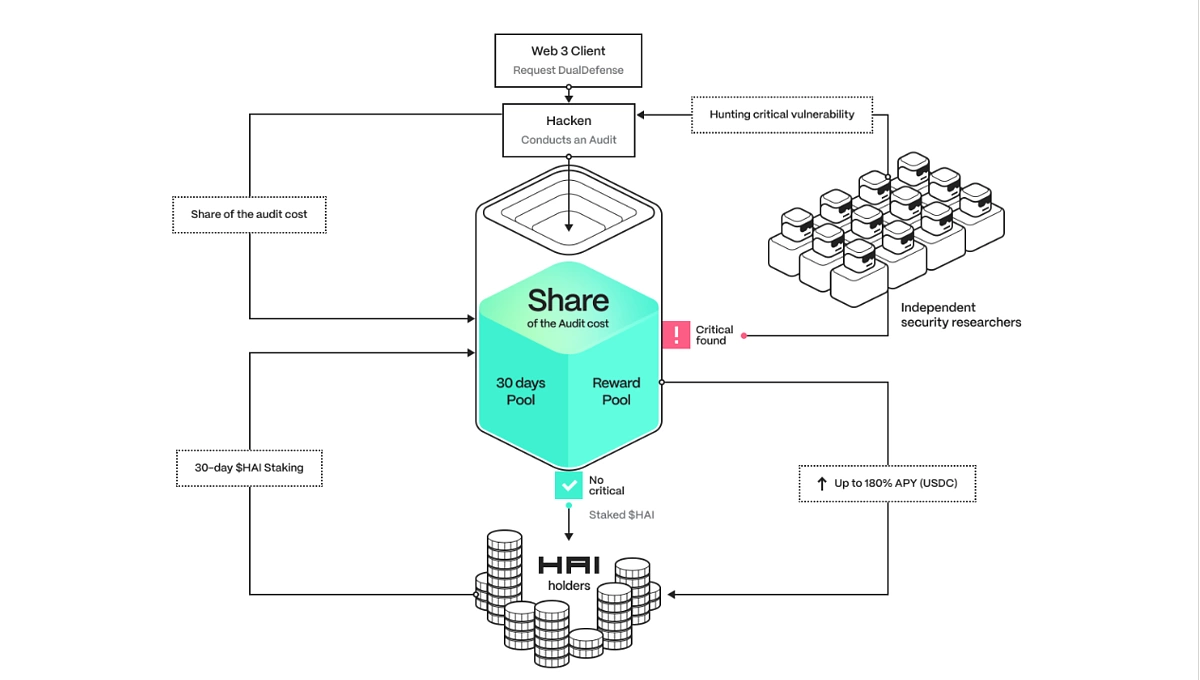
As the name implies, DualDefense Flash Pools provide an additional verification system for blockchain protocol audits. For every DualDefense audit, Hacken creates an APY pool that contains 10-20% of the earnings from each audit completed by the team. This is the APY that is shared among users that have staked HAI in DualDefense Flash Pools, who believe that Hacken’s audit will stand the test of independent bug hunters. If issues are detected, rewards from the Flash Pool will be paid out to white hat hackers, while stakers will still receive their APY as a reward for contributing to the security initiative.
The staked HAI makes up the reward pool for bug hunters, who will run additional checks on the code and the audit process in search of critical vulnerabilities. The review process lasts for 30 days, during which the pool stays active, accepting additional stakes from holders. If no critical vulnerability is found at the end of the 30-day period, HAI holders who stake to the pool share the APY Pool rewards, where the reward APY could be up to 180%. Do note however, that the final APY of a specific pool is dynamic and depends on the pool size.
Benefits of DualDefense Flash Pools
DualDefense Flash Pools are introducing a new approach in DeFi, combining security with real yield and prediction markets, offering users a new earn strategy. Let’s take a closer look at some of the benefits of DualDefense Flash Pools.
Security Prediction Market System
Given the success of prediction markets in crypto, where users are attracted by the idea of betting on possible outcomes, Hacken has adapted this to create the first-ever solution for enhancing the quality of audits for its clients. Through the DualDefense Flash Pools, users can bet on the quality of Hacken’s security audits by staking HAI. As a reward, they can earn up to 180% APY, allowing them to balance returns with risk.
Real Yield and Rewards
Most cryptocurrency projects operate inflationary tokenomics. Over time, the circulating supply gets expanded uncontrollably to fund yield-farming programs, leading to token devaluation and a reduction in investors' interest. In contrast, Hacken offers real yield with DualDefense Flash Pools by funding the APY pool with a share of the audit cost, encouraging active participation on the side of stakers, while driving demand that attracts interest from white hats. This makes for a sustainable long-term yield and reward system for crowdsourced security audits, which in turn attracts more projects to sign up for DualDefense as they enjoy an additional crowdsourced bug-hunting review.
30-Days Flash Pools
Most staking programs require long lock-up periods of between three to 12 months. Meanwhile, DualDefense Flash Pools only operate for 30 days while still offering high yields. DualDefense also allows the concurrent operation of more than one reward pool, allowing stakers to choose between multiple options with different rewards.
Cost-Effective and Battle-Tested Security Audits
For protocols, DualDefense offers clients two audits for the price of one. By signing up for DualDefense, their protocols are not only reviewed by the Hacken team, but also by a community of thousands of experienced white hats. This lets them save on bug bounties, while enjoying an additional check of the code by independent security researchers.
Expanded Utility for the HAI Token
The HAI token powers Hacken’s web3 audit facility. Since its launch, it has been used in several ways to boost the productivity of Hacken’s audit system. Now, the HAI token plays a key role in DualDefense, as participation in the Flash Pools is exclusively through HAI tokens, while stakers enjoy a stream of real yield from participating in these Flash Pools.
Now, let’s take a closer look at DualDefense Flash Pools and how they will affect HAI.
How Will DualDefense Flash Pools Affect the HAI Token?
DualDefense Flash Pools are designed to further add utility for the HAI token, as mentioned above. Here are some possible areas where DualDefense Flash Pools can drive demand for the HAI token.
Growth in HAI Value and Holders
DualDefense is a highly anticipated product for Hacken, its community, and projects that intend to run an audit. Pending the success of the program, Hacken is likely to grow its investor base as interest in the project grows. A growing community and utility are known factors for positive growth in the overall project’s value, this could also be the case for the HAI token, especially when almost all Hacken audits are linked to DualDefense Flash pools.
Through DualDefense, HAI will also be exposed to new investors – clients or the community associated with the reviewed protocol. As the HAI ecosystem expands, the demand for HAI will increase, boosting liquidity and long-term value as more participants lock their assets into HAI.
Incentive to HODL HAI token
Beyond offering users the opportunity to participate and earn with DualDefense Flash Pools, there is also incentive for HAI holders who choose to HODL. With Flash Pools opening, the demand for HAI will increase as each pool adds utility and rewards. With HAI stakers reducing the circulating supply, there is likely to be an increase in demand for HAI, which creates an incentive to HODL the HAI token.
Possible Coinbase Exposure
DualDefense Flash Pools are deployed on the Base Layer 2 network, which is developed by Coinbase, the largest listed cryptocurrency exchange. By developing on Base, HAI is positioning itself for potential exposure with Coinbase, and as Base grows, projects within its ecosystem are likely to gain market attention.
Final Thoughts
With DualDefense Flash Pools, Hacken is creating the first-ever security prediction market, bringing Hacken, white hat hackers, and crypto users together. Hacken contributes a share of their revenue, filling APY pools with USDC from audit fees, crypto users are invited to stake their HAI in Flash Pools to show their belief that Hacken’s security audit will stand up to independent bug hunters, while white hats have the opportunity to earn the staked HAI in Flash Pools in the event a critical vulnerability is found.
Having said this, it is important to understand the implications of taking part in DualDefense Flash Pools, especially for investors staking their tokens. While there is the chance of making significant profits by staking in the pool, keep in mind that there are chances of getting liquidated if a vulnerability is found in the audited code. It is therefore recommended that investors review the audit before committing their assets to their pool. Also, note that this article is only for educational purposes and should not be taken as financial advice.

Subscribe to the CoinGecko Daily Newsletter!






 Or check it out in the app stores