





 Make us preferred on Google
What Is Berachain?
Berachain is an EVM-identical Layer 1 blockchain that uses Proof-of-Liquidity, which separates gas tokens from governance tokens. By introducing PoL, Berachain aims to encourage users to provide liquidity to DeFi applications and create a synergy between validators and the ecosystem of projects.
Key Takeaways
-
Berachain is an EVM-identical Layer 1 blockchain network built with the Cosmos SDK.
-
It runs on the Proof-of-Liquidity (POL) consensus mechanism, which calculates rewards based on the amount of provided liquidity and separates gas tokens from governance tokens.
-
Berchain utilizes BERA, which is used for gas fees, and BGT, which is the blockchain’s soulbound governance token, along with HONEY, the Layer 1's native stablecoin
-
Berachain also presents fast transaction finality, relatively cheap transaction fees, and an overall agile, scalable, and modular blockchain network.
Proof-of-Stake (PoS) blockchains are emerging as the most popular consensus mechanism due to its scalability; however, it affects the liquidity of the network as it requires network validators to lock away the network’s native tokens on the consensus layer.
As a response to the on-chain liquidity problem, Berachain, a Layer 1 blockchain project proposes a novel native liquidity solution implemented at the consensus level. It aims to solve a key blockchain and DeFi liquidity problem by allowing users to stake assets on Berachain while letting them use those assets in DeFi protocols.
Berachain's mainnet and token generation event (TGE) is launching on February 6, 2025, promising users speed and scalability that rivals Solana, along with decentralization and security on par with Ethereum. If you've interacted with the Berachain testnet, you can check out the airdrop checker at https://checker.berachain.com/ to see if you are eligible for the Berachain airdrop!
Introducing Berachain
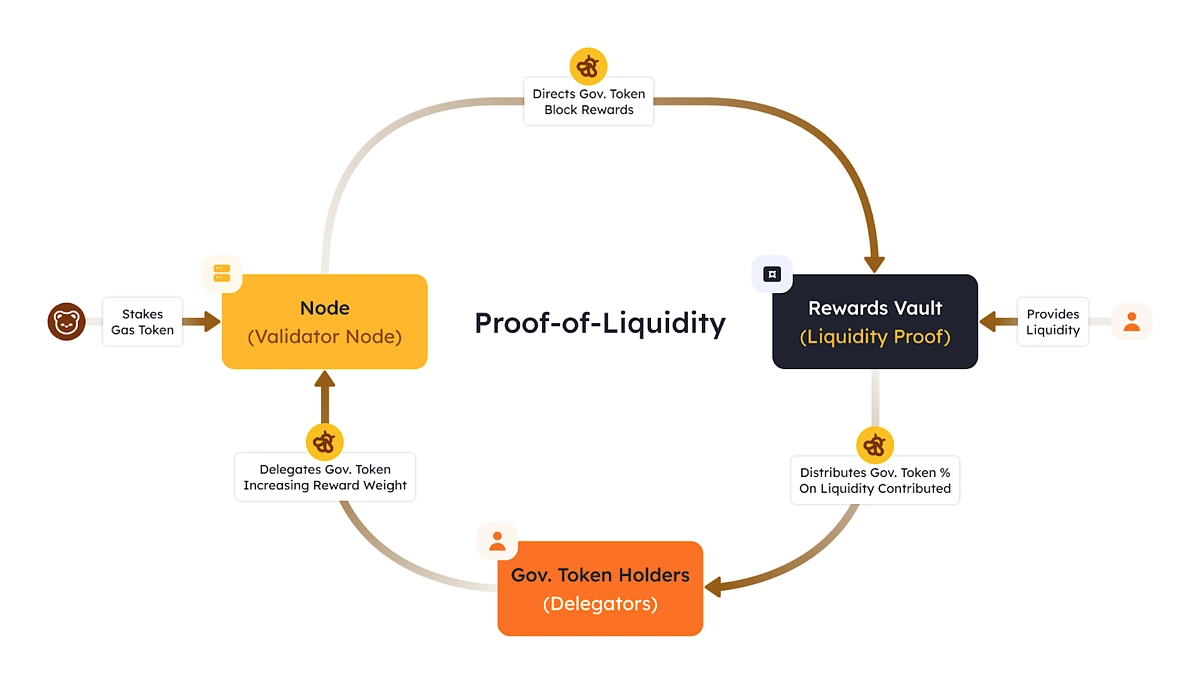
Berachain is an EVM-identical, modular Layer 1 blockchain network that utilizes Proof-of-Liquidity (POL) as its consensus mechanism. With Proof-of-Liquidity, users that provide liquidity to the chain gain a soulbound governance token (BGT) that determines the potential reward weight for a staker, providing applications with a liquidity-rich ecosystem to build on.
These protocols can create reward vaults, where users can stake POL-eligible assets to earn a portion of the BGT emitted to the vault. These vaults are chosen by the validators based on the incentives offered by the protocol, which usually take the form of offering an exchange rate between BGT emitted to the vault and another token.
Through this, Berachain envisions the creation of an incentive flywheel that brings together all network participants:
Users who lock their assets into the reward vault will receive BGT emissions from the validators, and these emissions can be delegated to validators to earn more rewards. Meanwhile, applications can incentivize user activity with BGT emissions.
Berachain is also EVM-identical, which means that any EVM (Ethereum Virtual Machine) applications can be deployed on the Berachain network ‘as-is’. Berachain is built with BeaconKit – a modular framework that enables the creation of L1 and L2 chains. As a result, this means Berachain can also support the improvements in the upcoming Dencun upgrade.
Funding
Berachain started as an NFT project called BongBears in 2021, and the bear theme continues with Berachain and also the founding team’s names: Smokey the Bear, Homme Bera, and Dev Bear.
Berachain has raised $142 million over two funding rounds. In April 2023, the project raised $42 million led by Polychain Capital at a valuation of $420.69 million. A year later, in April 2024, Berachain raised another $100 million in a Series B round led by Framework Ventures and the Abu Dhabi branch of Brevan Howard Digital (BH Digital), with other notable investors including Polygon’s Sandeep Nailwal and Samsung Next.
Based on reports, investors are backing Berachain through a simple agreement for future tokens (SAFT).
How Does Berachain Work?
The idea behind Berachain is the development of a cost-effective, secure, high-performance, and user-friendly blockchain network that is liquidity-rich. This is reflected in Berachain’s execution and consensus layer design. Berachain is built on the BeaconKit framework – a highly modular framework for developing EVM-identical consensus and execution layers.
Execution Layer: EVM-Identical
Berachain offers an EVM-identical execution environment that allows developers on Ethereum and other EVM networks to port their applications to the networks without making any changes to their code base. Compared to EVM-equivalent and EVM-compatible execution layers, which may require developers to make changes before deploying their apps on these chains, Berachain mirrors the execution environment on Ethereum. This also means that when the EVM is upgraded, Berachain can easily adopt the latest version.
Consensus Layer: Proof-of-Liquidity (POL)
Berachain's approach to solving the on-chain liquidity is its novel Proof-of-Liquidity (POL) consensus mechanism. POL is an adaptation of the established POS consensus mechanism with significant modification in the staking process, asset management, and reward distribution.
For one, it introduces a multi-token structure to separate the security and governance systems. It also aims to support the network's economy while building a sufficient value layer for the consensus system.
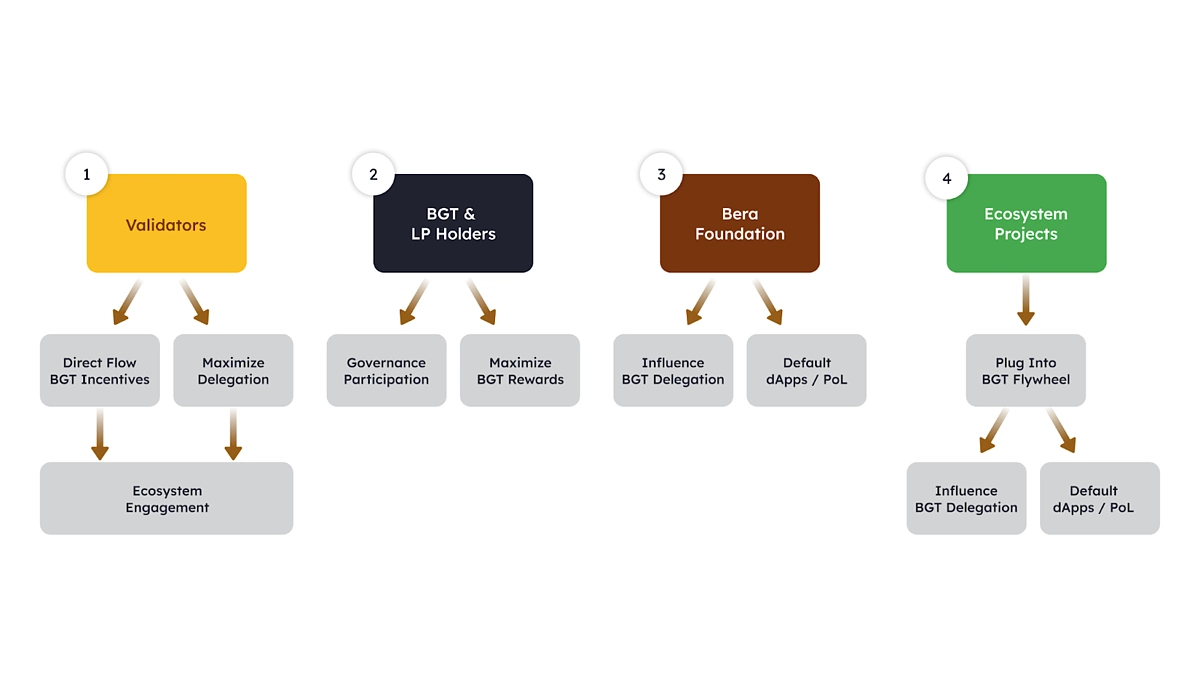
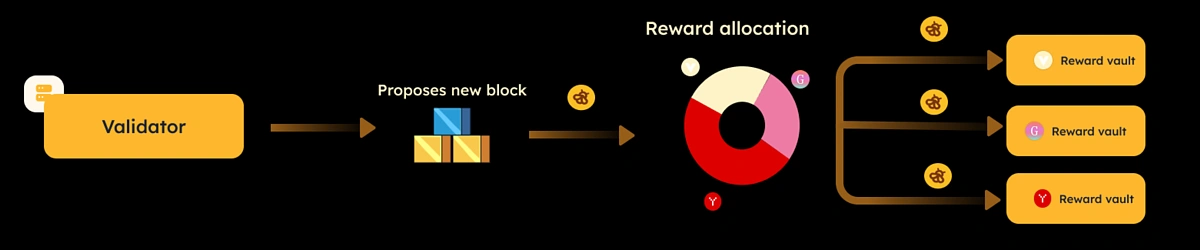
BGT emissions are similar to staking rewards on POS chains; however, the distribution method differs in Proof-of-Liquidity. In order to receive BGT, users must stake the PoL-eligible asset in its reward vault. The PoL-eligible asset is usually a receipt token, given to the user after they take a specific action (e.g. depositing USDC into a protocol), enabling protocols to get users to undertake desired actions like providing liquidity, in exchange for a PoL-eligible asset that can be staked in their vault.
Once the user receives the PoL-eligible asset, they can stake it in the corresponding vault and earn a share of all the BGT emitted to that vault.
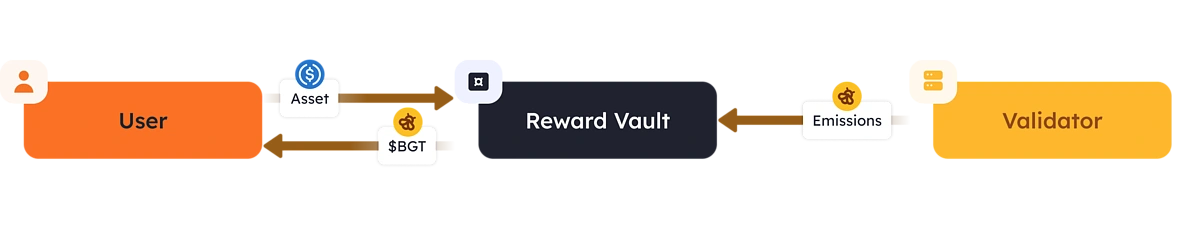
Applications will offer incentives to validators, which establishes an exchange rate between BGT emitted to the vault and a certain amount of a different asset. For example, a reward vault may offer an incentive to validators, where they will receive 30 USDC for every 1 BGT emitted to the vault, while a DEX may offer 10 of its native tokens for every 1 BGT emitted to its vault.
Berachain Tokens
Berachain operates a multi-token economy that separates the key areas of the network: economy, security, and on-chain governance.
BERA
BERA is the native token of the Berachain network. It is the gas token of the blockchain, where fees for regular and smart contract transactions are settled in BERA.
At genesis, the total supply will be 500 million BERA, with an estimated inflation rate of 10% annually due to BGT emissions. According to the project, BERA will be allocated across the following five categories based on the below:
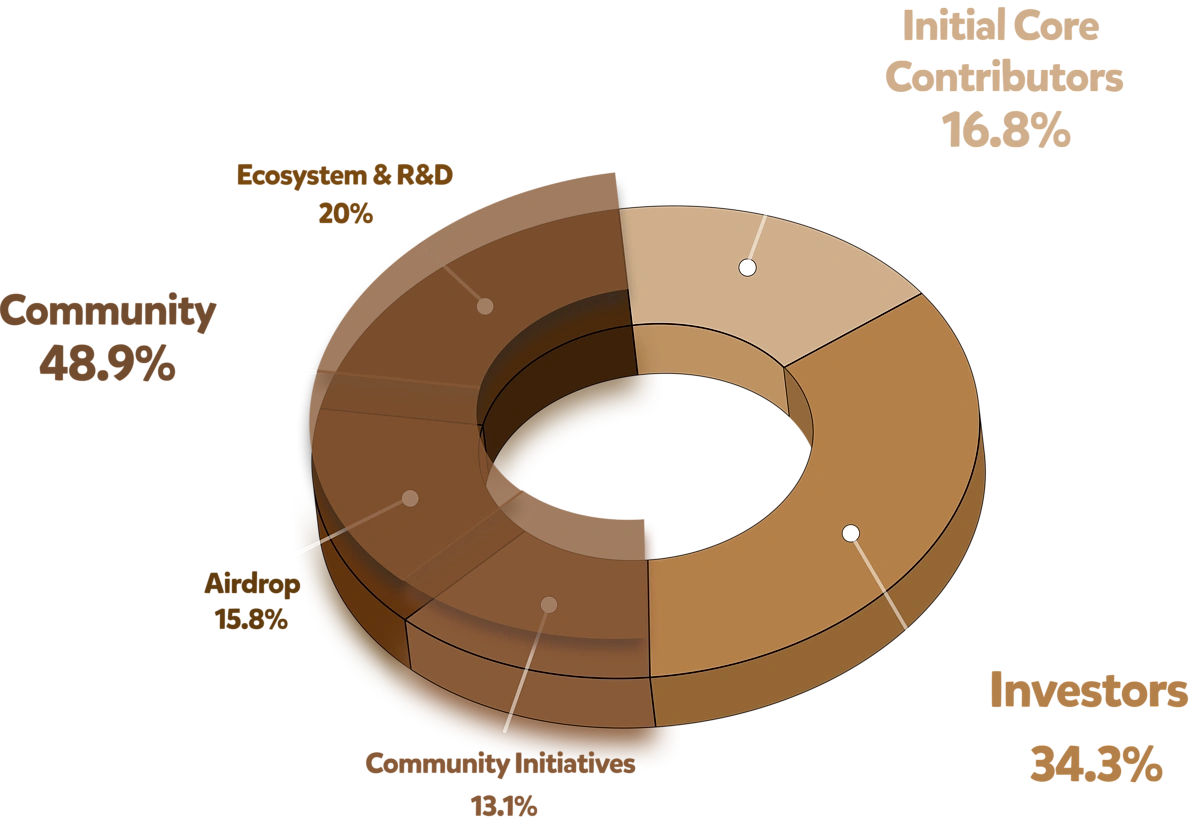
According to the project, all parties will follow a similar vesting schedule, with an initial unlock after a one-year cliff, where 1/6th of allocated tokens are unlocked, followed by linear vesting, where the remaining tokens will vest linearly over the subsequent 24 months.
Berachain Governance Token (BGT)
BGT is the governance token of the Berachain network and powers network security. It is a (non-transferable) soulbound token obtained by performing certain actions in dApps with BERA and other accepted assets with whitelisted reward vaults. Users can select validators to "boost" with their BGT, which increases the validator's reward emission. These incentives are determined by the validators' aggregate boost, and are returned to the BGT holders that boosted the validator. Users who are boosting validators will also earn a share of Berachain core dApp fees (from BeraSwap and HoneySwap).
As a governance token, BGT will also be used by the project’s DAO to decide on improvement proposals via community votes. BGT holders can vote individually, or delegate their voting powers to any other address. The DAO decides on issues such as assets to be accepted in the reward vault and proposals related to the native decentralized applications.
BGT can be redeemed for BERA through a burn process in a 1:1 ratio. However, BERA cannot be converted into BGT without staking, ensuring only BGT holders can earn the chain's economic incentives.
HONEY
HONEY is the native stablecoin of the Berachain network and is soft-pegged to the US dollar. According to the project, the intial collateral options will be USDC and PYUSD, with new assets to mint HONEY subject to project governance.
According to the project, it is designed to provide a stable and reliable means of exchange within the Berachain ecosystem and beyond. HONEY is minted through a dynamic procedure controlled by the vault router – a smart contract on the Berachain network that accepts collateral stablecoins to mint HONEY and manages deposited collateral.
Berachain operates multiple vaults for the accepted stablecoins; the vault router moves collateral to the appropriate asset vault and mints the equivalent HONEY. The minting rate, fee, and the accepted collateral for minting HONEY could change over time as decided by the Berachain DAO. HONEY can be used just like any other stablecoins – it can be used for P2P transfer of value and integrated into DeFi protocols like lending and perpetual trading platforms.
Berachain's BeraHub
While earlier phases of Berchain featured native dApps like BEX (decentralized exchange), BEND (lending platform), and BERP (perpetual trading platform), with launch around the corner, Berachain has rebranded and brought everything together under the BeraHub.
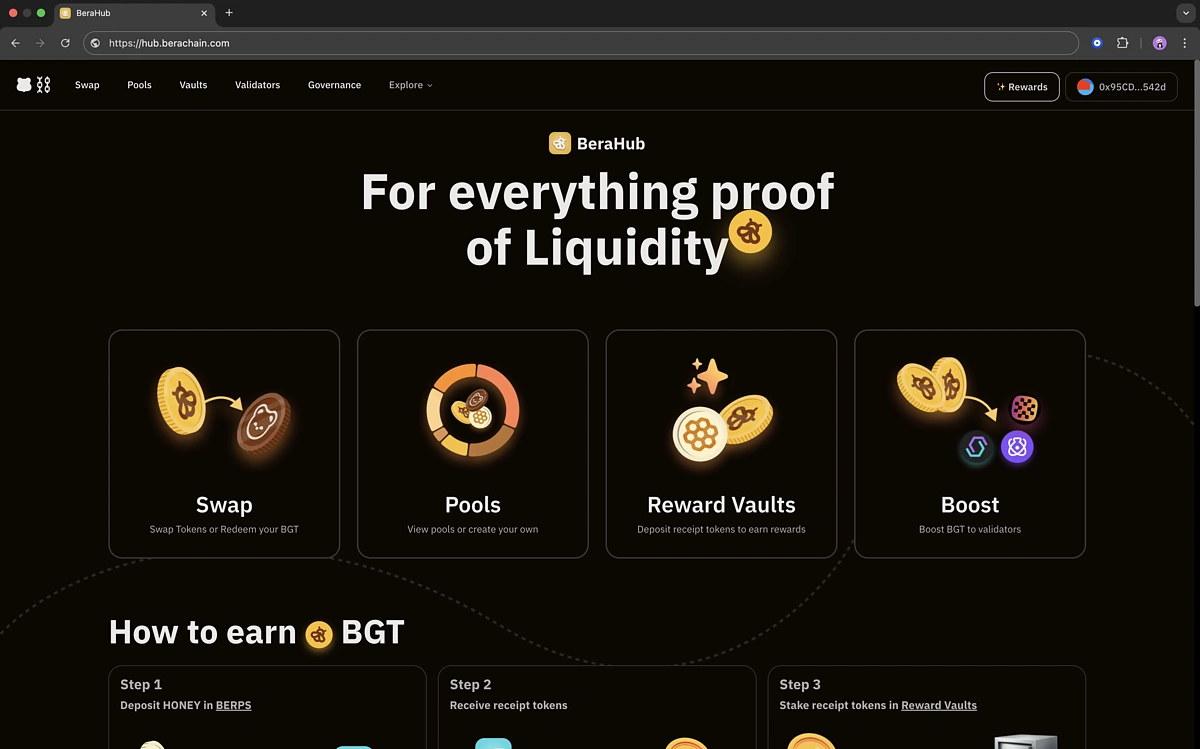
According to the project, BeraHub is the place to manage all things BGT related, while enabling users to access Berachain liquidity through BeraSwap. On the BGT side, users can expect to:
- Review active Reward Vaults
- Review active Validators
- Boost Validators with BGT
- Redeem BGT for BERA
- Claim earned BGT rewards
- Participate in Governance.
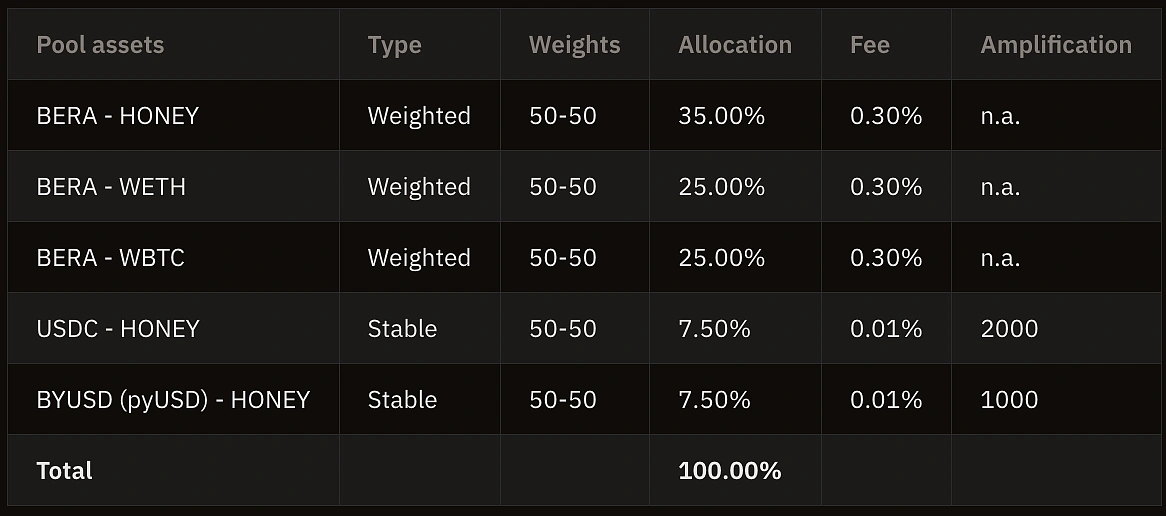
On the BeraSwap side, users can swap assets and provide liquidity into BeraSwap liquidity pools. Pool deposits in BeraSwap can become eligible for BGT emissions and incentivization by whitelisting associated Reward Vaults, and while validators can customize how their rewards are distributed, the default allocation is designed to benefit key BeraSwap liquidity pools.
Berachain Honey Swap
While not a part of BeraHub, Berachain Honey Swap lets users trade approved stablecoins and assets for HONEY, Berachain's native stablecoin. On HoneySwap, HONEY can be minted by depositing whitelisted collateral into a vault and minting HONEY against that collateral.
Final Thoughts
Berachain’s Proof-of-Liquidity consensus system aims to strike a balance between network security and liquidity for the protocol on the network, in contrast with traditional Proof-of-Stake platforms, where a fraction of the token’s overall liquidity is locked away for every asset staked on a POS chain. It tackles liquidity fragmentation through its multi-token approach, where users are encouraged to participate in liquidity provision in exchange for BGT, while validators receive incentives from protocols for allocating BGT.
Finally, note that this article is only for informational and educational purposes and should not be taken as financial or investment advice.









 Or check it out in the app stores