





Bitcoin Dominance
Bitcoin dominance is the market share of BTC compared against the rest of the crypto market. It is calculated by dividing Bitcoin's current market capitalization by the global crypto market cap.
Market Share Breakdown
Historical Dominance Changes
| Asset | 7D | 1M | 1Y |
|---|---|---|---|

BTC |
0.5% | 0.5% | 1.6% |

ETH |
0.4% | 0.5% | 1.6% |


Stablecoins |
0.3% | 0.7% | 2.8% |
| Others |
0.3% | 0.7% | 0.4% |
Bitcoin (BTC) Dominance
Bitcoin dominance is the market share of BTC compared against the rest of the crypto market. It is calculated by dividing Bitcoin's current market capitalization by the global crypto market cap.
Historical Dominance
| Asset | Today | 7D | 1M | 3M | 1Y |
|---|---|---|---|---|---|
|
BTC |
57.31% | 56.84% | 56.78% | 56.08% | 58.95% |
|
ETH |
10.52% | 10.95% | 10.99% | 9.56% | 12.1% |
|
Stablecoins |
10.05% | 9.79% | 10.76% | 12.76% | 7.26% |
| Others |
22.12% | 22.42% | 21.47% | 21.6% | 21.69% |
FAQs
-
What Is Bitcoin Dominance?
-
Bitcoin dominance is the market share of BTC compared against the rest of the crypto market. This metric allows traders to identify potential cryptocurrency market trends and decide on trading strategies. By measuring Bitcoin's proportion of the total market, traders and investors can better understand how the cryptocurrency market is performing and where it's headed.
Specifically, BTC dominance represents the ratio of Bitcoin’s market capitalization to the global market cap of all cryptocurrencies, where market capitalization is the total value of the coins that are in circulation. Bitcoin dominance is calculated by dividing Bitcoin’s current market capitalization by the global crypto market cap. -
How Traders Use Bitcoin Dominance for Trading
-
Generally, the overall cryptocurrency market cap trend follows that of Bitcoin, as seen in the Bitcoin dominance chart. This is mainly because Bitcoin influences the whole crypto space as it's the first, biggest, and most popular digital asset.
As a trader, a fall in Bitcoin dominance could suggest a potential altcoin season – a period when other cryptocurrencies enjoy larger price gains than Bitcoin – as investors are moving their funds to these more lucrative cryptocurrencies.
On the other hand, if Bitcoin dominance and price are on an upward trend, this could result in a Bitcoin bull run, where Bitcoin prices soar. -
How Rising Bitcoin Dominance Affects the Market
-
When Bitcoin dominance goes up, the next thing to consider is the price of BTC.
If the price of Bitcoin is also increasing:- This suggests positive market sentiment in favor of Bitcoin and a decrease of interest in other cryptocurrencies.
- Depending on an investor’s risk profile and preferences, this could be taken as a sign to accumulate more Bitcoin, or to prepare to exit the market once take-profit levels are reached.
On the other hand, if the price of Bitcoin is decreasing:- This suggests a bearish outlook on the market even though other cryptocurrencies may be performing well.
- Again, depending on the individual’s risk tolerance and preferences, this could be taken as a sign to start selling other cryptocurrencies, especially smaller altcoins, and start accumulating Bitcoin.
-
How Falling Bitcoin Dominance Affects the Market
-
When Bitcoin dominance goes down, we also need to view it alongside the price of BTC, which may provide more context.
If the price of BTC is also increasing while Bitcoin dominance is decreasing:- This suggests an increase in interest in other cryptocurrencies.
- This could imply the start of a bull market, with cryptocurrencies across the board enjoying price gains, with other cryptocurrencies gaining more momentum than Bitcoin.
- Active traders can consider researching on which narratives are trending to inform investment decisions.
However, if the price of BTC is decreasing along with Bitcoin dominance:- This is an unlikely event, and in the event it occurs, there is likely to be a flight to safety in favor of stablecoins.
- A bear market is imminent, and investors are likely to be selling BTC and altcoins.
- Depending on the investor’s risk tolerance, it could be a good time to reduce market exposure or look for opportunities to buy cryptocurrencies at lower prices.
-
History of Bitcoin Dominance
-
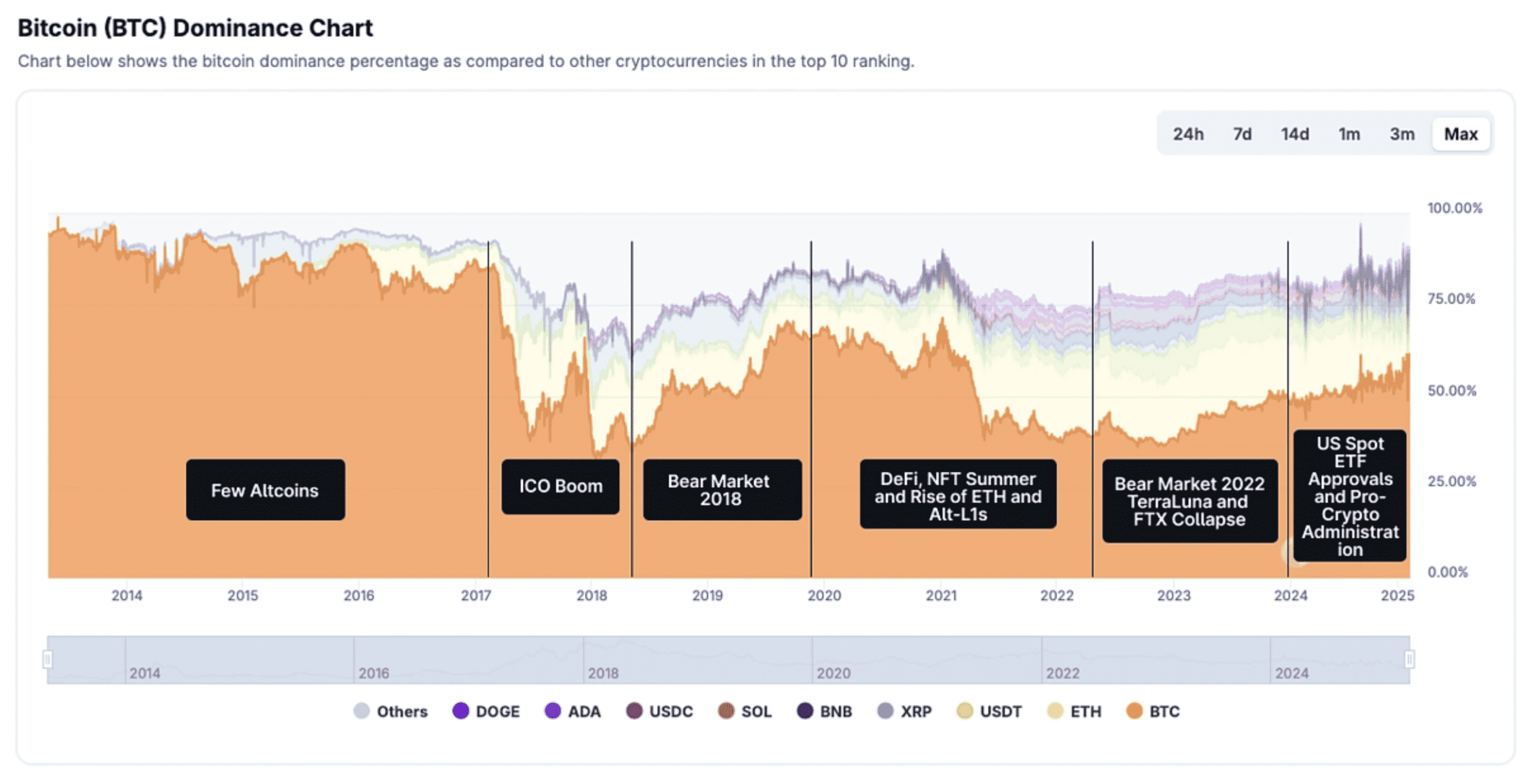 At the beginning, when few other cryptocurrencies were available, Bitcoin dominance was over 80%. Even when Ethereum entered the space in July 2015, Bitcoin still enjoyed dominance of over 90% as other early cryptocurrencies faded into obscurity.
Bitcoin Dominance in 2017 During ICO Boom
In 2017, there was a sharp drop in Bitcoin dominance due to the rise of Ethereum and the ICO boom it enabled. Investors flocked to every “next big thing,” and by the end of the bull run around the start of 2018, Bitcoin dominance had fallen to an all-time-low of around 38%.
Bitcoin Dominance During 2018’s Bear Market
In 2018, there was a cryptocurrency crash, with the sell-off of most cryptocurrencies, and the price of Bitcoin plummeted by about 65% between January and February 2018. Most ICOs never materialized, and many altcoins disappeared into obscurity.
In light of this, there was an increase in Bitcoin dominance as investors soon decided that BTC was a safer investment, and capital flowed back into Bitcoin. This resulted in Bitcoin dominance rebounding and returning to around 70% by August 2019.
Bitcoin Dominance in 2020’s Bull Run
In 2020 Covid-19 hit, causing economic uncertainty, and a new narrative of Bitcoin as “digital gold” and a hedge against inflation took off. This resulted in a price increase of BTC from around $8,000 in Jan 2020 to $63,000 in April 2021. Throughout this period, Bitcoin dominance was around 60%.
Some other key events that may have led to the fall in Bitcoin dominance in 2021 include:- DeFi Summer of 2020: Growth and attention around the decentralized finance space, which offered decentralized trading options and rewards.
- Surge in interest in NFTs and Play-to-Earn, with most of this activity taking place on Ethereum.
- ETH price surged from $400 at end 2020 to $4,000 in May 2021.
- This led to ETH dominance taking off, garnering around 16% market share, which resulted in a drop in Bitcoin dominance.
Bitcoin Dominance in 2022’s Bear Market
In 2022, the crypto market was shaken by two major events.- Terra Luna Collapse
- In May, the algorithmic stablecoin TerraUSD (UST) and its related cryptocurrency LUNA collapsed, wiping out almost $45 billion in market capitalization.
- This sparked an increase in Bitcoin dominance to around 45%, as investors returned to safer, more established projects.
- FTX Collapse
- In November, centralized exchange FTX collapsed with an estimated $8 billion of crypto assets missing.
- Bitcoin reached its lowest point since the end of 2020 at around $16,600.
- Bitcoin dominance started increasing from around 36% after the event as investors moved their funds to safer projects.
Bitcoin Dominance in 2024 and 2025
Bitcoin dominance has been gradually rising ever since, especially with increased institutional adoption.
- BTC Spot ETFs Approval
- In January 2024, BTC spot ETFs were approved by the US SEC. This allowed institutional investors to gain exposure to Bitcoin, with Bitcoin dominance at around 49%.
- Bitcoin Halving 2024
- In April 2024, Bitcoin halving took place, which generally generates bullish sentiments as it reduces Bitcoin’s issuance rates. This generally leads to price appreciation due to BTC’s limited supply.
- This event did not move Bitcoin dominance significantly, as it continued hovering at the 50% mark.
- Donald Trump’s Re-Election
- In November 2024, Donald Trump was again elected as the President of the United States, bringing optimism around a crypto-friendly regulatory environment.
- While this led to a memecoin rally thanks to the President’s own coin TRUMP, it also drove Bitcoin’s price up, with Bitcoin dominance sitting at around 55%.
- In March 2025, Donald Trump's administration established the Strategic Bitcoin Reserve and U.S. Digital Asset Stockpile.
Latest Research Articles






 Or check it out in the app stores