





 Make us preferred on Google
What Is DeFAI?
DeFAI is the combination of DeFi (Decentralized Finance) and AI (Artificial Intelligence). The main idea of DeFAI is that AI can make DeFi more accessible by handling the technical stuff, so users don't need to be experts.
Key Takeaways
-
DeFAI is a new web3 narrative that brings the best of Artificial Intelligence to decentralized finance.
-
DeFAI uses AI to make DeFi user-friendly via natural language commands and personalized strategies.
-
Unlike intent-centric bots (which automate outcomes), DeFAI prioritizes AI-guided decision-making.
-
By mimicking familiar interfaces (e.g., chatbots), DeFAI bridges the gap between crypto natives and newcomers.
Since the introduction of AI agents, “crypto” and “AI” are the words on everyone’s lips and headlines. Together with blockchain technology, they form the trifecta of innovation that will likely shape this decade’s tech landscape.
Mark Zuckerberg predicts there will be more AI agents in the world than humans. And blockchain, just so happens to be the perfect environment for these AI agents to thrive — permissionless, trustless, tamper-resistant, and transparent.
The currency for AI is crypto.
— CZ 🔶 BNB (@cz_binance) January 25, 2025
DeFAI, the convergence of decentralized finance and Artificial Intelligence, is a new crypto narrative that is bridging the DeFi accessibility gap using AI.
This article will explore the DeFAI narrative in detail and provides overviews of a few popular projects innovating in this niche.
Enter DeFAI (DeFi + AI)
DeFAI (Decentralized Finance + Artificial Intelligence) is the integration of Artificial Intelligence (AI) into Decentralized Finance (DeFi) systems to enhance efficiency, accessibility, and user experience.
DeFi is powerful, but it’s a maze 😵💫
— thirdframe (@thirdframe_io) January 27, 2025
Enter DeFAI: where AI meets DeFi#DeFAI is a new narrative that simplifies and surcharges your crypto experience! 🚀
Watch now to see how DeFAI is transforming DeFi into a user-friendly ecosystem.
You can use these platforms (also… pic.twitter.com/ZFoCI42f7T
DeFi is a paradigm that has completely rethought how financial systems and investment vehicles should work. It is completely trustless and intermediary-free; an impossible feat in most traditional finance cases.
Unfortunately, the caveat of DeFi is the overwhelming technicalities for the average user and steep learning curve.
For many, DeFi’s promise of empowerment is often overshadowed by the challenges of managing risk, interpreting complex data, and staying ahead in a 24/7 market. Users are left wondering: how can they leverage DeFi's potential without falling victim to its intricacies?
AI, on the other hand, has evidently demonstrated its potential to simplify decision-making and optimize processes across industries.
So, DeFAI’s overarching goal is to implement AI-based solutions into DeFi applications to abstract away technicalities and make on-chain interactions more friendly to the non-tech-savvy population.
DeFAI can offer real-time insights, automated trading, personalized strategies, and efficient decision-making tailored to individual needs all without overburdening users with technical nuances.
A common feature of current DeFAI-based applications is that users can execute complex DeFi operations with simple, human-like commands, without requiring in-depth technical knowledge.
DeFAI vs. Crypto AI Agents vs. AI Memecoins
Multiple categories have emerged within the crypto-and-AI narrative. Owing to their similarities, most fail to differentiate one from the other. The differences lie in the nuances and are not evident until you examine closely.
AI memecoins often rely on hype without delivering substantial functionality. Crypto AI agent projects typically target specific use cases. DeFAI takes the approach of making on-chain financial ecosystems more accessible to the masses.
The table below will help you understand the differences better.
|
DeFAI |
Crypto AI Agents |
AI Memecoins |
|
|
Purpose |
Enhance DeFi operations using AI |
General AI apps in crypto, such as trading bots, entertainment, or NFTs |
Speculative value and community-driven hype with minimal or no utility |
|
DeFi Integration |
Deeply integrates with DeFi platforms and protocols |
Typically focus on niche functions like market predictions or trading bots |
Often disconnected from practical use cases |
|
Economic Model |
Utility-focused tokenomics, where tokens grant access to AI-powered tools and premium features |
Some have utility, but many are narrowly designed for specific use cases |
Mostly speculative assets with no intrinsic value beyond trading |
|
Target Users |
Both seasoned DeFi users and newcomers by bridging the gap between financial sophistication and usability |
Tend to attract users that want a highly specific use case as different AI agents are optimized for different functions |
Primarily cater to retail investors chasing short-term gains or social media trends |
An important thing to note is that the three categories also have certain overlaps. For instance, many DeFAI projects that are currently being built incorporate crypto AI agents. And certain AI memecoins could evolve to utility coins in the future to serve in an application’s DeFAI ecosystem.
Is DeFAI Different From Intent-Centric Blockchains?
At first glance, DeFAI and intent-centric blockchains or projects may appear similar due to their shared focus on improving user experience and system efficiency.
But under the hood, DeFAI and intent-based architecture are fundamentally different. They differ in design philosophy, implementation, and the scope of problems they address.
The Similarity
On the surface, both DeFAI and intent-centric blockchains aim to simplify user experience and improve efficiency within the blockchain ecosystem. They both attempt to abstract away the complexities of on-chain interactions so that users can focus on their desired outcomes rather than the intricate technical details.
But that’s where the similarity ends.
The Difference
DeFAI, in the current state, mainly uses machine learning algorithms and large language models to simplify human-blockchain interactions. Intent-centric blockchains, on the other hand, focus on the concept of "intent," where users express their desired outcome, and the system, often with the help of "solvers," finds the optimal way to achieve it.
You can think of solvers as specialized modules within intent-centric blockchains that decode a user’s intent into executable on-chain actions. For example, if a user wants to swap tokens or bridge assets across chains, the solver determines the best path (considering factors like gas fees, slippage, and liquidity availability) and executes the necessary transactions.
DeFAI, in contrast, approaches the problem differently. Instead of focusing on the infrastructure required to execute intents, it uses AI to assist users in making better decisions before execution. DeFAI’s AI models analyze on-chain data, predict market trends, and recommend actions tailored to the user's goals (e.g., selecting the best liquidity pool for liquidity provision or optimizing asset allocation for yield farming).
That said, always do your own research on the DeFAI’s agent recommendations.
Example: Swapping Tokens
Let's take a common intent and see how each approach handles it.
Intent: swapping tokens across blockchains.
DeFAI would use AI algorithms to provide users with real-time recommendations:
-
Step 1: The user inputs, “I want to swap 1 ETH for USDC.”
-
Step 2: DeFAI analyzes on-chain data, including DEX prices, liquidity pools, gas fees, and bridging costs.
-
Step 3: It suggests an optimal route, such as swapping ETH for USDC on Uniswap via Ethereum and then bridging USDC to Polygon for a lower gas fee.
-
Step 4: The user executes the suggested transactions semi-manually or through a linked wallet interface.
Here, DeFAI operates as an intelligent assistant, helping the user make informed decisions while leaving the final control of execution in their hands.
In an intent-centric blockchain, the process is more automated:
-
Step 1: The user inputs, “Swap 1 ETH for USDC.”
-
Step 2: The system captures the intent and routes it to a solver.
-
Step 3: The solver determines the optimal path, which might involve splitting the transaction across multiple DEXs, utilizing rollups to reduce costs, or bundling the swap and bridge into a single operation.
-
Step 4: The blockchain executes the transactions on behalf of the user, delivering USDC to their wallet without requiring further input.
Here, the user interacts only at the intent level.
DeFAI Use Cases
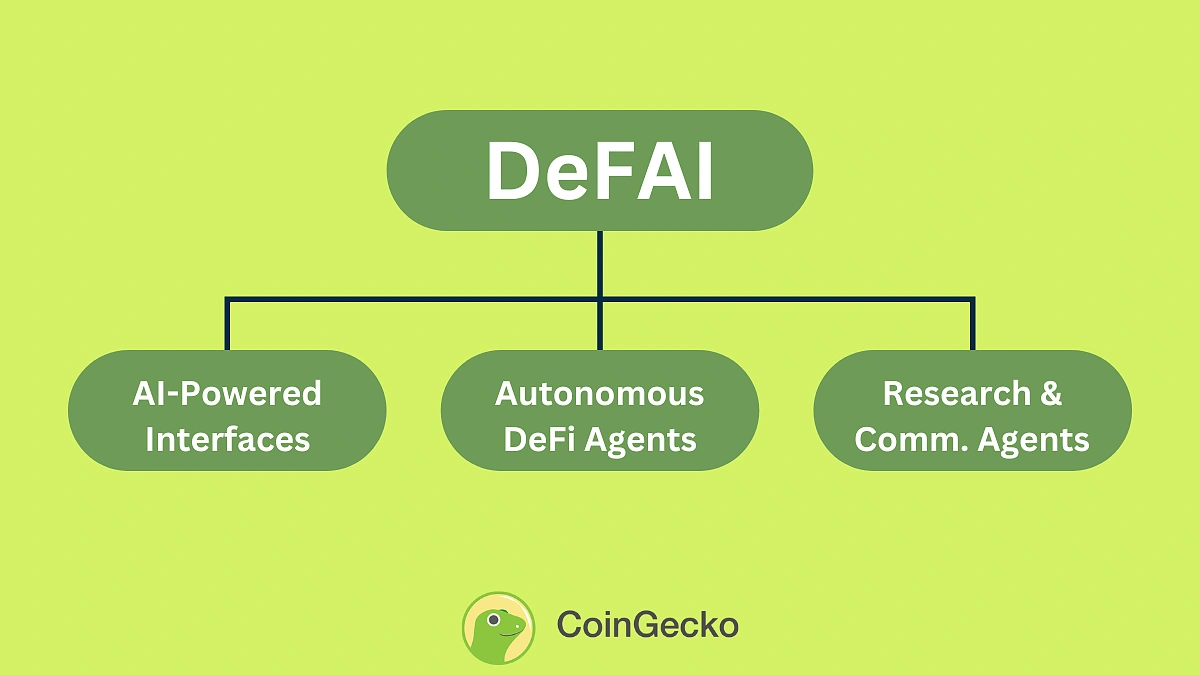
Personalized Financial Strategies
AI is excellent at learning from the data fed into it (training set) and coming up with outputs that are tailored to the training set. Now, if this data were to be your transaction history, investment patterns, and risk tolerance, the DeFAI app could create highly customized financial strategies.
For example, imagine an AI-powered DeFi app that analyzes your on-chain activity and detects that you frequently interact with stablecoins. Based on this, it might recommend high-yield stablecoin staking platforms.
Projects like Mozaic Finance are already working in this direction by helping users allocate funds dynamically to maximize returns while managing risks.
Validator Selection For Staking
Staking is a popular (and mostly secure) way of earning guaranteed yield on the staked asset. However, this yield is only guaranteed if the validator you delegate your tokens to are honest and highly performant. Choosing the wrong validator can result in reduced rewards or, in some cases, penalties like slashing.
When there is an ocean of validator options, choosing one is a difficult task. Naturally, this is a good problem to hand to AI.
DeFAI apps, like HeyElsa, can analyze multiple validators when prompted, evaluating important metrics like uptime, and reputation. For example, if a user asks HeyElsa to stake their assets, the system intelligently compares validators and chooses the one most aligned with the user’s preferences.
Natural Language Portfolio Management
With thousands of tokens across each blockchain, keeping track of investments has become an increasingly complex challenge for retail crypto investors. Fleeting trends, meme tokens, and airdrops often lead to over-diversified portfolios, making it difficult to manage assets effectively.
DeFAI addresses this issue by introducing natural language portfolio management, allowing users to interact with their portfolios as easily as sending a message.
What if you could just state your desire straightforward to the app — something like, "Show me my top-performing tokens this month" or "How many assets are in my wallet worth less than $1” — and the app outputs accurate results in understandable language?
Platforms like HeyElsa and Griffain enable such functionality by combining AI and blockchain. They can interpret user commands, analyze on-chain portfolio, and perform the requested actions across DeFi protocols all within a chat-like interface.
Similarly, SoDAS (Solana DeFi Agent Swarm) integrates with messaging platforms like Telegram and Discord, enabling users to manage their portfolios through conversational interactions.
Goal-Based Trading Approach
Trading cryptocurrency requires a rock-solid mindset. While your strategy may be well-thought-out, when it’s time to act, emotions can take over — this is often the case with most investors.
Watching momentary price fluctuations often leads to impulsive decisions. DeFAI applications can help you by automating trading strategies around specific goals, removing emotional bias to a large extent if not entirely.
Platforms like Loomix on LogX are leading the way in this space. Users can define specific financial goals, say “sell 50% of my ETH if its price drops below $3,500 to minimize losses, or sell at $4,000 to lock in profits” and Loomix's AI algorithms go and achieve them.
Another example is Aspis, which provides AI-powered vaults tailored to specific financial objectives. For example, you could instruct the system to allocate funds to achieve a 20% yield with a 5% risk cap. The AI agents within Aspis dynamically adjust these strategies to meet your goals, adapting to market fluctuations in real-time to optimize performance.
8 Leading DeFAI Projects
Below is a list of eight DeFAI projects (in no particular order) along with a short description and a few of their key features.
|
Project |
Description |
Key Features |
|
Automation solutions for DeFi operations |
Natural language trading, token launch automation, multi-agent coordination |
|
|
Cross-chain functionality and interoperability |
Integrates over 200 protocols and 100 blockchains, automated strategies, liquidity management |
|
|
Open-source platform within the Solana ecosystem |
Seamless protocol interaction using the Solana Agent Kit |
|
|
AI-driven tools for simplified DeFi interactions |
Autonomous agents, AI-powered transaction interfaces |
|
|
AI-powered crypto agent with a ChatGPT-like interface |
Natural language commands for token swaps, transfers, and more |
|
|
DeFAI platform with AIDAO framework |
Customizable vaults, dynamic fund parameters, AI trading agents |
|
|
AI-powered yield farming platform |
Omnichain interoperability, AI-optimized yield strategies, automated compounding |
|
|
AI-powered DeFi analytics and prediction platform |
Optimize DeFi strategies, automate asset rebalancing, and manage portfolios |
Conclusion
DeFi+AI reframes the relationship between autonomy and automation. Unlike intent-centric protocols, which prioritize outcome-driven automation, DeFAI preserves human agency by acting as an intelligent advisor rather than an executor.
DeFAI’s most provocative implication lies in its potential to humanize blockchain.
DeFAI could catalyze a new era where blockchain transcends its niche by embedding intelligence into its infrastructure. The ultimate test will be whether DeFAI can scale without sacrificing decentralization’s core tenets, which is a challenge that demands transparency in AI training, accountability in recommendations, and resilience against algorithmic monocultures.
While DeFAI can offer users a more efficient and convenient way to navigate decentralized finance, always do your own research before investing any capital.
Frequently Asked Questions (FAQs)
How to pronounce DeFAI?
The pronunciation of "DeFAI" varies depending on personal or regional preference. Some pronounce it as "deaf-AI," combining "deaf" with "AI," while others say "Deef-AI," rhyming with "leaf-AI." Both versions are commonly used, so there isn’t a definitive “correct” way.
Is DeFAI going to stand the test of time?
Yes, DeFAI will stand the test of time. DeFi is an evergreen concept, and AI continues to evolve, making systems smarter and more intuitive. Combining the two simplifies complex interfaces, creating accessible and efficient tools. Even if current DeFAI apps change, the synergy of DeFi and AI is a lasting innovation that will persist in new forms.
Is DeFAI just a fancy wrapping for chatbots with DeFi functionalities?
No, DeFAI is more than just fancy chatbots. While conversational interfaces are a part of it, the real power of DeFAI lies in its ability to analyze data, automate strategies, and make intelligent, goal-driven decisions. Most DeFAI apps today resemble chatbots but that does not imply that the concept is limited to conversational interfaces.






 Or check it out in the app stores