


Polymarket Overview
What Is Polymarket?
Polymarket is a decentralized prediction market platform where users can speculate on the outcomes of future events by buying and selling shares of event contracts. Event contracts are a new type of futures contract that allows participants to speculate on the outcome of a specific event typically through “yes or no” options.
Unlike traditional betting platforms or bookmakers, Polymarket operates on the blockchain, specifically on the Polygon network. This means all transactions are transparent, verifiable, and don't require a centralized company to hold your funds or determine odds.
How Polymarket Differs from Traditional Betting
Traditional betting platforms act as the "house" — they set the odds, hold your money, and take a cut from every bet. If you win, the house pays you out from a centralized pool. Polymarket adopts a more decentralized approach.
Decentralized structure: There's no central authority setting odds or holding funds. Instead, users trade with each other directly through smart contracts (automated programs on the blockchain that execute transactions when conditions are met).
Market-driven pricing: Odds aren't set by bookmakers but emerge from collective trading activity. If many people believe an event will happen, the price of "Yes" shares rises, reflecting higher probability.
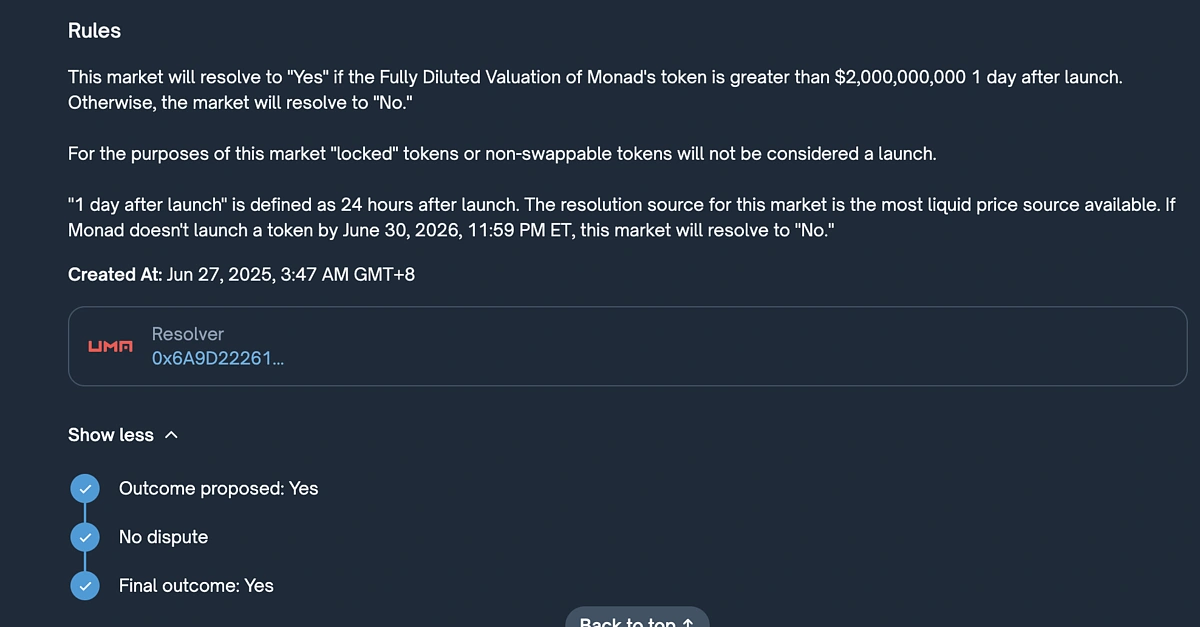
Transparency: The rules of the event outcomes are clearly outlined for all participants before they make their bets, creating a more transparent environment for punters.
Global accessibility: Anyone with an internet connection and cryptocurrency can participate without need for KYC processes, though regulatory restrictions may apply in certain jurisdictions.
Polymarket's Market Position
Launched in 2020, Polymarket rose to prominence in late 2024 when it gained widespread media attention and usage as a platform to speculate on the outcome of the 2024 US Presidential elections. Since then, Polymarket has grown to become the current on-chain market leader of prediction markets, securing major deals with sports partners such as the UFC and NHL.
Polymarket’s explosive growth in late 2024.

In October 2025, Polymarket's prominence was further validated when Intercontinental Exchange (ICE), the parent company of the New York Stock Exchange, announced a strategic investment of up to $2 billion in the platform, valuing Polymarket at approximately $8 billion. This landmark deal represents one of the largest investments by a traditional financial institution in a decentralized finance platform.
How Do Prediction Markets Work?
A prediction market is a platform where people trade contracts based on the outcomes of future events. The core idea is simple: collective wisdom often produces accurate forecasts. When thousands of people put their money where their beliefs are, the resulting prices tend to reflect genuine probabilities.
Here's a simple analogy: Imagine a classroom where students trade tokens on whether it will rain tomorrow. If most students believe rain is likely, they'll buy "Yes" tokens, driving the price up. If new information emerges (like a weather forecast showing clear skies), students will sell their "Yes" tokens and buy "No" tokens, adjusting the price. The final price before the event reflects the class's collective best guess at the probability of rain.
The Mechanics of Outcome Shares
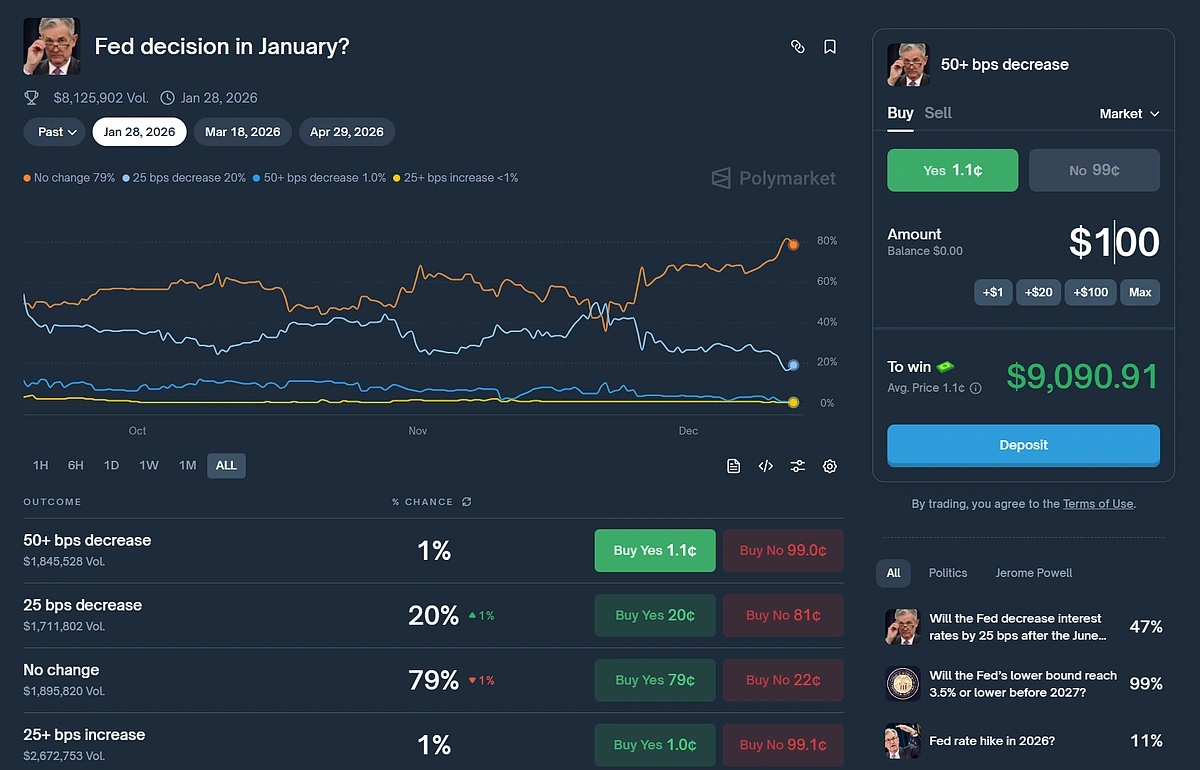
On Polymarket, each market has two or more possible outcomes, and users can buy shares representing each outcome. Each share is priced between $0.01 and $1.00, and the price represents the market's implied probability of that outcome occurring.
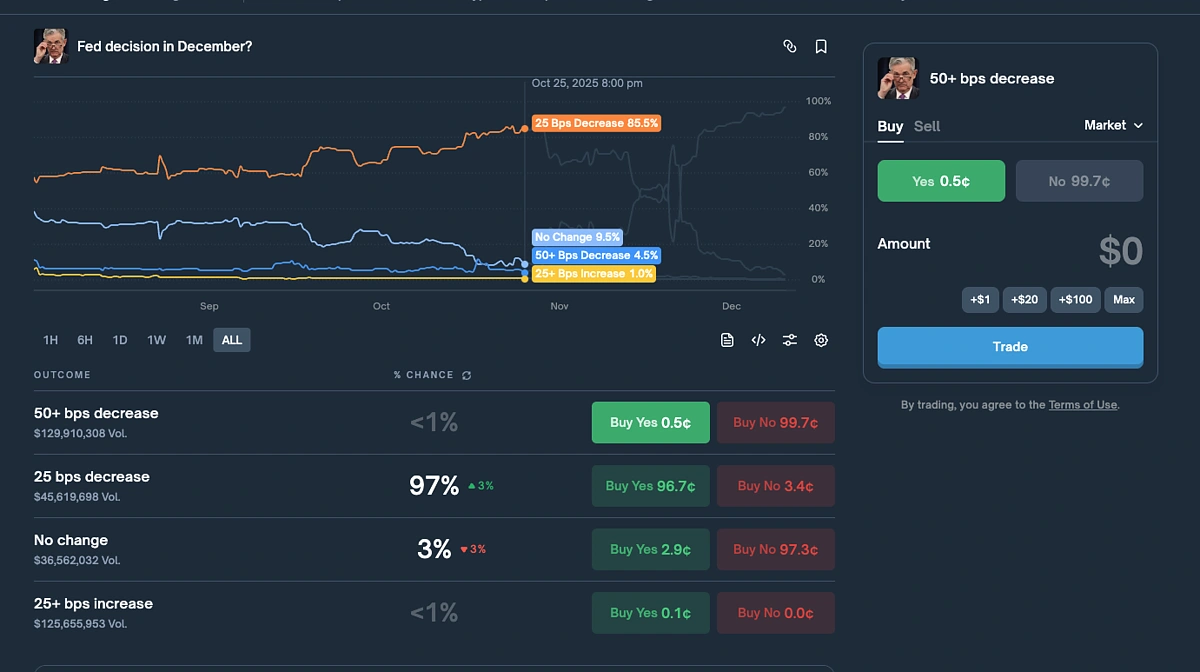
Example: The US Federal Reserve decision on interest rates in December 2025.
-
“No” shares for a 50+ bps (basis points) decrease is at $0.997, this suggests that the market believes that there is a >99% probability that a 50+ bps decrease will not occur.
-
On the other hand, “Yes” shares for a 25 bps decrease trades at $0.967, which means that the market currently believes there is a 96.7% probability that a 25 bps decrease will occur.
Notice that "Yes" and "No" prices always add up to $1.00, since one outcome must occur.
How profits work: If you buy "Yes" shares at $0.967 and a 25 bps decrease is announced, each share pays out $1.00, giving you a profit of $0.033 per share (minus any fees). If any other Fed decision occurs, your shares become worthless and you lose your $0.967 investment per share.
Trading before resolution: You don't have to hold shares until the market resolves. If you buy "No" at $0.034 and the price rises to $0.10 as new information emerges, you can sell immediately and lock in a $0.066 profit per share without waiting for the event to conclude.
How Do Users Interact with Polymarket?
Getting started on Polymarket involves several steps. While the platform has made the process increasingly user-friendly, it still requires basic familiarity with cryptocurrency.
Step-by-Step Guide to Using Polymarket
Step 1: Create an Account
Visit polymarket.com and sign up using an email address or crypto wallet. Unlike some crypto platforms, Polymarket's onboarding process is relatively straightforward and doesn't require extensive verification for basic usage. However, larger withdrawals may trigger additional identity verification requirements.
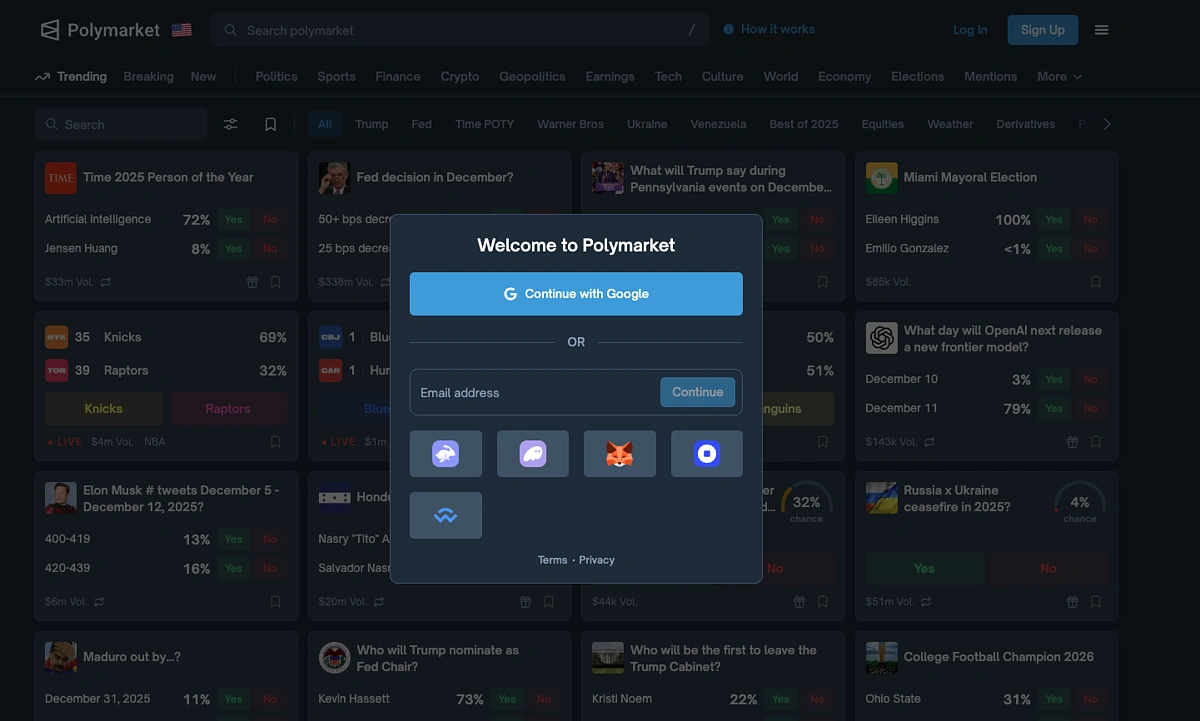
Step 2: Set Up a Wallet
Polymarket requires a cryptocurrency wallet to interact with the blockchain. The platform offers an integrated wallet solution that simplifies this process for beginners, or you can connect an existing Web3 wallet like MetaMask or use WalletConnect for additional wallet options.
Step 3: Deposit USDC
To trade on Polymarket, you'll need the USDC stablecoin. There are four options available — crypto transfers, card deposits, exchange deposits and Paypal deposits. Choose your preferred method.

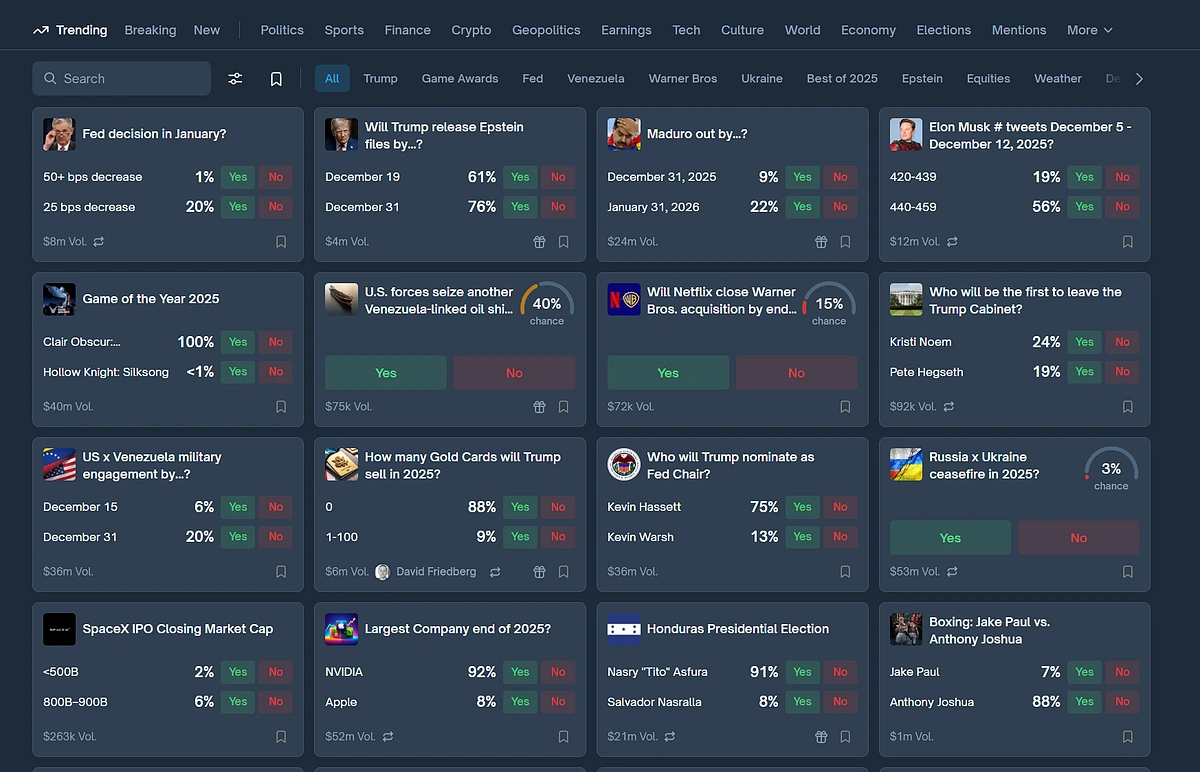
Step 4: Browse and Select Markets
Polymarket offers hundreds of active markets across various categories. You can filter by category, search for specific topics, or explore trending markets. Each market displays:
-
The question being asked.
-
Current prices for each outcome.
-
Total trading volume.
-
Resolution source and criteria.
Step 5: Buy Outcome Shares
Once you've found a market you want to trade on, select the outcome you believe will occur and enter the amount of USDC you want to spend. The platform will show you exactly how many shares you'll receive and your potential profit if you're correct.
Step 6: Market Resolution and Payouts
When an event concludes, Polymarket's resolution process determines the correct outcome based on predefined criteria and trusted sources. If you hold winning shares, they're automatically redeemed for $1.00 each in USDC. Losing shares expire worthless.

Step 7: Withdraw Funds
You can withdraw your USDC at any time to an external wallet or exchange. From there, you can convert it to regular currency or hold it as cryptocurrency.
Popular Use Cases and Market Types
Polymarket hosts thousands of markets across diverse categories, reflecting the wide range of events people want to forecast.
Elections and Politics
Political markets have become Polymarket's most prominent category, attracting massive trading volume during election cycles. The 2024 US presidential election saw over $3.2 billion traded on the platform, with Polymarket becoming a widely cited source for real-time probability tracking alongside traditional polls.
Sports/Esports
Sports prediction markets allow fans to speculate on game outcomes, championship winners, player performances, and season-long questions.
Example markets: "Will [Team] win the Super Bowl?", "Will [Player] win MVP?", "Will [Athlete] break the world record?".
Cryptocurrency and Technology
Crypto-native users naturally gravitate toward markets about cryptocurrency prices, protocol launches, regulatory decisions, and technology milestones.
Example markets: "Will Bitcoin reach $100,000 in 2025?", "Will the Ethereum ETF be approved?", "Will [Protocol] launch on schedule?".
Pop Culture and Entertainment
Polymarket extends beyond finance and politics into entertainment, covering award shows, celebrity news, and cultural phenomena.
Example markets: "Will [Film] win Best Picture?", "Will [Artist] release an album in [Year]?", "Will [Show] be renewed for another season?".
Current Events and Miscellaneous
Some of Polymarket's most creative markets involve one-off current events, scientific developments, or unusual questions that capture public attention.
Example markets: "Will humans land on Mars by 2030?", "Will [Company] acquire [Company]?", "Will inflation exceed X% this quarter?".
Risks and Considerations
While Polymarket offers an innovative way to engage with prediction markets, users should understand the significant risks involved.
Financial Risk and Loss of Funds
Real money at stake: Every trade involves actual financial risk. If your prediction is wrong, you lose the USDC you invested. There's no safety net or guarantee of returns.
Market volatility: Share prices can swing dramatically as new information emerges. A position that looks profitable one day might turn into a loss the next.
Timing matters: Even if you're ultimately correct about an outcome, poor timing can result in losses if you sell shares during temporary price dips.
Market Manipulation Concerns
Large traders influence: Wealthy participants with significant capital can potentially move markets by placing large trades, creating artificial price movements.
Information asymmetry: Some traders may have access to better information or analysis tools, putting casual participants at a disadvantage.
Notable incidents: Polymarket trader “AlphaRaccoon”, nets $1 million in trading profits in under 24 hours for accurately predicting Google’s 2025 Year in Search rankings. His near-perfect predictions raised suspicions of insider trading although nothing conclusive was found.
Market Resolution Concerns

The context: Earlier in 2025, a controversial $237M Polymarket wager over whether Ukrainian President Zelensky had worn a suit took the limelight. The resolution ultimately resolved to “No” despite clear media appearances that he did indeed wear a suit. The controversial resolution was due to Polymarket’s UMA oracle ultimately finding a lack of “credible reporting consensus”. This revealed several issues.
The issue with strict rules-based systems: Simple yes or no questions become points of contention when an oracle is used with a weighting system that can become manipulated.
You are wrong even when you are right: Occasionally, market resolution criteria may be ambiguous or controversial, leading to disputes about correct outcomes. However, Polymarket still has an option to dispute a market resolution to mitigate this issue.
Regulatory Considerations
Legal gray areas: Prediction markets occupy uncertain regulatory territory in many jurisdictions. While Polymarket operates globally, laws regarding online betting, securities, and gambling vary widely by country.
US regulatory history: In January 2022, Polymarket was fined $1.4 million by the US Commodity Futures Trading Commission (CFTC) for operating an unregistered derivatives trading platform. The platform settled with the CFTC and agreed to block US users from accessing the service.
Recent US developments: Following a multi-year compliance overhaul and the acquisition of QCEX, a CFTC-licensed derivatives exchange, Polymarket received regulatory approval to return to the US market in late 2025. In November 2025, the CFTC issued an amended Order of Designation granting Polymarket the status of a fully regulated Designated Contract Market, allowing US users to access the platform through regulated intermediaries.
Geographic restrictions: Beyond the US, Polymarket has been blocked in several countries including Singapore and Switzerland, where it's classified as an illegal gambling website.
FBI investigation: In November 2024, the FBI raided the home of Polymarket CEO Shayne Coplan as part of a Department of Justice investigation into whether the platform allowed US-based users to place bets. This investigation was later closed in July 2025 without new charges being filed.
Changing regulations: The legal landscape for crypto prediction markets continues to evolve, and future regulatory actions could impact platform availability or functionality.
Technical and Platform Risks
Smart contract vulnerabilities: While audited, smart contracts can contain bugs or exploits that could potentially result in loss of funds.
Blockchain dependence: If the Polygon network experiences downtime or congestion, you might not be able to trade or withdraw funds.
Responsible Participation
Only risk what you can afford to lose: Treat Polymarket participation like any speculative investment — never invest money you need for essential expenses.
Understand the markets: Don't trade on topics you don't understand or haven't researched. Informed predictions consistently outperform random guessing.
Avoid emotional trading: It's easy to let emotions drive decisions, especially when real money is involved. Stick to rational analysis rather than wishful thinking.
Recognize gambling parallels: While prediction markets differ from traditional gambling in important ways, they share similar psychological hooks and addiction risks. Set limits and monitor your behavior.
Conclusion
Polymarket represents a fascinating evolution in how we think about forecasting, collective intelligence, and financial markets. By combining blockchain technology with the wisdom of crowds, it has created the world's largest decentralized prediction market, offering transparent, accessible ways to speculate on everything from elections to entertainment.
However, Polymarket is not without risks. The platform involves real financial stakes, operates in evolving regulatory environments, and requires users to navigate both cryptocurrency systems and market mechanics. Success requires careful research, responsible risk management, and honest assessment of your knowledge and capabilities.
We once again wish to remind users to act responsibly when using the Polymarket platform. While it is not legally classified as gambling platform in many jurisdictions, they share many similar parallels and have been classified and banned as an illegal gambling platform in some jurisdictions including: Singapore, Thailand and Romania.
This article is for educational and informational purposes only and should not be construed as financial, investment, legal, or trading advice. Polymarket and prediction markets involve significant financial risk, and you could lose all funds you invest. The regulatory status of prediction markets varies by jurisdiction, and participation may be restricted or prohibited in your location. Always conduct your own research, understand the risks involved, before participating. The information presented here reflects publicly available data and platform documentation as of December 2025 but may not reflect the most current platform features, regulations, or market conditions.
By the way, CoinGecko now tracks crypto price predictions powered by Polymarket data. See where prediction markets think Bitcoin and Ethereum prices are headed.










 Or check it out in the app stores