



 Make us preferred on Google
What Is Restaking?
Restaking lets users stake the same tokens on the main blockchain and other protocols, securing multiple networks at once.
Key Takeaways
-
Restaking is a growing narrative focused on capital efficiency, enabling users to use the same tokens to secure the main blockchain and other networks simultaneously.
-
Restaking offers users additional rewards for securing additional protocols, in exchange for undertaking increased slashing risks.
-
Restaking lets users extract more value from staked tokens, benefiting stakers and other networks.

Restaking is focused on improving capital efficiency in the crypto space. Originally, tokens staked to secure the blockchain lie dormant, but restaking puts these tokens to work securing new protocols. This ensures decentralization from launch, instead of the protocol needing to establish its own validator set.
Understanding Restaking
Restaking allows validators on proof-of-stake (PoS) blockchains like Ethereum and Solana to use their staked cryptocurrencies to secure other proof-of-stake protocols.
This improves the utility of the staked asset and offers the holder an additional set of rewards (albeit with added slashing risks). Before restaking, staked cryptocurrencies like ETH and SOL were locked up. This resulted in some problems:
-
A large amount of the coin’s liquidity is lying dormant on blockchains.
-
Only large holders could earn staking rewards from blockchains like Ethereum.
-
Validators could only earn rewards for staking on the main blockchain.
-
New protocols need to build their own validator sets for security.
Restaking builds on liquid staking, which turns staked coins into liquid staking tokens that can be used in DeFi to generate yield. Liquid staking also opens up staking to a larger audience, as there are no minimum staking requirements, which allows smaller holders to benefit from staking rewards.
With restaking, other decentralized protocols can utilize staked assets to improve their security. Validators are rewarded with additional incentives from these protocols, on top of staking rewards from the main blockchain. These protocols can range from:
-
Oracle networks like eoracle.
-
Data availability layers like EigenDA.
What Is Slashing?
Slashing is a component of Proof-of-Stake chains, where staked tokens act as collateral; if a validator breaks rules during the consensus process, they will lose a percentage of their staked tokens.
In restaking, users accept additional slashing conditions set by protocols in exchange for added rewards. This ensures validators act in the best interests of the protocols they are securing.
How Restaking Works
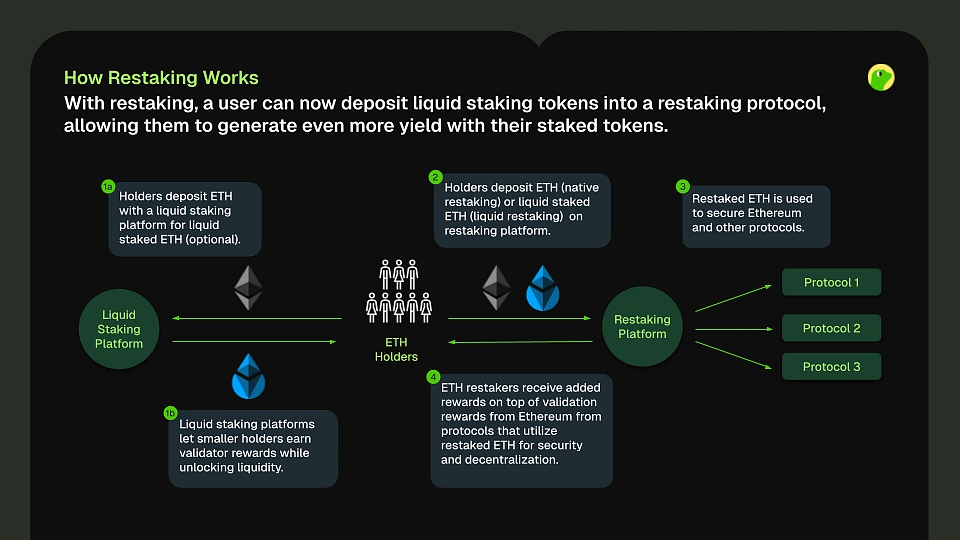
Restaking lets users stake the same coins on both the main network and other protocols, securing all of these networks at once.
What Is Native Restaking?
Native restaking is only open to users who operate validator nodes. Validators who wish to commit their setup to a restaking program will be expected to download and run additional node software required for the restaking module. When this is done, the validators agree to the restaking terms including an additional slash condition.
Native restaking is available on EigenLayer, Symbiotic, and Karak.
What Is Liquid Restaking?
Liquid restaking can utilize both liquid staking tokens (LST) and the original token. After staking their tokens with the restaking protocol, users will receive a liquid restaking token (LRT). This LRT represents the user’s staked and restaked assets, and it also unlocks the liquidity within these assets for use in DeFi.
This makes it easy for users to capitalize on restaking, as they won’t need to set up any operator software, and they can also opt to let the restaking protocol select projects to work with.
Liquid restaking protocols include: Renzo and Ether.fi.
What Is Bitcoin Staking?
As Bitcoin is a proof-of-work network, Bitcoin staking is not involved in securing the Bitcoin network. However, projects like Babylon are drawing on the concept of restaking on PoS networks to expand the utility of Bitcoin by using it to secure protocols and new blockchains.
At time of writing, there are no staking rewards yet, as Babylon is still in a locking-only phase without a PoS chain.
Benefits of Restaking
Restaking allows users to put their staked assets to work to generate more yield, while providing security for new protocols. Let’s take a closer look at these benefits:
Improved Rewards for Stakers
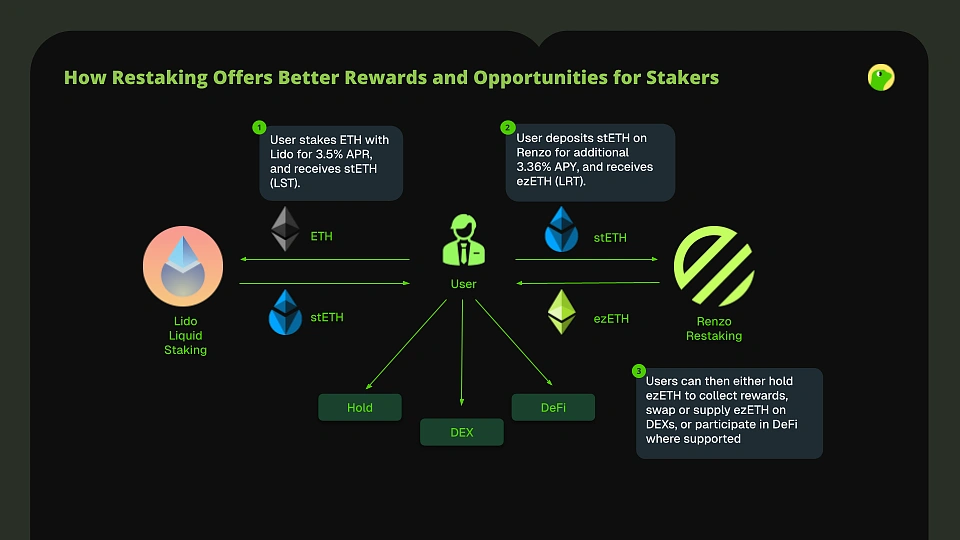
At time of writing, Ethereum offers a 3.5% yield on solo staked assets, while LSTs offer a range of 2.55% to 3.52%. Once this is restaked on a restaking protocol, users will be able to earn additional rewards based on their restaking strategy as they secure additional protocols.
Cold Start Security for New Protocols and Networks
New projects like data availability layers and Layer 2 networks face an uphill climb in developing a robust security system in the early stages. Restaking enables these protocols to strengthen their security through a large set of validators, ensuring decentralization. While projects will need to incentivize validators through rewards, it is still more cost-efficient than building their security infrastructure from the ground up and finding validators.
Scalable Security Based on Protocol Needs
With restaking services, a protocol can achieve elastic security, scaling in and out in response to network demands. This cost-effective approach to network security scaling means protocols can scale up security during periods of high demand by contracting validators through a restaking protocol, and scaling down when the network returns to normal conditions.
Potential Risks of Restaking
While restaking promises improved capital efficiency for users and scalable security for protocols, there are also potential risks to the parent network, the renting network, and the stakers as well.
Slashing
Restaking terms include extra slash conditions in exchange for increased rewards. Depending on the terms set by the protocol, slashing could result in the loss of a significant percentage of a validator’s staked assets. Stakers who opt in are committed to following the rules of the contract and will be subjected to the slash penalty if they behave maliciously.
Yield Risks
While the idea of EigenLayer is to enable protocols to leverage Ethereum for security, restakers are incentivized by the rewards from the protocol they are staking their assets with. This means that restakers may opt for protocols with the highest yield to maximize their returns. There is also the concern that investors will view restaking as a quick, easily leveraged financial product, potentially impacting the Layer 1 network.
Impact on the Layer 1 Blockchain
Vitalik Buterin, co-founder of Ethereum, has highlighted one of the risks of restaking, where protocols rely on Ethereum’s social consensus for a fork or re-org in the event of major losses, leading to conflict around which version of the Layer 1 is canonical. As a solution, Sreeram Kannan, founder of EigenLayer, agrees that applications that reuse Ethereum’s validator set should not be bailed out by the Layer 1’s social consensus.
Do not:
— Sreeram Kannan (@sreeramkannan) May 21, 2023
a) don’t build complex financial primitives on restaking - they can spiral out
b) don’t rely on Ethereum to fork for application layer errors - this is a super important principle
c) do not use subjective slashing - as it is subject to tyranny of the dishonest majority
Restaking Protocols to Watch
Restaking is a rising narrative, and holders are exploring restaking opportunities to maximize their yield. Here are some protocols in the restaking space—note that this list is not exhaustive, and is intended only to illustrate the different offerings within the space.
EigenLayer: Restaking on Ethereum

EigenLayer is the first restaking protocol, pioneering the idea of using staked ETH to secure other protocols.
Stakers can commit their native Ethereum tokens or Liquid Staking Tokens (LST) to EigenLayer to offer additional security services to AVSs (Autonomous Verified Services) on the Ethereum blockchain and earn extra rewards from the protocols their assets are restaked to. According to EigenLayer, it has over $6.8 billion in TVL at time of writing, and over 4.6 million native and LST ETH staked.
LSTs from yield protocols and validators like Ankr (ankrETH), Lido (stETH), and Coinbase (cbETH) can be staked on the EigenLayer restaking protocol under Liquid Restaking. Validators who opt into the restaking program agree to EigenLayer’s terms, including additional slashing conditions for validators who default.
AVSs include data availability solutions, oracles, and consensus protocols.
Jito: Restaking on Solana

Jito is a restaking protocol on Solana, where users can stake SOL, JitoSOL, and mSOL (Marinade Staked Solana) across multiple networks. These staked assets provide security to these networks, and users earn rewards in return. On Jito, users receive Vault Receipt Tokens which are liquid restaking tokens. These can be held to maintain their restaking position and used in supported DeFi applications, and will be burned when users wish to withdraw their original assets.
Renzo Protocol: Strategy Manager for EigenLayer
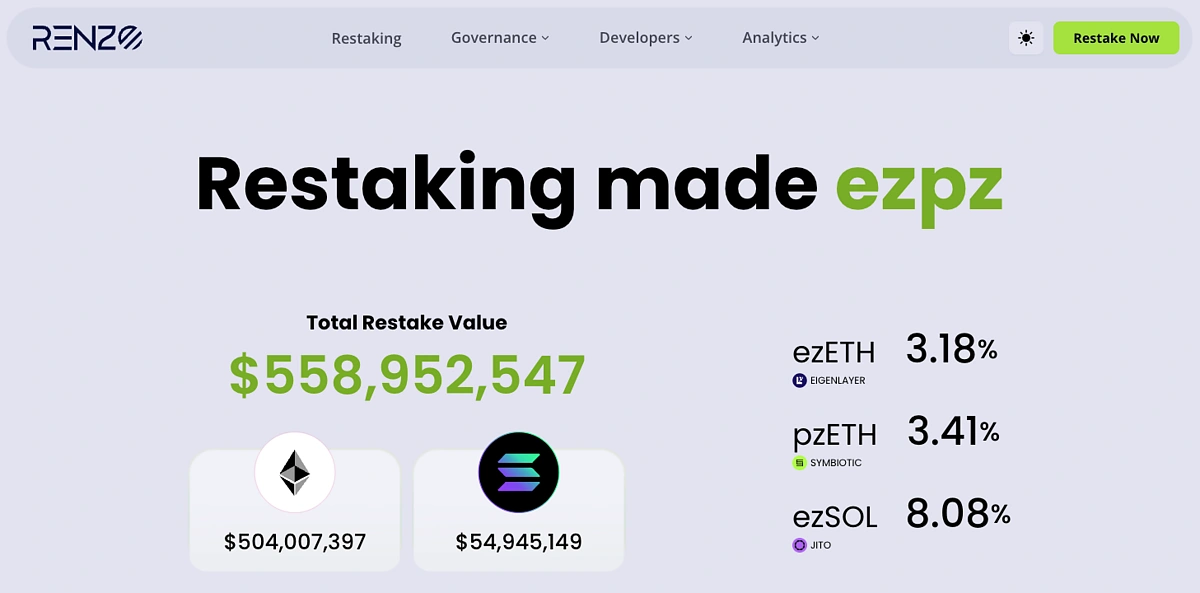
Renzo manages strategies for liquid restaking tokens, abstracting away complexities so Ethereum and Solana restaking is accessible to everyone. As every AVS offers a different set of rewards and slashing risks, it becomes increasingly challenging for users to manage their restaking strategies as more AVSs join the network. Renzo helps users manage their restaking strategy on EigenLayer, Symbiotic, and Jito Network.
Pendle Finance: Distributing Restaking Yield To Liquidity Providers

Pendle Finance has been exploring the most effective ways to manage yield. Pendle enables users to tokenize the future yield of their restaked assets. Users can deposit their liquid restaking tokens (LRTs) like ezETH from Renzo. These LRTs are then split into the principal token (like ETH), and yield tokens, which allow users to manage and trade the principal and yield components separately.
Final Thoughts
Restaking provides more value for stakers while providing security for other protocols. It improves the capital efficiency of staked tokens, as stakers provide more services when staking and earn more rewards, and where supported, can even use their receipt tokens in supported DeFi protocols.
While projects like Renzo handle the complexities around selecting a restaking strategy and which protocols to choose, users are advised to do their own research before committing any assets.
This article is only for informational and educational purposes and should not be taken as investment or financial advice.






 Or check it out in the app stores