



Stable Stablechain Overview

What Is Stable?
Existing blockchain infrastructure creates friction for stablecoin users in several ways. On general-purpose chains, users typically hold two or more tokens — the token/stablecoin they want to transfer and a volatile native token for gas fees. Transaction costs fluctuate with network demand, making budgeting difficult for businesses processing thousands of payments. Settlement times can range from seconds to minutes depending on network congestion, creating uncertainty for time-sensitive transfers.
Stable eliminates these pain points through stablecoin-native design, predictable costs denominated in dollars rather than volatile tokens, and optimized architecture for high-throughput payment processing. Basically, users can utilize the blockchain without exposing themselves to the price volatility of regular cryptocurrencies.
How Stable Works
Stable operates as an EVM-compatible Layer 1 blockchain, meaning developers familiar with Ethereum can easily build applications on Stable using the same tools and programming languages. The network uses a Delegated Proof of Stake (DPoS) consensus mechanism, where token holders vote to elect validators who process transactions and secure the network. This approach delivers faster block times and higher throughput compared to traditional Proof of Work systems.
What makes Stable unique is its integration with USDT0. USDT0 is an upgraded version of the original USDT token. It utilizes LayerZero’s cross-chain messaging protocol, and enables USDT0 to be easily moved and bridged across multiple blockchains easily and at a lower cost than regular USDT.
Transactions involving USDT0 on Stable have no gas fees at the protocol level, making transfers essentially free for users. The network employs a dual-token architecture: USDT serves as the gas and settlement token for everyday transactions, while the STABLE token provides governance rights and helps secure the network through staking.
Key Features and Capabilities
Transaction Speed: Stable achieves sub-second block finality, meaning transactions are confirmed and irreversible in less than one second. This performance rivals traditional payment networks while maintaining blockchain's transparency and security benefits.
Cost Efficiency: By using USDT as the gas token, transaction costs remain predictable and denominated in dollars. Users avoid the volatility-related cost uncertainty that plagues gas fees paid in ETH or other cryptocurrencies. For USDT0 transfers specifically, protocol-level gas fees are eliminated entirely.
Smart Contract Support: As an EVM-compatible chain, Stable supports smart contracts (self-executing programs that run on the blockchain) written in Solidity, the same programming language used for Ethereum. This allows developers to create decentralized applications (dApps) for payments, lending, and other financial services.
Cross-Chain Functionality: Through LayerZero integration, Stable can communicate with other blockchain networks, enabling users to move assets between different chains without relying solely on centralized exchanges or custodians (third parties who hold assets on your behalf).
Enterprise Features: Stable offers guaranteed blockspace allocation, allowing institutions to reserve transaction processing capacity during peak demand. The platform supports batch transactions for efficient bulk payment processing and confidential transfers that balance privacy requirements with regulatory compliance needs.
Security Measures: The network employs DPoS consensus with elected validators who stake tokens as collateral, creating economic incentives for honest behavior. Validators who act maliciously risk losing their stake and reputation within the ecosystem.
Who Uses Stable and Why
Payment Processors: Companies facilitating cross-border money transfers benefit from Stable's low costs and fast settlement times. Traditional remittance services often charge 5-10% fees and take days to settle; Stable enables near-instant transfers at fraction-of-a-cent costs.
Decentralized Finance (DeFi) Protocols: Applications offering lending, borrowing, or yield generation can build on Stable to provide services with minimal transaction overhead, passing savings to end users.
Businesses and Merchants: Companies accepting stablecoin payments can integrate Stable to reduce payment processing costs and eliminate volatility concerns associated with traditional cryptocurrency payments.
Treasury Management: Organizations holding USDT reserves can use Stable for efficient treasury operations, moving funds between accounts or counterparties without high transaction fees eating into yields.
Emerging Market Users: Individuals in countries with currency instability or limited banking access use stablecoins for everyday transactions. Stable's low costs make small-value transfers economically viable, expanding financial inclusion.
The core benefit across all user types is simplicity — holding and transacting in USDT without needing multiple tokens or dealing with unpredictable fees.
Stable Within Tether's Ecosystem
Stable represents a strategic expansion of Tether's influence beyond stablecoin issuance. By creating dedicated infrastructure for USDT, Tether captures more value from the stablecoin economy — not just from reserves backing USDT, but also from transaction fees and ecosystem growth on Stable.
While Tether also issues Tether Gold (XAUT), a token backed by physical gold, and supports USDT on numerous blockchains including Ethereum, Tron, and Solana, Stable provides a unified environment optimized specifically for stablecoin activity. The relationship is complementary: USDT continues operating on existing chains for broad accessibility, while Stable offers an optimized alternative for users prioritizing speed and cost-efficiency.
Tether CEO Paolo Ardoino serves as an advisor to Stable, reflecting the close relationship between the companies despite Stable operating through Bitfinex (which shares common ownership with Tether through parent company iFinex). This alignment ensures Stable development considers USDT's real-world use cases and integration needs.
Comparing Stable to Alternatives
Stable vs. Ethereum Mainnet: Using USDT on Ethereum provides maximum security and liquidity but comes with higher costs and variable settlement times. Stable trades some of Ethereum's decentralization for dramatically improved efficiency.
Stable vs. Layer 2 Solutions: Ethereum Layer 2 networks like Arbitrum or Optimism offer faster, cheaper USDT transactions than mainnet but still require bridging assets and often use ETH for gas. Stable provides native USDT gas payments and protocol-level optimizations specifically for stablecoins.
Stable vs. Circle's Arc: Circle's Arc network serves similar purposes for USDC, using it as a native gas token for enterprise-grade stablecoin infrastructure. Both represent the "stablechain" trend, but Stable focuses on USDT's massive existing user base while Arc targets USDC adoption among traditional financial institutions. The choice between them may come down to which stablecoin ecosystem users already participate in.
Stable vs. Tron: Tron has become popular for USDT transfers due to low fees, processing billions in daily USDT volume. However, Tron remains a general-purpose blockchain supporting multiple tokens and dApps. Stable's singular focus on stablecoins allows for more aggressive optimizations and features specifically designed for payment use cases.
Future Outlook and Roadmap
Stable launched with a phased approach. Phase 1 introduced USDT as native gas, sub-second block times, and core infrastructure. Phase 2, planned for later in 2025, will introduce advanced features like the USDT aggregator and guaranteed blockspace for enterprise users.
The launch of the Stable Foundation as an independent organization signals plans for decentralized governance, allowing STABLE token holders to participate in protocol decisions. This governance structure could influence future development priorities, fee structures, and network upgrades.
Several trends could impact Stable's trajectory. Growing stablecoin adoption—the market has grown from roughly $199 billion to over $308 billion in market capitalization within the past year — suggests increasing demand for specialized infrastructure. Regulatory clarity, particularly through legislation like the proposed GENIUS Act in the United States, could create frameworks supporting compliant stablecoin networks. Competition from other stablecoin-focused chains like Circle's Arc or Stripe's Tempo network will test different approaches to solving similar infrastructure challenges.
Stable's partnerships with institutions like PayPal, Anchorage Digital, and Standard Chartered's Libeara platform indicate potential for enterprise adoption, which could drive sustained network usage beyond speculative activity.
Risks and Considerations
Technical Risks: As with any blockchain network, Stable faces potential smart contract vulnerabilities, consensus mechanism weaknesses, or unforeseen technical issues. The network's relative newness means it hasn't been battle-tested like more established chains.
Centralization Concerns: DPoS consensus concentrates validation power among elected validators, creating potential single points of failure or influence. While this enables efficiency, it reduces the extreme decentralization found in larger Proof of Work or Proof of Stake networks.
Regulatory Uncertainty: Stablecoin regulations remain in flux globally. Adverse regulatory actions against USDT specifically or stablecoins generally could impact Stable's viability. Networks closely associated with specific stablecoin issuers face questions about whether they constitute centralized payment systems subject to traditional financial regulations.
Tether Dependency: Stable's close integration with USDT means concerns about Tether's reserve backing or regulatory status directly affect the network. Users should understand that Stable's success ties closely to USDT's continued operation and market acceptance.
Adoption Risk: Network effects favor established blockchains with existing users, developers, and liquidity. Stable must attract sufficient adoption to justify its existence separate from more established networks. Low usage could lead to stagnant development or eventual abandonment.
Competitive Landscape: Multiple projects are building stablecoin-focused infrastructure. Market fragmentation could prevent any single network from achieving the scale needed for sustainable operation, or dominant players could emerge leaving others with minimal usage.
USDX Depeg Controversy
Stable Lab’s USDX stablecoin depegged in November 2025, due to the $128 million DeFi protocol Balancer exploit. A majority of USDX’s liquidity was hosted on Balancer and was thus drained alongside the other affected Balancer vaults. As a result, the stablecoin has depegged and has not recovered as of writing in December 2025.
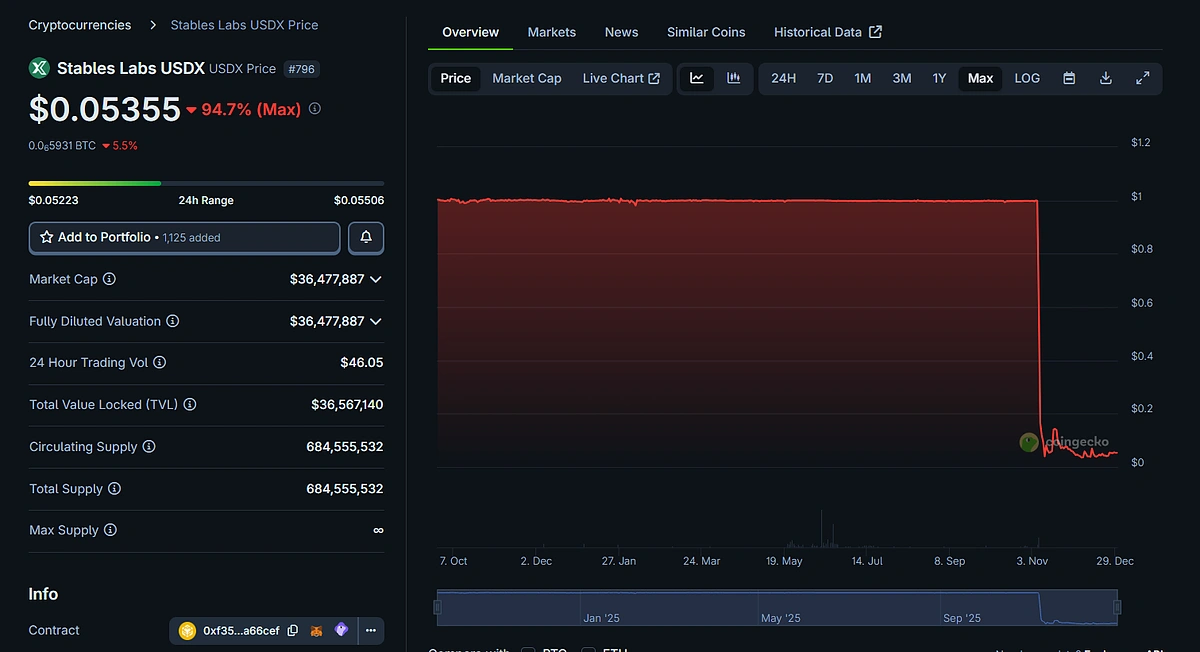
While the Balancer hack affected only $128 million, the loss of confidence has led to USDX losing over $600 million in market capitalization.
Conclusion
Stable represents an important evolution in blockchain infrastructure — the recognition that specialized networks optimized for specific use cases can outperform general-purpose alternatives. As a network endorsed by USDT, the largest stablecoin in circulation, many consider Stable to be a major player in the stablechain space.
With its December 2025 mainnet launch, institutional partnerships, and technical roadmap emphasizing speed and cost-efficiency, Stable positions itself as purpose-built infrastructure for the world's most-used stablecoin. Whether it achieves sustainable adoption depends on executing its technical vision, navigating regulatory uncertainties, and competing effectively with both general-purpose blockchains and emerging stablecoin-specific alternatives.
As the stablecoin market continues growing and infrastructure providers specialize, Stable's approach could cement themselves as one of the most important blockchains in the next decade.
This article is for educational purposes only and does not constitute financial advice. Readers should conduct their own research before making any investment decisions. Past performance does not guarantee future results. The information presented here is based on publicly available sources and may contain inaccuracies or become outdated as technology and regulations evolve.








 Or check it out in the app stores