



 Make us preferred on Google
What Is USDH?
USDH is Hyperliquid's planned native stablecoin designed to capture yield revenue for the Hyperliquid ecosystem. It will be created through a competitive bidding process where external issuers compete to build and manage the token.
Key Takeaways
- USDH is Hyperliquid's native stablecoin, with Native Markets winning the competitive selection process through a validator vote that concluded on September 15, 2025.
- Native Markets defeated established competitors including Paxos, Ethena, Frax, Sky, and Agora, despite offering less generous revenue sharing (50% vs 95-100% from competitors).
- The victory establishes Native Markets, co-founded by Hyperliquid ecosystem participants, as the issuer of what could become a multi-billion dollar stablecoin backed by reserves managed through Stripe's Bridge platform.
- USDH will be deployed natively on Hyperliquid's HyperEVM network, with a phased rollout beginning "within days" starting with capped testing before full availability.
- The outcome demonstrates the importance of ecosystem alignment and native knowledge over pure financial incentives in DeFi governance decisions.
Introduction: Why Is Hyperliquid Launching a Stablecoin?
In the decentralized finance (DeFi) landscape, Hyperliquid has emerged as a significant player. As a decentralized exchange (DEX) built on its own Layer 1 blockchain, it has combined the performance characteristics of centralized exchanges with the self-custodial benefits of decentralized systems. The platform holds approximately 70% of the decentralized perpetual futures market share, with monthly derivatives trading volumes approaching $400 billion and monthly revenues exceeding $100 million.
However, this success has been built upon a significant dependency. The platform's liquidity consists overwhelmingly of external stablecoins, with an estimated $5.6 billion in total stablecoin deposits, 95% of which is Circle's USD Coin (USDC). This reliance creates three strategic challenges for the protocol.
First is the issue of value leakage. The massive pool of USDC on Hyperliquid is invested by its issuer, Circle, into yield-bearing assets like U.S. Treasuries. The revenue generated from these reserves flows entirely to Circle, with no economic benefit returning to the Hyperliquid ecosystem that created the demand for that capital.
Second is the matter of sovereignty and risk. By building its foundation on a centralized, permissioned asset like USDC, which can be frozen at the issuer level, Hyperliquid exposes itself to potential censorship risk. This creates tension with its goal of fostering a permissionless and decentralized financial system.
Third, a bridged stablecoin introduces additional bridge security risks. USDC is mitigating this by issuing native USDC on Hyperliquid and enabling CCTP (cross-chain transfer protocol which allows transfer of USDC across different blockchain networks without requiring bridging or liquidity pools) after the Hyperliquid team announced USDH.
The decision to launch a native stablecoin represents a strategic pivot. By reserving the USDH ticker, Hyperliquid is moving to create its own native asset designed to internalize the value generated by its ecosystem. This initiative aims to transform the platform from a venue for capital into an economy with its own native currency, where the profits from the ecosystem's money supply support its own growth.
Introducing USDH
USDH is the official ticker reserved by the Hyperliquid protocol for its future native, dollar-pegged stablecoin. It is designed to serve as a "Hyperliquid-first, Hyperliquid-aligned, and compliant" asset that will function as a core component of the platform's liquidity and economic model.
Unlike a typical stablecoin project, the final form of USDH—its backing mechanism, governance structure, and revenue model—was not predetermined by the protocol. Instead Hyperliquid initiated a competitive bidding process, inviting external teams and established stablecoin issuers to submit proposals for the right to build and manage USDH. The specific characteristics of USDH were defined by the proposal that won the community's approval.
The Selection Process and Results
The selection process for selecting the issuer of USDH represents a significant governance event in Hyperliquid, with the winner chosen through a transparent, on-chain vote by the network's validators between September 11-14 2025. The stake-weighted vote occurred entirely onchain, with validator power determined by the amount of HYPE tokens staked.
Native Markets won the competition despite bids from established players such as Paxos, BitGo, Ethena, and others. Native Markets was heavily favored to win the vote throughout most of the proposal period by prediction markets, with Polymarket showing odds above 90-95% before the vote.
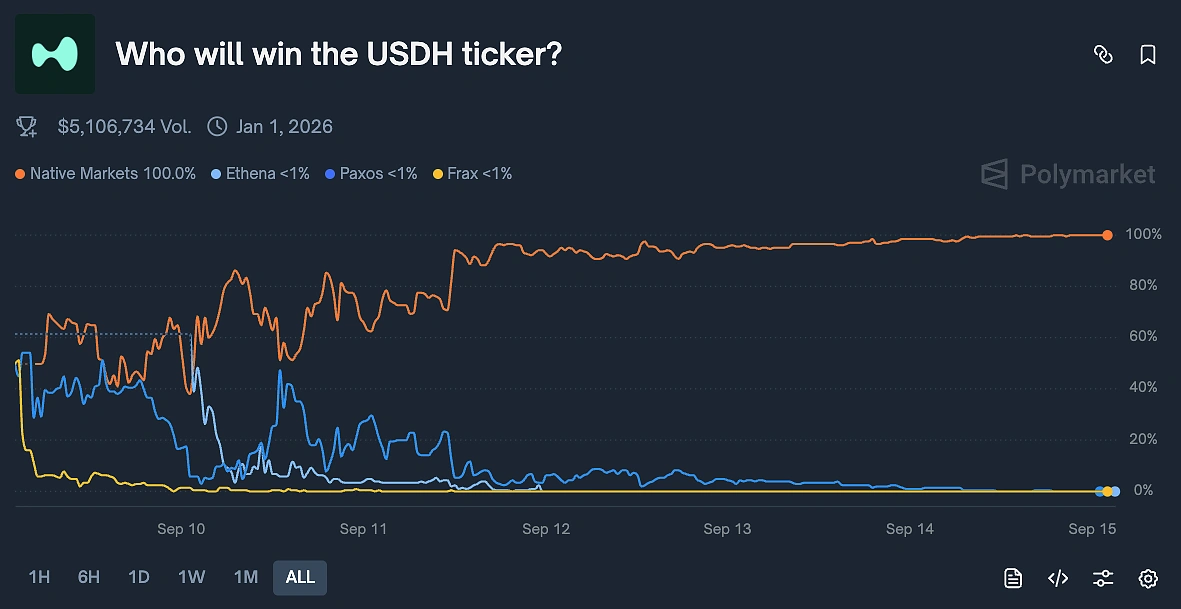
The competition had a significant impact on Hyperliquid's native token, HYPE, which rallied to a price peak at $57.30 as contenders made generous proposals for using USDH reserve revenue for token buybacks.

Market Implications and Competition Dynamics
The move poses a direct challenge to incumbents, particularly Circle's USDC. Hyperliquid's current holdings of approximately $5.5 billion in USDC represent about 7.5% of the stablecoin's total circulating supply. A successful migration to USDH could result in a revenue loss for Circle estimated between $150 million and $220 million annually, based on current yield rates on reserves.
In response to this potential disruption, Circle has announced plans to deploy native USDC and its Cross-Chain Transfer Protocol (CCTP) on Hyperliquid, signaling its intent to compete to retain its market share on one of DeFi's most important venues.
This competitive dynamic represents a shift in the stablecoin market structure. Previously, centralized issuers like Tether and Circle maintain control over 100% of the yield generated from their reserves. In Circle’s case, they pay a significant share of their yield to Coinbase, their distribution partner, which has raised eyeballs for other distributors of USDC.
The Hyperliquid process has created a competitive environment where issuers must offer a generous portion—or even all—of their revenue back to the host ecosystem to win selection. This reframes stablecoin issuance from a product into a service, where providers must compete on their alignment and value proposition to the underlying platform.
However, in spite of the seemingly adverse implications for USDC on Hyperliquid, the Hyperliquid foundation has stated that they intend to continue to support external stablecoins like USDC, with no intentions of phasing out other non-USDH stablecoins.
Native Markets: The Winning Proposal
Native Markets, a team formed specifically to launch a Hyperliquid-native stablecoin, won the validator vote despite offering less generous revenue sharing than competitors. The team is co-founded by Max Fiege (an early Hyperliquid ecosystem investor and advisor), Anish Agnihotri (blockchain researcher and developer), and MC Lader (former President and COO of Uniswap Labs).
Native Markets' proposal pledges to split all reserve yield equally between Hyperliquid's Assistance Fund (which conducts HYPE buybacks) and ecosystem growth initiatives. This 50/50 split contrasted with competitors like Paxos and Ethena who offered 95% revenue sharing, or Frax and Agora who pledged 100% of yield to the ecosystem.
The winning proposal utilizes Stripe's tokenization platform, Bridge, to manage reserves, with backing "fully backed by cash and US treasury equivalents with offchain reserves initially managed by BlackRock and onchain reserves by Superstate." USDH will be issued natively on Hyperliquid's HyperEVM network.
The victory demonstrated that ecosystem alignment and native knowledge trumped purely financial incentives, though it also sparked controversy. Some community members questioned how a relatively new team could quickly gain majority validator support, with critics like Dragonfly co-founder Haseeb Qureshi calling the process "a bit of a farce" and suggesting insider influence.
Starting to feel like the USDH RFP was a bit of a farce.
— Haseeb >|< (@hosseeb) September 9, 2025
Hearing from multiple bidders that none of the validators are interested in considering anyone besides Native Markets. It's not even a serious discussion, as though there was a backroom deal already done.
Native Markets'… pic.twitter.com/qrc9xChv6z
Implementation and Rollout
Following the validator vote conclusion, Native Markets announced an immediate move into a staged rollout process.
We will be deploying both the USDH HIP-1 and corresponding ERC-20 within days.
— max.hl (@fiege_max) September 14, 2025
We will then start with a testing phase for mints and redeems of up to $800/tx with an initial group, to be followed by the opening of the USDH/USDC spot order book as well as uncapped mints &…
The team said activity will start with the following phases:
- Testing Phase: Small-scale testing for mints and redemptions with caps of about $800 per transaction to stress-test the system
- Spot Trading: Opening of a USDH/USDC spot pair on Hyperliquid
- Full Availability: Removal of caps and general availability for all users
USDC and other stablecoins will continue to be supported on Hyperliquid as quote assets, as long as they meet certain thresholds such as a 200,000 HYPE stake (worth about $10 million), a robust $1 peg mechanism, and minimum depth against USDC and HYPE.
Other Competing Proposals
While Native Markets ultimately won, several established players submitted comprehensive proposals:
Paxos: The regulated stablecoin issuer offered 95% of reserve yield for HYPE buybacks, emphasizing global regulatory compliance including GENIUS Act and MiCA. Despite its institutional credentials and zero-fee migration promises, it secured only 7.6% of validator support.
Ethena Labs: Initially proposed 95% revenue sharing plus $75-150 million in ecosystem incentives, but withdrew from the competition following community pushback about alignment concerns and focus beyond stablecoins.
Frax Finance: Offered 100% of Treasury yield passed through to users with zero take-rate, positioning itself as the most community-aligned option from a pure financial perspective.
Sky (formerly MakerDAO): Proposed direct 4.85% yield to USDH holders plus $25 million for ecosystem development, leveraging its $8 billion balance sheet and seven-year operational track record.
Agora: The VanEck-backed startup pledged 100% of net revenue to the ecosystem while positioning itself as a neutral coalition approach.
|
Bidder |
Proposed Backing Mechanism |
Revenue Share Model |
Key Differentiators/Incentives |
| Native Markets (Winner) | Fiat-Collateralized (via Stripe Bridge) | 50% to HYPE buybacks, 50% to development/fund | Hyperliquid-native team; deep ecosystem knowledge |
|
Paxos |
Fiat-Collateralized (U.S. T-bills & Repos) |
95% of interest to HYPE buybacks & ecosystem |
GENIUS/MiCA compliant; institutional scale; zero-fee migration; PayPal ecosystem integrations |
|
Ethena Labs |
Synthetic (USDtb, backed by BlackRock's BUIDL) |
95% of net revenue to HYPE buybacks & ecosystem |
$75M-$150M incentives; launch of hUSDe; validator "guardian network" |
|
Frax Finance |
Fiat-Collateralized (frxUSD, backed by BUIDL) |
100% of Treasury yield passed through to users |
DeFi-native ethos; zero take-rate; inherits multichain infrastructure |
|
Sky |
Overcollateralized (Crypto & RWAs) |
4.85% direct yield to all USDH holders |
$8B balance sheet; 7-year track record; $2.2B instant liquidity (PSM) |
|
Agora (includes Agora’s institutional stablecoin infrastructure, Rain’s global card and on/offramp coverage, and LayerZero’s interoperability) |
Fiat-Collateralized (U.S. T-bills & Repos) |
100% of net revenue to HYPE buybacks/fund |
Neutral coalition (VanEck, MoonPay); no L1 conflict; $10M seed liquidity |
USDH and the Stablecoin Ecosystem
With Native Markets as the issuer, USDH's characteristics are now defined. The stablecoin will be fiat-collateralized, backed by U.S. Treasury equivalents, and managed through a hybrid approach combining traditional finance infrastructure (BlackRock, Stripe) with crypto-native elements.
|
USDH |
USDC |
||||
|
Backing Mechanism |
Fiat-Collateralized |
Fiat-Collateralized |
Fiat-Collateralized |
Delta-Neutral Synthetic |
Crypto/RWA Overcollateralized |
|
Primary Reserve Assets |
Cash & U.S. T-bills |
Cash, T-bills, Repos, Loans, BTC, Gold |
Cash & U.S. T-bills |
Staked ETH, BTC & Short Futures |
ETH, USDC, Tokenized RWAs |
|
Yield Generation |
50% to ecosystem, 50% to growth |
Issuer decides yield distribution from reserves |
Issuer decides yield distribution from reserves |
Staking rewards & funding rates |
Stability fees & RWA |
|
Decentralization Level |
Issued by Native Markets, Reserve funds handled by Blackrock (off-chain) and Bridge (on-chain) |
Centralized Issuer |
Centralized Issuer |
Protocol-managed (reliant on CEXs) |
DAO Governed |
|
Regulatory Approach |
GENIUS-compliant via Bridge |
Opaque; faces global scrutiny |
Regulated; frequent audits |
Crypto-native; seeks compliance |
Decentralized; DAO-governed |
Risks and Considerations
While the launch of USDH presents a significant opportunity for Hyperliquid, it is not without risks that the ecosystem must navigate
-
Centralization Concerns: Despite being positioned as "native," USDH relies heavily on Stripe's Bridge infrastructure, creating dependency on a major fintech player that has its own blockchain ambitions with Tempo. This creates potential conflicts of interest that concerned some community members.
-
Liquidity Migration Challenge: Moving billions of dollars in liquidity from established USDC to new USDH presents technical and adoption challenges. Success depends on smooth execution of the phased rollout and user acceptance.
-
Revenue Sharing Trade-off: Native Markets' 50% revenue share is significantly lower than competitors' offers. The ecosystem sacrificed immediate financial returns for perceived alignment benefits, which may prove controversial if execution falters.
-
Regulatory Uncertainty: While USDH aims for GENIUS Act compliance through Bridge, the evolving regulatory environment for stablecoins could impact the model's viability.
-
Execution Risk: Native Markets is a newly formed team managing what could become a multi-billion dollar stablecoin. Their ability to execute the ambitious rollout timeline and maintain operational excellence remains unproven.
Final Thoughts
The creation of USDH and Native Markets' victory represents a significant development for Hyperliquid and provides insights for the broader DeFi industry. It demonstrates how leading protocols are working to achieve economic sovereignty, capture a larger share of value generated by their ecosystems, and build more sustainable economic models.
The outcome revealed that ecosystem alignment and native understanding can outweigh purely financial incentives in DeFi governance decisions. Despite offering lower revenue sharing than competitors, Native Markets' deep integration with the Hyperliquid ecosystem and validator relationships proved decisive.
However, significant challenges remain ahead. USDH's biggest test will be "breaking through the dominance of USDC and USDT, where adoption and liquidity remain king," with success dependent on proving it can compete while maintaining stability. The stablecoin will need to demonstrate it can effectively migrate billions in liquidity from established assets and maintain user trust.
The competitive bidding process has established new precedents for how protocols can approach stablecoin integration, creating expectations that issuers must compete on alignment and value-sharing rather than simply providing stable assets. The Native Markets victory marks the beginning of USDH's implementation phase, with its ultimate success dependent on execution during the upcoming rollout.
This article is only for informational purposes and should not be taken as financial advice. Always do your own research before investing in any projects or protocols.









 Or check it out in the app stores