





 Make us preferred on Google
Overview of Top Privacy Coins

Bitcoin and most other cryptocurrencies are not anonymous, as is commonly believed. They are pseudonymous. Bitcoin operates by ensuring that all participants on the public blockchain maintain an append-only ledger. Because all ledger data must be synchronized, wallet addresses and every transaction are publicly accessible.
While Bitcoin addresses are not inherently linked to personal identities, they become traceable when users connect them to their identity through activities like interacting with centralized crypto exchanges like Binance or Coinbase, which require user verification. Once a Bitcoin address is associated with a verified identity, all transactions involving that address can be tracked and potentially linked back to the user.
What Are Privacy Coins?
Privacy coins are cryptocurrencies that use advanced cryptographic techniques to obscure transaction details such as sender and receiver identities, wallet addresses, and transaction amounts. Unlike Bitcoin and other transparent cryptocurrencies where all transaction data is publicly viewable on the blockchain, privacy coins employ specialized technologies to provide enhanced anonymity for users.
Common Privacy Technologies:
-
Stealth Addresses: Generate unique, one-time addresses for each transaction, preventing observers from linking transactions to a recipient's actual wallet address.
-
Ring Signatures: Combine a sender's transaction signature with multiple other signatures, making it computationally infeasible to determine which signature is authentic.
-
Zero-Knowledge Proofs (zk-proofs): Allow one party to prove a statement is true without revealing any information beyond the validity of that statement itself. Variants include:
-
zk-SNARKs (Zero-Knowledge Succinct Non-Interactive Argument of Knowledge)
-
Bulletproofs
-
zk-STARKs
-
-
Ring Confidential Transactions (RingCT): Hide transaction amounts on the blockchain.
-
CoinJoin/Mixing: Combine multiple transactions to obscure the link between sender and recipient.
Are Privacy Coins Legal?
Privacy coins are legal in most jurisdictions, though several countries have implemented bans or restrictions. Japan banned privacy coin trading in 2018, followed by South Korea and Australia in 2020. More recently, the UAE introduced strict crypto regulations that impact privacy coins, and the European Union's Markets in Crypto-Assets (MiCA) regulation, which came into full effect in December 2024, has significantly restricted privacy coin availability across the European Economic Area.
The regulatory environment for privacy coins has intensified dramatically. In 2024, the sector experienced record-breaking delistings with nearly 60 privacy coins removed from centralized exchanges globally—the highest number since 2021. As of late 2025, 73 exchanges worldwide have delisted privacy coins, up from 51 in 2023.
Major exchanges have taken decisive action:
-
Kraken delisted Monero (XMR) from the European Economic Area in October 2024
-
Binance fully delisted XMR, with Monero delistings surging sixfold in 2024
-
OKX removed privacy token trading pairs in January 2024
-
Dash experienced delistings that increased nearly twentyfold
Despite this regulatory pressure, privacy coin adoption continues to grow in certain sectors. As of Q1 2025, privacy coins are used in 11.4% of all cryptocurrency transactions globally, up from 9.7% in 2024. However, it's important to note that based on the report, only 7% of global privacy coin transactions in 2025 are suspected of illicit intent — significantly lower than public perception suggests.
Now, let’s look at three of the most prominent privacy coins and their underlying technologies.
1. Zcash (ZEC)
Zcash has experienced explosive growth, with its price surging approximately 1,260% since September 2025, and is currently trading at almost $654 at time of writing. ZEC has overtaken Monero's market capitalization in early November 2025, making it the leading privacy coin by market capitalization at over $11 billion.
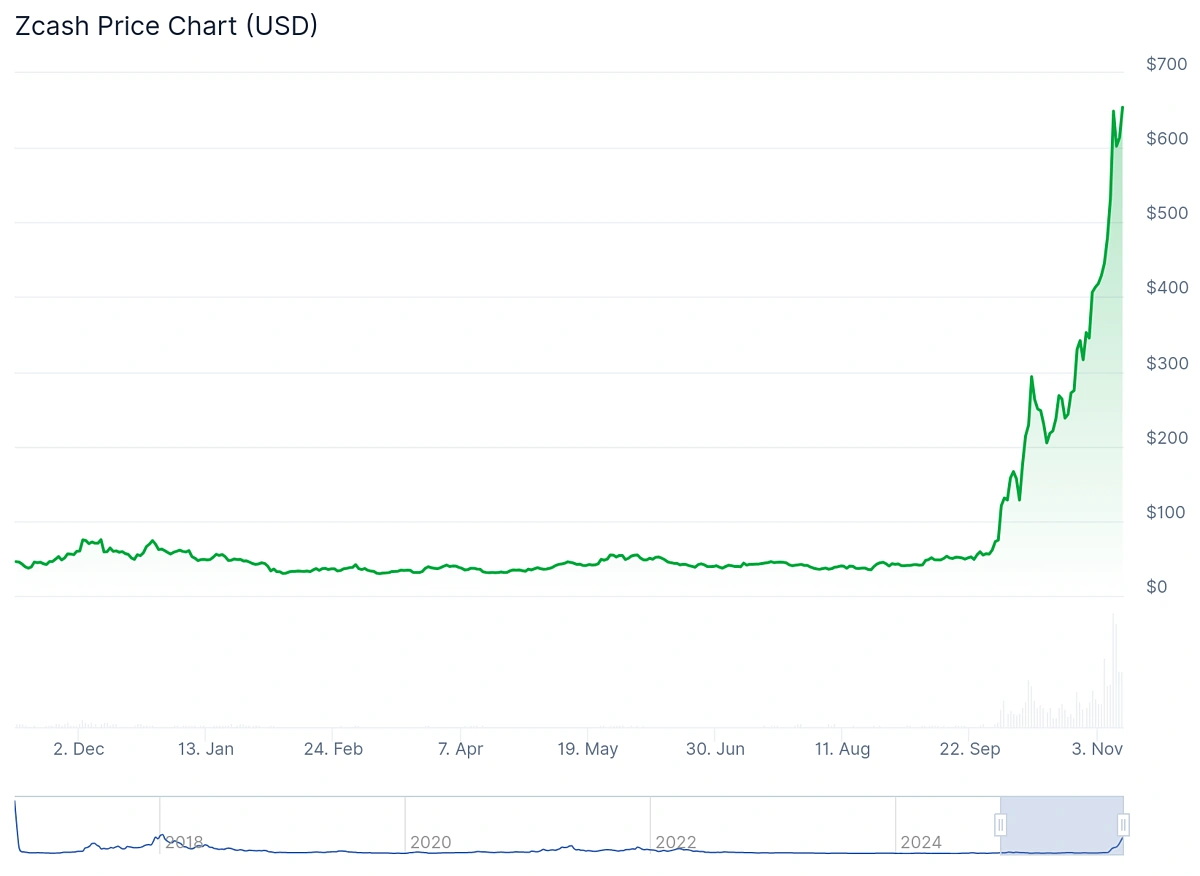
The rally has been bolstered by endorsements from prominent crypto figures, notably Arthur Hayes, who has predicted Zcash could reach $10,000 per coin and disclosed ZEC as a major holding in his Maelstrom Fund.
How Zcash Works
Zcash uses the Bitcoin algorithm, but with zk-proofs and shielded addresses (similar to Monero's stealth addresses).
While Monero uses stealth addresses for recipients and ring signatures for senders to protect their privacy, Zcash's shielded addresses can be enabled for both senders and recipients.
Similar to Monero, Zcash also uses a version of the non-interactive zk-proof, known as "zk-SNARK" (Zero-Knowledge Succinct Non-Interactive Argument of Knowledge). You can think of zk-SNARK and bulletproofs as cousins that function in a similar manner, but use different methods to construct a proof.
Technological Evolution: The privacy technology landscape continues to evolve, with advancements like zk-STARKs (an evolution of zk-SNARKs) improving efficiency and security. Additionally, Zcash introduced Zashi CrossPay in 2024-2025, a privacy-preserving cross-chain payment protocol that positions Zcash as a potential privacy layer for broader crypto networks such as Bitcoin and Ethereum.
Unlike other privacy coins, Zcash senders can also include private memos in shielded transactions — a feature not available in Monero.
Zcash is unique because it offers fully private and fully public transactions, allowing users to make certain transaction details public, while obfuscating others. In reality, a vast majority of Zcash's transactions are public. However, shielded adoption has been increasing — as of late 2025, approximately 20-25% of circulating ZEC is now held in encrypted addresses, with about 30% of transactions involving the shielded pool.
However, this has raised concerns that a third party can identify private transactions by process of elimination.
Regulatory Advantage
Zcash's optional privacy model has proven to be a significant competitive advantage in the increasingly regulated crypto landscape. Unlike Monero, which remains delisted from most major Western-regulated exchanges due to its mandatory privacy features, Zcash offers flexibility. Users can choose between transparent and shielded transactions, giving institutions room to maintain compliance and reporting requirements.
This flexibility makes ZEC what some analysts call a "regulatory-acceptable asset," particularly appealing to institutions seeking privacy without the compliance risks associated with mandatory-privacy coins. In 2024, Zcash introduced an audit-friendly viewing key option, though only about 12% of wallets actively use this feature as of March 2025.
2. Monero (XMR)
Monero is one of the most established privacy coins, and was one of the earliest privacy coin projects in the crypto space. At time of writing, XMR is trading at around $415, with a market capitalization of approximately $7.68 billion. Stealth addresses, ring signatures, zero-knowledge proofs (zk-proofs), and RingCT form Monero's proprietary privacy protocol.
How Monero Works
When a transaction is initiated on Monero, the protocol creates a randomized, one-time-use destination address for the transaction, known as a stealth address. Stealth addresses cannot be linked back to the recipient, ensuring their privacy.
To protect the anonymity of the sender, ring signatures are used to sign the transaction. Ring signatures are formed from the sender's public key with a number of other public keys. This helps obfuscate the identity of the actual sender.
To verify transactions, Monero deploys a version of non-interactive zk-proofs known as bulletproof. Zero-knowledge proofs allow one party to prove a statement is true without conveying any additional information beyond the validity of that statement itself.
Finally, Ring CT obfuscates actual transaction values. Monero also broadcasts decoy wallet addresses with every transaction, making it extremely difficult to trace the actual transaction path.
Combined, these features grant Monero a high level of privacy. Much of the Monero team remains anonymous today. The development team has managed to roll out updates approximately every 6 months. The Monero developer community is organized into workgroups according to their respective expertise.
Monero uses a Proof of Work consensus mechanism, making it mineable by individual users.
Regulatory Challenges
Unlike Zcash's optional privacy model, Monero enforces mandatory privacy on all transactions. This fundamental design choice has made it a primary target for regulatory action. Monero's development team declined requests to implement opt-in traceability features, maintaining their stance on absolute privacy — a decision that has limited exchange listings but preserved the coin's core mission. 74% of privacy coin developers cite compliance with the Financial Action Task Force (FATF) Travel Rule as their biggest challenge in 2025.
Despite regulatory headwinds, Monero experienced a 24% surge in early November 2025 and maintains strong community support as the preferred choice for users prioritizing complete transactional privacy.
3. Dash (DASH)
Dash experienced significant volatility in late 2025, with substantial price movements alongside other privacy-focused cryptocurrencies. The coin has seen periods of strong gains during broader privacy coin rallies.
Dash offers an optional privacy feature called CoinJoin (formerly known as PrivateSend). According to the official Dash documentation, CoinJoin is described as providing "consumer grade financial privacy" through a non-custodial mixing process that shuffles Dash transactions with other users through a process coordinated by masternodes.
The system works by:
- Denomination Creation: Breaking transaction inputs into standard denominations (0.00100001, 0.0100001, 0.100001, 1.00001, and 10.0001 DASH).
- Mixing Rounds: Combining these denominations with inputs from at least two other users in the masternode pool. Users can select between 2-16 rounds of mixing, with 4 rounds as the default and recommended setting.
- Transaction Completion: Once mixed, the denominated funds can be spent like regular Dash, with privacy enhanced through the obfuscation of transaction history.
Dash also has plans to add Confidential Transactions (CT) support.
Challenges with Privacy Coins
The risk of privacy coins arises directly from their core appeal of being able to obfuscate all transactions. This gives rise to the potential for privacy coins to be utilized by bad actors for illicit activities and financial transactions, making it almost — if not outright impossible — for law enforcement agencies to identify a money trail.
That's why authorities are generally unreceptive toward privacy coins, and state organizations like the IRS have published six-figure bounties to "crack" coins like Monero. In 2020, the IRS offered a reward of $625,000 to anyone who could crack Monero's privacy network. Though a company called CipherTrace came forward and alleged they had done so, Monero denies that anyone successfully exposed their network.
Important Context on Illicit Use: While privacy coins have been associated with illicit activities in media reports and regulatory discussions, available data suggests the actual rate of suspicious transactions is lower than commonly assumed. Privacy advocates point out that traditional financial systems and transparent cryptocurrencies also facilitate illicit activities, and that privacy-enhancing technologies serve many legitimate purposes including personal safety, protection from surveillance, and financial sovereignty.
Given the negative stance from authorities, cryptocurrency exchanges also generally take a cautious approach when listing privacy coins.
Major Impact of Exchange Delistings
Certain exchanges that used to offer privacy coin trading pairs have also delisted them. The scale of this trend accelerated dramatically in 2024-2025:
-
2024 set records: Nearly 60 delistings occurred, the highest since 2021.
-
Major platforms affected: Kraken, Binance, OKX, Huobi (HTX), Bittrex, Coincheck, Upbit.
-
Regional variations: Delistings were particularly severe in EU, UAE, and South Korea.
These moves directly limit the number of avenues where a user can exit or liquidate their privacy coin holdings, thereby potentially reducing liquidity and accessibility. The reduced exchange access creates several challenges:
-
Decreased Liquidity: Fewer exchanges offering privacy coins means it's more difficult to buy or sell large quantities without significantly impacting the price.
-
Increased Volatility: Lower trading volumes make these cryptocurrencies more susceptible to price manipulation and market fluctuations.
-
Compliance Costs: Privacy-focused blockchain firms face compliance costs that surged by 35% year-over-year, averaging $1.2 million annually in 2025.
-
Limited Institutional Access: Larger institutional investors typically prefer stable and liquid markets, making delistings a barrier to mainstream adoption.
Alternative Trading Venues: As centralized exchanges delist privacy coins, traders have increasingly turned to decentralized exchanges (DEXs) and peer-to-peer (P2P) platforms. LocalMonero and similar P2P markets saw a 19% uptick in activity following major delistings. Only 18% of privacy coin projects are currently integrated with RegTech solutions that support automated compliance.
That's not to say that privacy coins are without criticism. Monero is associated with use in financial crimes like money laundering. However, privacy advocates argue that financial privacy is a fundamental right, and that privacy-enhancing technologies serve legitimate purposes including protection of personal safety, evasion of surveillance, and preservation of financial sovereignty.
The Rise of Privacy Blockchains
The privacy crypto sector has undergone a significant transformation, with privacy coins losing 44.3% market share to privacy blockchains since 2021.
-
Privacy Coins are cryptocurrencies modeled after Bitcoin, built primarily as digital currencies with privacy as their core function (e.g., Monero, Zcash, Dash).
-
Privacy Blockchains are next-generation blockchain platforms that offer privacy features alongside broader functionality, including smart contracts, decentralized applications, and more complex use cases (e.g., Mina Protocol, Oasis Network, Secret Network).
Market Share Shift: Based on monthly average token market capitalization of leading crypto privacy assets, privacy coins previously accounted for 96.6% of the crypto privacy market in January 2021 (at a $4.62 billion market capitalization), but held just 52.3% as of February 2024 ($3.08 billion).
In contrast, privacy blockchains' market share grew by 14 times, from 3.4% ($0.16 billion) to 47.7% ($2.81 billion). This shift represents the evolution from pioneering privacy-focused currencies to more versatile blockchain ecosystems that integrate privacy capabilities with smart contract functionality and greater regulatory considerations.
These platforms represent a different approach to privacy in cryptocurrency — rather than solely focusing on private transactions, they provide privacy-enhanced infrastructure for broader blockchain applications.
Recent Market Momentum in November 2025
Privacy coins experienced significant price increases in late 2025, with the sector demonstrating renewed market interest.
Market Performance: According to CoinGecko data, the Privacy coin market capitalization is currently $43.4 billion at time of writing, with a 50.6% increase in a single 24-hour period. This substantial growth occurred amid heightened trading activity across major privacy coins including Monero, Zcash, and Dash.
Contributing Factors: Several elements may have contributed to this market activity:
-
Technical breakouts: Multiple privacy coins broke through long-term resistance levels.
-
Market rotation: Capital appeared to rotate into previously undervalued cryptocurrency sectors, partly due to analyst attention.
-
Ongoing privacy concerns: Continued discussions about data privacy and financial surveillance in the broader technology landscape.
This price activity demonstrates continued market demand for privacy-preserving technologies, even within a challenging regulatory environment.
Conclusion: Future Trends and Outlook
The privacy coin landscape has evolved significantly since 2023. While regulatory pressures have intensified with record delistings and stricter compliance requirements, the sector has simultaneously experienced substantial growth and innovation. Zcash's surge past Monero in market capitalization, periodic price rallies in late 2025, and the evolution toward privacy blockchains demonstrate that privacy-preserving technology continues to develop within the cryptocurrency ecosystem.
Key Trends Shaping the Future:
-
Continued Regulatory Scrutiny: Privacy coins will likely remain a focal point of regulatory attention. Further restrictions and compliance requirements are expected as governments worldwide strengthen cryptocurrency oversight.
-
Technology Integration: Privacy-enhancing technologies are increasingly being integrated into mainstream blockchain platforms rather than remaining isolated to dedicated privacy coins. Ethereum's layer-2 solutions and other projects now include optional privacy features.
-
Market Bifurcation: The market is splitting into two camps:
-
Mandatory privacy coins (like Monero) that maintain absolute anonymity and accept the regulatory consequences.
-
Optional privacy solutions (like Zcash) that offer flexibility and regulatory compliance pathways.
-
-
Compliance Innovation: RegTech solutions addressing crypto compliance are projected to reach $5.4 billion in 2025, with 18% specifically focused on privacy coins. More projects may explore "selective disclosure" mechanisms that allow optional transparency for regulatory compliance while preserving privacy by default.
-
Sustained Market Interest: Privacy remains a fundamental concern for many users. The price rallies observed in late 2025 demonstrate that market demand for privacy-preserving technologies continues to exist and may be growing.
-
Shift to Privacy Blockchains: The evolution from standalone privacy coins to full-featured privacy blockchains with smart contract capabilities represents the next phase of privacy-preserving technology in crypto.
Privacy-preserving technologies appear positioned to play an ongoing role in the cryptocurrency ecosystem, particularly as concerns about surveillance, data breaches, and financial sovereignty continue to grow globally.
Article originally published September 28, 2023 by Valerioshi X. Updated November 2025 with current market data, regulatory developments, and technological advancements.
Disclaimer: This article is only for informational purposes and should not be taken as financial advice. Users are advised to do their own research before investing in any cryptocurrency or utilizing any platform.










 Or check it out in the app stores