





 Make us preferred on Google
What Is DePIN?
DePIN (Decentralized Physical Infrastructure Networks) are blockchain-based systems that use token rewards to incentivize individuals to contribute real-world physical resources — such as computing power, wireless connectivity, storage, or energy — to a shared network. Instead of corporations building and owning infrastructure, DePIN crowdsources it from individuals who earn cryptocurrency in return.
- How it works: Providers contribute hardware (routers, GPUs, sensors, etc.). Middleware relays usage data to a blockchain, which distributes token rewards based on each provider's contribution.
- Two categories: Physical Resource Networks (PRNs) provide location-based resources like wireless coverage. Digital Resource Networks (DRNs) provide fungible resources like compute and storage.
- Key examples: Helium (wireless), Filecoin (storage), Hivemapper (mapping), Render Network (GPU compute).

Various centralized platforms rely on community contributions to build networks of resources for millions of users. Ride-sharing services like Uber are a familiar example — drivers contribute vehicles and services, get paid, and the platform connects them to a wide user base. But the platform maintains control of the providers' access, pricing, and data.
DePIN applies blockchain technology to this model. Instead of a centralized company managing the infrastructure and setting the terms, a decentralized protocol coordinates providers, tracks contributions on-chain, and distributes cryptocurrency rewards automatically. Anyone with the required hardware can participate as a provider, and anyone can access the services — no gatekeepers, no membership applications.
As of April 2026, the DePIN category on CoinGecko tracks dozens of projects spanning wireless, compute, storage, energy, and mapping — a sector that has grown significantly since the term was first coined in late 2022.
DePIN vs. Traditional Infrastructure
| Traditional Infrastructure | DePIN | |
|---|---|---|
| Who builds it | Corporations (AWS, AT&T, Google) | Crowdsourced from individual providers |
| Control | Centralized | Distributed across providers |
| Pricing | Set by corporation; often opaque | Market-driven; typically lower |
| Revenue model | Users pay corporation for access | Providers earn tokens for contributing resources |
| Barrier to entry (supply side) | Massive capital expenditure | Low — often existing hardware (router, GPU, dashcam) |
| Permissioning | Requires contracts, approvals | Permissionless — anyone with required hardware can join |
| Payment | Fiat (invoices, subscriptions) | Cryptocurrency (automatic, on-chain) |
How Does DePIN Work?
DePIN creates a connection between physical facilities and the blockchain. The system has three layers:
Physical infrastructure: The physical facility could be anything from a sensor or internet router to a GPU cluster or solar panel. This is managed by a private provider. In many cases, providers already own these facilities — a DePIN simply gives them a way to monetize idle resources. Any number of providers can contribute their facility to a DePIN, similar to how miners contribute computing power to a Proof of Work blockchain.
Middleware: The middleware handles the connection between the physical infrastructure and the blockchain. Like a decentralized oracle network that picks up real-world data and communicates it to a blockchain application, the middleware gathers data on activity across each provider's facility and relays it to the network.
Blockchain system: Data gathered by the middleware are sent to the blockchain, which serves as both an administrator and a payment system. Based on the data provided, the blockchain rations demand across providers and computes rewards based on contribution, which are distributed in cryptocurrency. On the user side, the blockchain handles resource procurement with pricing models integrated into the payment system — users are charged for each service they utilize.
DePIN Categories: PRN vs. DRN
DePINs are classified into two broad categories:
| Category | Full Name | What Providers Contribute | Key Trait | Examples |
|---|---|---|---|---|
| PRN | Physical Resource Network | Hardware related to connectivity, mobility, energy, mapping | Location-dependent and non-fungible — services are tied to a specific place | Helium, Hivemapper, DIMO |
| DRN | Digital Resource Network | Computing power, storage, bandwidth | Location-independent and fungible — resources can be contributed from anywhere | Filecoin, Render, Theta |
The DePIN Flywheel
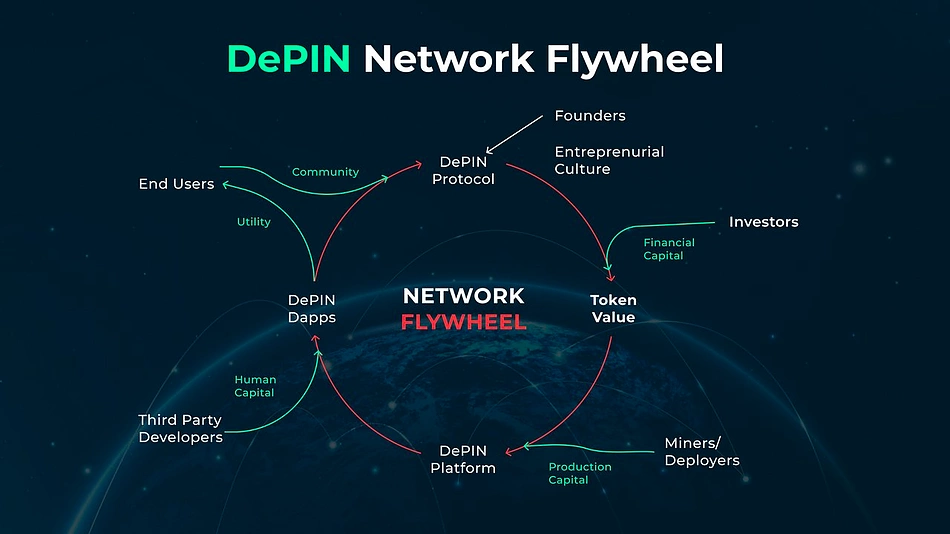
DePINs grow through a self-reinforcing cycle. First, providers are incentivized to commit their physical facilities to the network in exchange for token rewards. As more providers join, the network's capacity and coverage expand, making it more useful for end users. Users are attracted by lower costs compared to centralized alternatives. As usage grows, the network generates more fee revenue, the native token appreciates, rewards become more attractive, and even more providers join. This virtuous cycle is known as the DePIN flywheel.
Advantages and Challenges of DePIN
| Advantages | Challenges | |
|---|---|---|
| Scalability | Horizontal scaling — add more providers instead of upgrading centralized hardware. Networks can scale in and out based on demand. | Early-stage adoption limits provider density in many regions |
| Cost | Lower fees than centralized alternatives; minimal platform overhead since the network doesn't own the infrastructure | Providers bear their own hardware and operating costs, which can be significant for some setups |
| Access | Permissionless for both providers and users — no contracts, approvals, or membership requirements | Technical complexity may deter non-crypto-native participants |
| Incentives | Token rewards create passive or active income for providers, including those with previously idle resources | Profitability depends on network growth and token value — early-stage networks may struggle to offer attractive rewards |
| Decentralization | Control distributed across providers; no single point of failure. Similar to a DAO for physical infrastructure. | Token-weighted reward systems can still concentrate influence among large providers |
DePIN Sectors and Projects
DePIN spans multiple sectors, each addressing a different type of physical or digital infrastructure. Here are the major categories and leading projects:
| Sector | Project | Token | What It Does |
|---|---|---|---|
| AI Compute | Bittensor | TAO | Decentralized AI network rewarding miners for contributing machine intelligence across specialized subnets |
| GPU Compute | Render Network | RENDER | Distributed GPU rendering for 3D graphics and AI workloads |
| Cloud Compute | Akash Network | AKT | Decentralized cloud computing marketplace — an open alternative to AWS and Google Cloud |
| Data / Bandwidth | Grass | GRASS | Users contribute idle internet bandwidth to power AI web-scraping and data collection |
| Storage | Filecoin | FIL | Decentralized marketplace for data storage |
| Wireless | Helium | HNT / MOBILE | Decentralized 5G and IoT connectivity from user-operated hotspots |
| Bandwidth | Theta Network | THETA | Decentralized video delivery and bandwidth sharing |
| Data Indexing | The Graph | GRT | Decentralized protocol for indexing and querying blockchain data |
| Geospatial | Hivemapper | HONEY | Crowdsourced street-level mapping via dashcams |
| Sensor / IoT | IoTeX | IOTX | Blockchain platform for Internet of Things devices and real-world data |
For live prices and market data on more DePIN tokens, visit CoinGecko's DePIN category page.
Below is a closer look at how each sector operates.
AI Compute

Bittensor is a decentralized AI network that uses blockchain incentives to reward participants who contribute valuable computation — whether that's running inference, training models, or processing financial signals. The network is organized into specialized subnets, each focused on a specific AI task such as large language model training, image generation, or predictive analytics. Providers compete to produce the highest-quality outputs and earn TAO tokens based on their performance. In February 2025, Bittensor transitioned to Dynamic TAO (dTAO), a market-driven system where each subnet has its own token and liquidity pool, allowing users to stake directly to the subnets they believe in.
GPU Compute

Render Network is a decentralized GPU rendering platform that connects GPU owners with creators and developers who need computing power for 3D graphics, motion design, visual effects, and AI model training. Providers contribute idle GPU capacity to the network and earn RENDER tokens based on the jobs they process. Render has become one of the largest DePIN projects by market cap, driven by surging demand for distributed GPU resources as AI workloads have grown. The network supports rendering jobs from major creative tools and has partnered with studios and platforms across the entertainment and AI industries.
Cloud Compute

Akash Network is a decentralized cloud computing marketplace that functions as an open alternative to centralized providers like AWS and Google Cloud. Users who need cloud resources can purchase them from providers with excess capacity, with transactions settled in AKT tokens. Akash supports a wide range of workloads including web hosting, machine learning inference, and general-purpose compute. Its reverse-auction pricing model typically offers costs 70–80% lower than centralized equivalents, making it attractive to AI startups and developers who need fast, affordable access to compute without enterprise onboarding queues.
Data / Bandwidth

Grass enables users to contribute their unused internet bandwidth to a decentralized network that powers AI data collection and web scraping. Users install a browser extension or desktop app, and Grass routes data requests through their connection — earning GRASS tokens in return. The network supplies structured web data to AI companies that need large-scale internet access for model training, offering a decentralized alternative to centralized data scraping infrastructure. Built as a layer-2 data rollup on Solana, Grass grew to over two million users during its beta phase and has positioned itself at the intersection of DePIN and AI data infrastructure.
Storage
Filecoin is a decentralized data storage marketplace. Providers contribute storage space to the network and earn FIL tokens, while users pay fees to store their data across the distributed network. The Filecoin blockchain records each provider's contribution and handles all payment settlement.
Wireless

Wireless DePIN projects build decentralized connectivity networks for IoT and cellular devices. Providers deploy hotspots or small cell hardware and earn tokens based on the coverage and data they provide. Helium is the most prominent example, operating a multi-token system: HNT is burned by users to access connectivity, while the MOBILE token rewards 5G hotspot operators.
Bandwidth

Theta Network optimizes content delivery by incentivizing providers to share their bandwidth. The network consists of a blockchain layer (handling payments and smart contracts) and an Edge network (handling storage and delivery of media assets). Bandwidth providers earn THETA tokens, and bandwidth can be shared from mobile, PC, and other devices.
Data Indexing

The Graph is a decentralized indexing protocol that organizes and serves blockchain data, functioning as a kind of search engine for on-chain information. Developers use The Graph to query data from blockchains like Ethereum, Solana, and others through open APIs called subgraphs — eliminating the need to run their own indexing infrastructure. Node operators called Indexers earn GRT tokens for processing these queries. The Graph powers data access for many of the largest dApps in DeFi, NFTs, and gaming, making it a foundational infrastructure layer across the broader Web3 ecosystem.
Geospatial

Hivemapper is building a crowdsourced map using contributions from its community. Drivers install a Hivemapper dashcam on their vehicles, and the network reads locational data as they drive. Contributors are rewarded with HONEY tokens relative to the areas covered and the freshness of their mapping data.
Sensor / IoT

IoTeX is a blockchain platform purpose-built for the Internet of Things, enabling smart devices and sensors to interact with decentralized applications. IoTeX provides the infrastructure for devices to register their identity, transmit verifiable real-world data on-chain, and trigger smart contract actions based on that data. The platform supports a growing ecosystem of DePIN projects building on top of its chain, spanning categories like environmental monitoring, location tracking, and device authentication. Providers earn IOTX tokens for contributing device data and computational resources to the network.
Common Questions About DePIN
What does DePIN stand for?
DePIN stands for Decentralized Physical Infrastructure Networks. It describes blockchain projects that use token incentives to crowdsource real-world infrastructure like wireless connectivity, computing power, storage, and energy from individual providers.
How do you earn money with DePIN?
By contributing physical resources to a DePIN network. For example, operating a Helium hotspot earns MOBILE tokens, sharing GPU power through Render Network earns RENDER tokens, and contributing mapping data via Hivemapper earns HONEY tokens. Earnings depend on the network's demand for your specific resource and the current token value.
What is the difference between DePIN and DeFi?
DeFi (Decentralized Finance) decentralizes financial services like lending, trading, and borrowing. DePIN decentralizes physical infrastructure like wireless networks, cloud storage, and computing power. DeFi operates entirely on-chain, while DePIN bridges blockchain incentives with real-world hardware.
Is DePIN a good investment?
DePIN is a growing sector, but individual project risk varies significantly. Factors to evaluate include real user demand (not just speculative token activity), the size and growth of the provider network, and whether the project offers a genuine cost advantage over centralized alternatives. As with all crypto investments, conduct your own research.
What are the biggest DePIN projects?
As of 2026, some of the largest DePIN projects by market cap include Render Network (GPU compute), Filecoin (storage), Helium (wireless), and Theta Network (bandwidth). You can track live DePIN market data on CoinGecko's DePIN category page.
Final Thoughts
DePIN represents a shift in how physical and digital infrastructure is built and maintained — moving from corporation-owned systems to distributed networks of individual contributors, coordinated by blockchain incentives. The model has shown promise across wireless, compute, storage, energy, and mapping sectors, with projects like Helium, Filecoin, and Render Network demonstrating real-world usage beyond speculation.
However, DePIN is still an emerging sector. The flywheel model depends on achieving sufficient provider density and user demand to sustain attractive rewards — and most projects are still in early stages of that growth curve. Provider economics, token volatility, and technical complexity remain real barriers to mainstream adoption.
For investors and participants, the key metrics to evaluate are real usage data (not just token price), the provider network's size and geographic coverage, and whether the protocol offers a meaningful cost or performance advantage over its centralized equivalent.
This article is for educational and informational purposes only and should not be construed as financial advice. Featured projects are for illustrative purposes and are not endorsed by CoinGecko.









 Or check it out in the app stores