



 Make us preferred on Google
What Is Bittensor (TAO)?
Bittensor is challenging centralized AI systems through developing a decentralized AI network powered by blockchain and driven by incentives. TAO is the native token facilitating all economic activities on Bittensor.
Key Takeaways
-
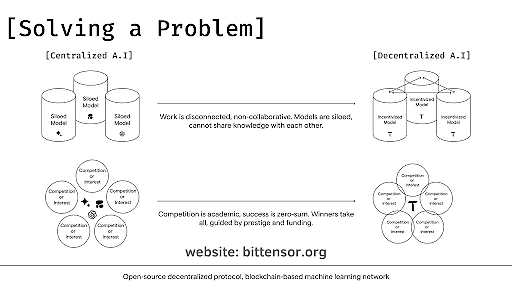
Bittensor’s goal is to create a decentralized network of AI systems that operate like a global brain or ‘Neural Network’, which allows AI systems to learn from each other and evolve collectively.
-
The Yuma Consensus evaluates the contributions of network participants by aggregating evaluations assigned by validators to miners. Those who contribute valuable intelligence are rewarded on a weight basis.
-
The TAO token is used for registration, staking, and as payment for services within the network, facilitating all economic activities on Bittensor.

The Role of Decentralized AI in the Future of Technology
Only in the last two years, artificial intelligence has progressed at an unprecedented rate but at the same time raised serious concerns around issues like data ownership, algorithmic bias, and centralized control.
As explored in a Reflexivity Research report, several projects are innovating at the intersection of AI and blockchain to help build a more open and trustworthy AI ecosystem.
"The discovery problem is happening with AI right now—you have something that was inherently based on sharing information, sharing research, sharing science. It (was) completely open and (is) now being closed into five companies, and these five companies are building tools that we will all become entirely dependent upon; and because they're so complicated, we have no idea how to verify the correctness. We have no idea to verify how they work, what they're actually doing. And because we become so dependent on them, if you let just a few months or a few years go by it becomes too late because those dependencies are so strong so I think it really important that we have an open source alternative to these closed companies."
Jack Dorsey & Lyn Alden | The Power of Open Source
Bittensor Network: The Neural Internet with Subnet Architecture
Bittensor operates as a decentralized network of AI models, where miners run AI models across 93 subnets to compete based on specific criteria. Subnets on Bittensor are specialized mini-networks that focus on specific AI tasks, where models compete for rewards (TAO) based on performance, and their performance is assessed and ranked by validators.
The subnets handle tasks such as text generation, image generation, text-to-speech, and model fine-tuning as we will see below.
The core idea is that monetary incentives will naturally attract the top-performing models and innovators to the most relevant subnets, which creates a "horse racing for AI models" environment.
Bittensor is an ideal platform for projects looking to solve computationally expensive AI problems with a high demand. Some advantages of building on Bittensor include:
-
The verification system, which ensures the accuracy and quality of the AI-generated data through the miner-validator loop.
-
The ability to deliver cost-effective solutions by replacing human annotators with LLMs.
-
The potential for monetization of the digital commodity.
Those who contribute more effectively to the network's intelligence are rewarded accordingly.
Why Bittensor Matters
Bittensor was founded on the idea that anyone with specialised resources and knowledge could contribute to decentralized AI. At the same time, by creating competition within its ecosystem, Bittensor ensures that only the most efficient, reliable, and innovative subnets are rewarded with more TAO tokens, while subnets with lower performance receive less TAO tokens and may even be removed from the network.
One key element of Bittensor is its decentralized nature, which reduces the risk of a single entity controlling the flow of information and censoring content. While centralized platforms are currently acting in ‘good faith’, they remain opaque, and there's always the possibility that this could change in the future.
A decentralized environment like Bittensor could offer a higher degree of censorship resistance, which is a significant selling point as mainstream AI platforms become increasingly trained to avoid sensitive topics or provide biased responses. We understand that the value of an alternative AI solution that tells the "truth" becomes exponentially higher.
How Bittensor Works
The Bittensor ecosystem consists of a diverse range of participants, all of whom help to ensure the best AI models rise to the top.
-
Subnet owners: Individuals or organizations that devise the model for their subnet, its incentive mechanism, and develop the code for both miners and validators.
-
Miners: Miners that host the AI models available to the subnet, and are responsible for processing queries and generating knowledge. They receive TAO based on their contributions to the network.
-
Validators: Validators act as evaluators within the network, assessing the quality and effectiveness of AI models when managing user requests.
-
Delegators: Delegators can stake TAO to a validator to receive a share of rewards earned by the validator.
-
Consumers: Consumers are end-users that query the network, and pay for this information with TAO.
What Are Subnets on Bittensor?
Bittensor is a Layer 1 blockchain with subnets, which operate like mini-networks focused on specific AI tasks. In each subnet, different models compete for the rewards, while learning in the process. Each subnet has its own self-contained incentive mechanisms, as defined by the subnet creator.
Anyone can register a subnet on Bittensor by locking a specific amount of TAO for the duration of the subnet’s existence. Subnet owners assume the role of full network administrators and are entitled to emissions distributed through their respective subnets.
Here are some of the most interesting Bittensor subnets:
-
SN1 (Apex): Trains AI systems to outperform proprietary language models
-
SN2 (Omron): Verifies AI outputs using zero-knowledge proofs
-
SN4 (Targon): Delivers fast and accurate responses for language models
-
SN10 (Sturdy): Optimizes autonomous DeFi yield farming algorithms
-
SN13 (Dataverse): Incentivizes distributed data collection and storage
-
SN18 (Cortex.t): Provides decentralized API access for text and image generation
-
SN23 (SocialTensor): Rewards distributed text, image, and meme creation
-
SN45 (Gen42): Offers decentralized AI code generation services
And that's just a small sample! There are over 90 active subnets tackling everything from protein folding to sports betting.
Yuma Consensus
Bittensor uses its Yuma Consensus to decide which AI models (miners) provide the most value, ensuring that miners and validators are fairly compensated for their work.
Validators assess the performance of miners by assigning them scores (“weights”) that reflect the usefulness of their AI models. The system then aggregates these weights, giving more weight to the input of more trusted validators. Through weights, the system can identify a consensus on which miners are providing the most value.
Based on the consensus, rewards are allocated as follows:
-
Miners receive tokens proportional to their consensus scores.
-
Validators earn rewards for consistent, fast, and honest evaluations of miners, especially when their assessments align with the consensus.
Safeguards Against Manipulation
Clipping: If a validator assigns a score significantly higher than the consensus, their score is “clipped,” where neither the miner nor validator receives rewards for scores beyond the benchmark. The benchmark is determined by the most trusted validators, as measured by stake.
TAO Token
TAO, the native token of the Bittensor network, derives its intrinsic value from its unique role in the ecosystem. Unlike the standard L1 model where network tokens derive their value from selling block space, the value of TAO is tied to the AI services it enables. As these AI services become more useful, the demand for TAO increases.
TAO tokens have not been allocated to any party through ICOs, IDOs, private sales to VCs, or privileged allocations to the team, foundation, or advisors.
Instead, every circulating token has to be earned through active participation in the network. This means that;
-
Validators require TAO tokens for registration.
-
Consumers may purchase TAO to participate in voting processes related to intelligence alignment.
-
It is used as a form of payment within the network.
The tokenomics of TAO closely mirror that of Bitcoin, with a capped supply and scheduled halving events.
TAO & Bitcoin Similarities
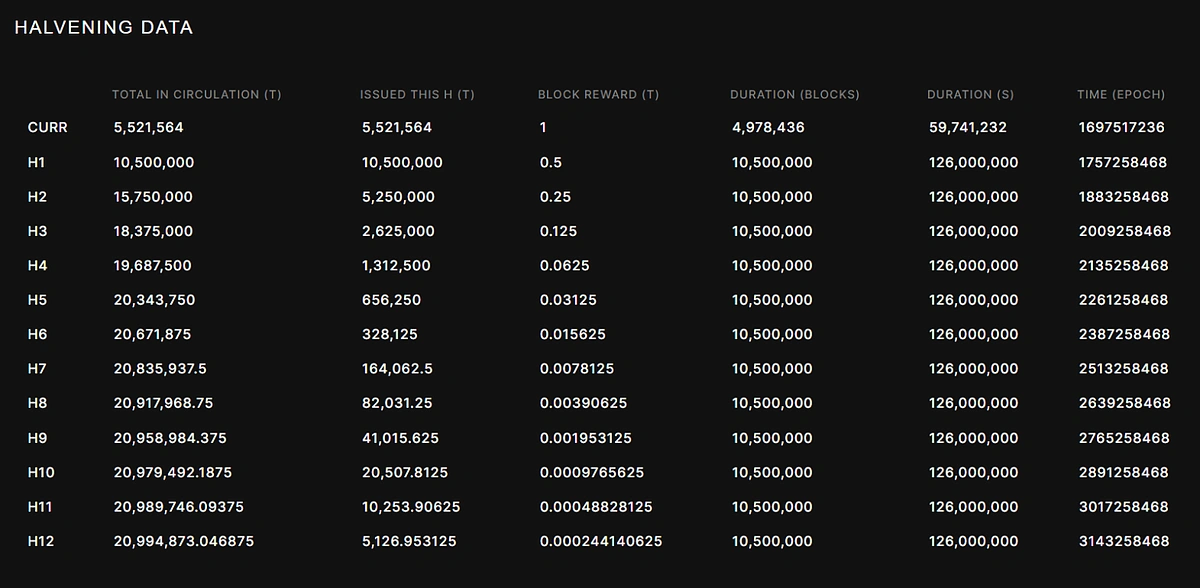
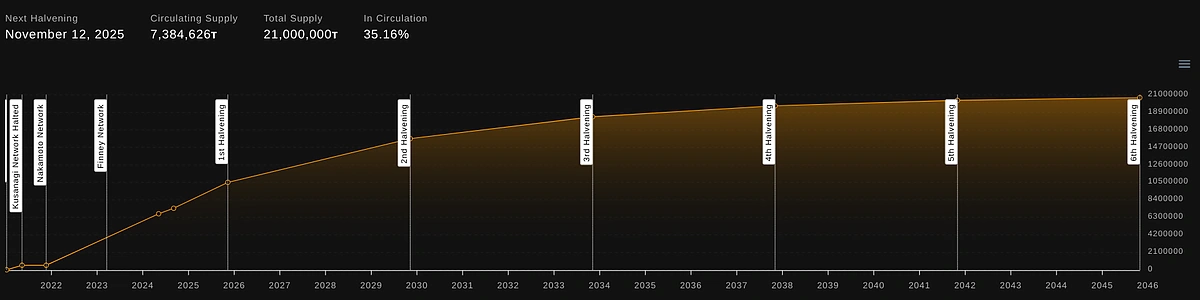
The total supply of TAO is capped at 21,000,000𝞃, just like BTC. Another similarity with bitcoin is that TAO’s issuance schedule also follows the concept of the halving, which occurs approximately every 4 years. However, this is determined by the total token issuance rather than block number. For example, once half of the total supply has been issued, the rate of issuance is halved.
The first-ever Bittensor halving is anticipated to occur around November 2025. This event will halve the block reward from 1 TAO per block to 0.50 TAO per block. When we look at TAO's full dilution it is planned to span over a century, also mirroring Bitcoin's emission schedule.
What Is TAO Used For?
Besides being used to incentivize supply-side participation and as demand-side payment it can also be used to delegate (stake) to specific validators, who in turn bond to specific miners. Anyone with TAO tokens can engage in staking by delegating to a preferred validator and earn if the validator earns commissions.
TAO validators receive a validating Annual Percentage Rate (APR) based on total validator emissions for all validators across the network but it does not account for differences in validator performance or subnet allocation.
How Do I Delegate My TAO?
To delegate your TAO tokens, you can use the Taostats platform if you have a PolkadotJS wallet. This platform enables safe delegation and un-delegation procedures.
-
The minimum amount you can delegate is 0.1 TAO.
-
Each coldkey/hotkey pair can perform only ONE transaction per 360 blocks, which is approximately every 72 minutes.
You can choose a validator at the following page: Taostats Validators.
TaoBridge
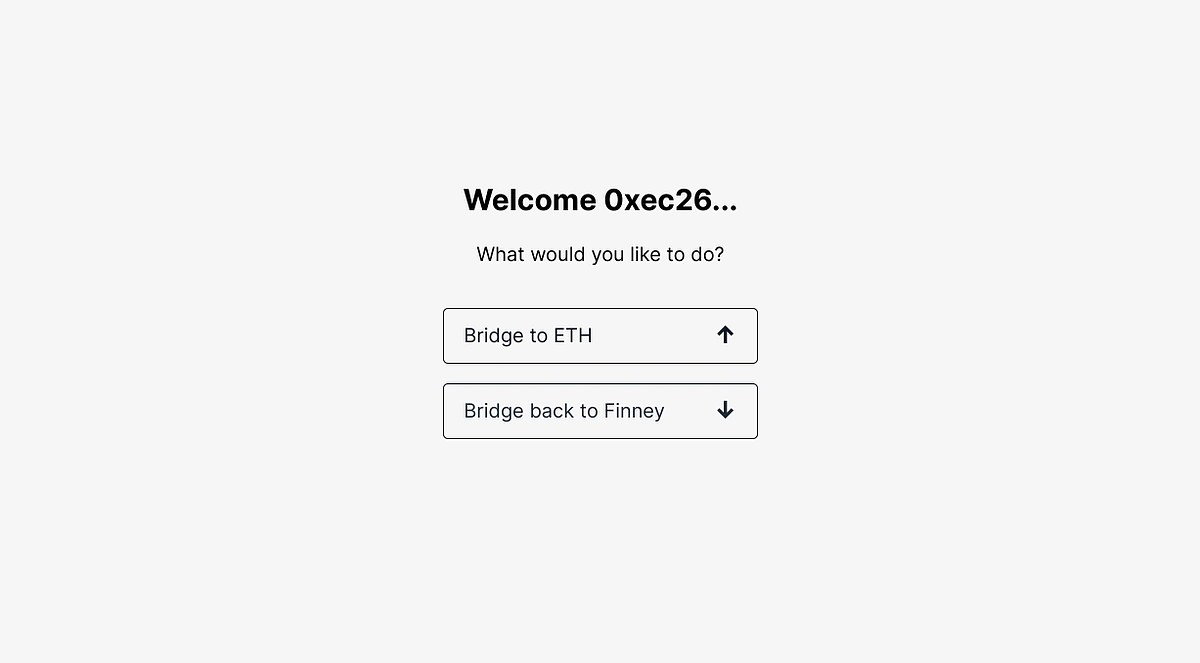
The TAO bridge and wTAO tokens were created by the Bittensor community and allows users to bridge assets between Bittensor and Ethereum network in a permissionless manner and without limitations of centralized exchanges.
Dynamic TAO—dTAO
On February 14, 2025, Bittensor introduced dynamic TAO (dTAO) and with it, emissions are no longer assigned through validator weightings. Instead, they flow through a market-driven system using subnet tokens, or Alpha tokens.
The price of these tokens reflects market demand for a subnet, with higher demand leading to more TAO emissions.
Subnets now have to earn TAO by generating real demand for their own tokens (Alpha tokens), which creates a more competitive environment where success has to be earned.
Before dTAO, Bittensor faced several issues, such as:
-
Validator Bottlenecks: As more subnets launched, top validators struggled to keep up.
-
Conflicts of Interest: Some validators assigned higher weights to their own subnets, inflating their rewards.
-
Poor Coordination: Validators' weighting methodologies didn't always align with the network's broader goals, and stakers had no direct say in the emission allocation (now they do).
Now with this new upgrade they aim to create a more decentralized and incentive-aligned system for determining the value of individual subnets. Under the current system, validators determine which subnets receive emissions based on their perceived value.
Participants who wish to stake and receive emissions from a specific subnet will need to stake Tao and receive a portion of that subnet's token in return. This allows market participants to support and speculate on a variety of "AI markets," and creates a more free, merit-based system.
Conclusion
Bittensor is applying the incentive model that drove Bitcoin's success to the realm of machine intelligence. It rewards the production and quality of AI within its own peer-to-peer network and operates on the principle that machine intelligence can be measured and monetized through interactions among diverse intelligence systems.
With scores recorded on a blockchain, and where successful contributors earn rewards based on their network weight they create a blockchain marketplace for AI that could fundamentally change the way we approach machine learning.
Chamath name drops Bittensor $TAO as a project he is “looking into” pic.twitter.com/C2GUoaBIni
— Lucky ☘️ (@LuckyXBT__) July 23, 2024
A BittensorBitTensor Summit called ‘Endgame’ , is taking place from April 25-27, 2025, at the Distribution Hall in Austin, TX. Here anyone can learn more and can dive deeper into the world of decentralized AI and connect with top builders of DeAI.
For those looking to delve deeper into the specifics of TAO, taostats.io is the go-to resource for real-time statistics and analytics.
This article is only for informational purposes and should not be taken as financial or investment advice. Always do your own research before investing in any cryptocurrency or project.







 Or check it out in the app stores