





 Make us preferred on Google
This article is brought to you by FBS.

Introduction
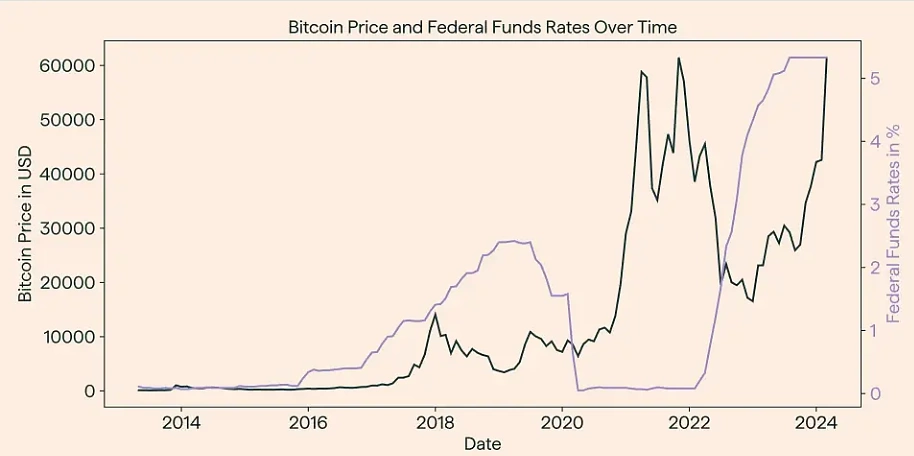
The US Federal Reserve's key interest rate decisions have a wide-reaching impact, influencing global markets, including cryptocurrencies like Bitcoin. The crypto market, often seen as a hedge against traditional assets, reacts dynamically to rate hikes and cuts. As the Federal Reserve shifts its monetary policy, it causes ripples in the demand, volatility, and liquidity of cryptocurrencies, which investors need to monitor carefully.
How Interest Rates Affect Cryptocurrency
Interest rate hikes and cuts impact the cryptocurrency market differently, mainly depending on investor sentiment and the broader economic context. Rate cuts tend to fuel optimism as it increases liquidity in the market, leading to higher risk-taking and increased demand for speculative assets like Bitcoin. Conversely, rate hikes tend to reduce liquidity, making riskier assets less attractive. Let’s take a closer look at the two scenarios — rate hikes and rate cuts — and their different impacts on the crypto market.
What Happens During Rate Cuts?
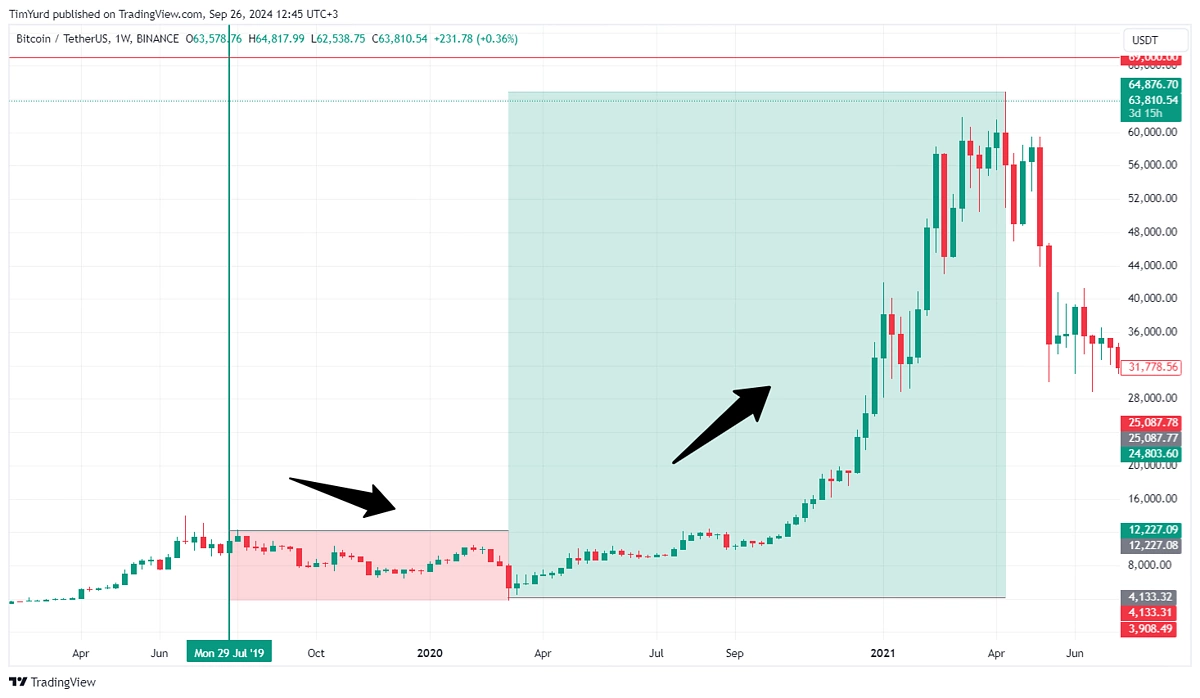
A central bank or Fed's decision to cut rates is usually a sign that the economy is weakening. When the Fed cuts rates, borrowing becomes cheaper, which tends to encourage risky investments, including cryptocurrencies.
Historical data shows that when the Fed cut rates by 0.25% in 2020, Bitcoin initially experienced a 60% correction, followed by a remarkable 1,600% surge throughout the year. Lower interest rates tend to drive investors away from traditional savings vehicles toward more speculative assets like cryptocurrencies. Bitcoin, in particular, benefits as a safe-haven asset during inflation fears, especially when those fears coincide with falling interest rates.
A research report by S&P Global supports this thesis by emphasizing the pronounced correlation between Bitcoin price fluctuations and monetary policy adjustments. Indeed, periods of low interest rates are associated with rising prices, while rapid rate hikes lead to declines, reflecting broader market trends.
Why Rate Hikes Trigger Declines in Crypto
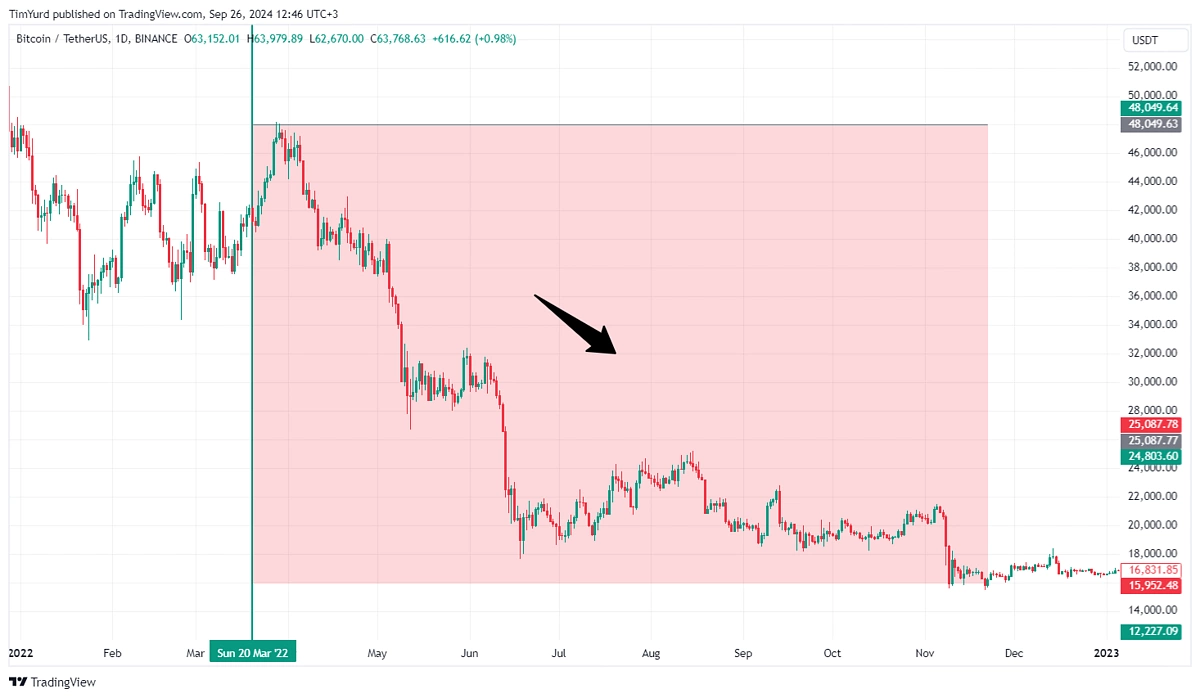
On the other hand, rising interest rates have the opposite effect. As Cointelegraph notes, rising interest rates squeeze liquidity in financial markets, making risky assets like cryptocurrencies less attractive. Rising rates increase yields on low-risk fixed income instruments, prompting investors to pull capital out of volatile assets like Bitcoin.
Cryptocurrencies have responded to the decrease in liquidity like other risk assets: they fell when the Fed announced its intention to raise rates in November 2021 and then throughout 2022 when the Fed aggressively followed through on its promise. In addition, the collapse of cryptocurrencies such as LUNA / UST, and exchanges like FTX has undermined traders' confidence in these virtual assets. Bitcoin's price fell about 65% at the time.
Markets are currently consolidating as the pace of rate cuts and the health of the US economy remain unclear.
Bitcoin is actively moving on expectations: while the markets were expecting a rate hike, Bitcoin was falling, but as soon as the Fed stopped raising rates, the markets started pricing in a rate cut, which caused the price to rise.
At the moment, the markets are consolidating since the speed of the rate cut and the state of the US economy are not entirely clear. But as the Fed begins to ease its monetary policy after a period of tightening, a rise in Bitcoin’s price seems inevitable. However, in the short term, it may still go into a correction.
Thus, when the economy is expected to improve, risky asset classes like equities and crypto are also expected to rise together, driven by positive investor sentiment and increased liquidity. However, when rates rise mainly due to monetary policy tightening to combat inflation, the cost of capital increases. As a result, risk-on assets like Bitcoin lose their appeal, causing their value to fall as rates continue to rise.
Other Factors
US Treasuries
Cryptocurrency was often advertised as a panacea for all problems, be it inflation, low interest rates, lack of purchasing power, or the devaluation of the US dollar. These positives were easy to believe, while cryptocurrency was growing seemingly independently of other assets.
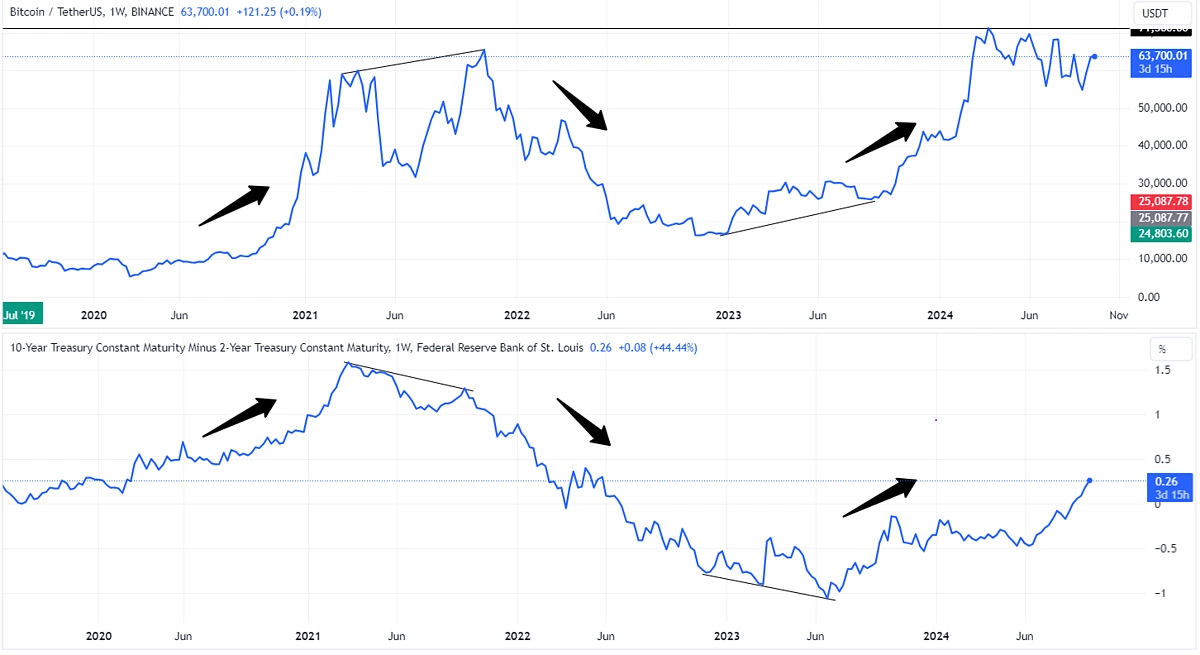
It is interesting to look at the correlation between Bitcoin's price and the yield curve spread between 10-year US Treasuries and 2-year Treasuries. Divergences between the assets lead to a corresponding correction in Bitcoin's price.
As far as we know, when short-term US bonds become more profitable than long-term ones, this is called an inversion of the yield curve. Under normal circumstances, long-term bonds offer higher yields, as investors focus more on riskier assets, such as Bitcoin, 2-year bonds, stocks, etc in the short term. However, when the yield curve inverts, i.e. when short-term bond yields are higher than long-term bonds, it’s a sign that investors are jittery about the state of the economy and may exit risky assets, including Bitcoin.
On the contrary, an increase in the yield of long-term bonds over short-term ones (which we are seeing now) gives a positive signal for risky instruments such as cryptocurrencies.
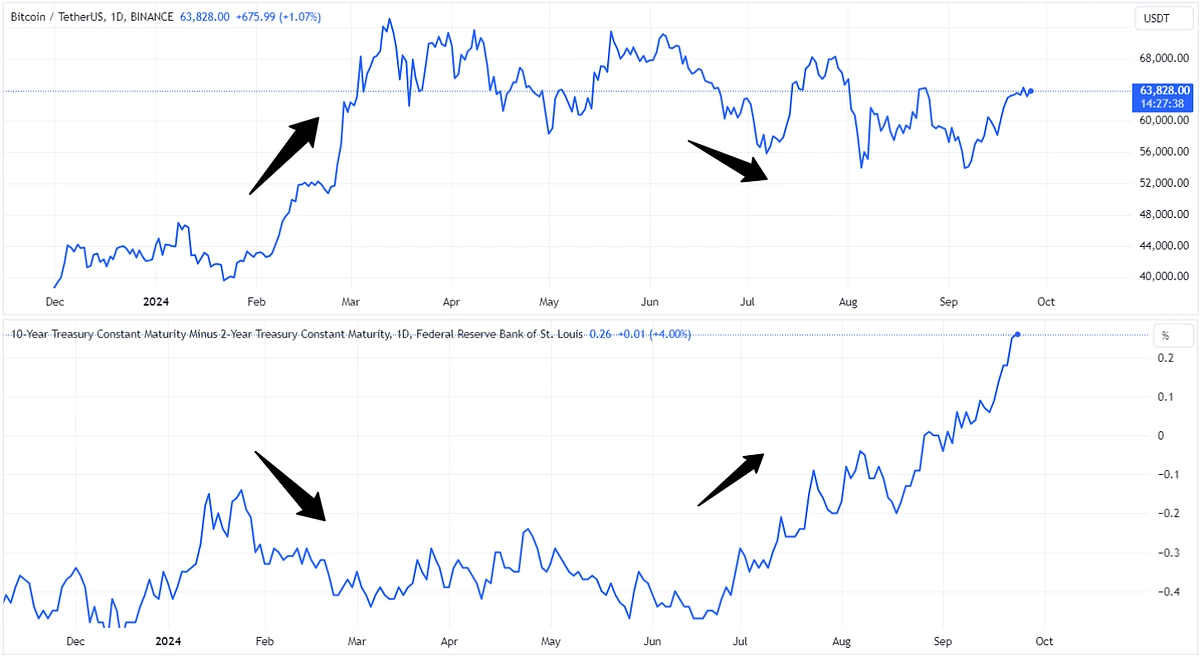
A closer look indicates that this last Bitcoin’s range is also lagging behind the yield curve spread (shows a divergence). Further synchronization of these assets, with falling inflation and, accordingly, interest rates, may give hope for Bitcoin growth in the medium and long term.
Bitcoin Buying by Institutional Players
Institutional interest in Bitcoin has surged, with hedge funds and asset managers viewing it as a hedge against fiat currency devaluation and a key diversification tool. The increasing demand for Bitcoin ETFs highlights this trend as institutions seek regulated exposure. According to Reuters, this institutional backing is expected to support Bitcoin's price stability and future growth, contributing to potential bull rallies. The influx of institutional capital has been crucial for Bitcoin’s market growth, helping it maintain high price levels and providing long-term confidence in the asset’s value.
This suggests that while Bitcoin does respond to changes in the federal funds rate, it does not do so in isolation. The impact of interest rates must be viewed through the lens of broader market conditions, institutional interests, and regulatory changes.
Macroeconomic Factors
China recently introduced a massive stimulus package that included cutting interest and mortgage rates, freeing up liquidity, and pledging over $100 billion to support the stock market. This comprehensive move could significantly impact global markets, boosting risky, liquidity-sensitive asset classes like stocks, gold, and Bitcoin. Analysts believe that, if successful, it could also drive inflation upward, which has been hovering just above zero. This departure from China’s usual incremental approach marks a major shift in its economic strategy, and its global ripple effects will be closely watched.
Bitcoin’s Role as a Hedge Against Inflation
Bitcoin's fixed supply of 21 million coins positions it as a strong hedge against inflation. Unlike fiat currencies, which governments can print, Bitcoin’s scarcity ensures its value is protected from inflationary pressures. This became evident in 2021 when US inflation soared to 7%, and Bitcoin appreciated by over 300%, acting as a safeguard against currency devaluation.
Bitcoin shares characteristics with gold, often called "digital gold," as both seem to act as stores of value during periods of high inflation. Its decentralized nature ensures it remains immune to government monetary policies that often trigger inflation.

Historical trends from the 1970s show inflation developing in three waves, and experts suggest history might repeat itself. This could result in further growth for Bitcoin, similar to gold's rise during inflationary periods.

The inverse correlation between Bitcoin and the U.S. dollar is also crucial. When the dollar weakens, Bitcoin often strengthens, making it an attractive alternative. This inverse relationship, much like that between gold and the dollar, suggests that Bitcoin may continue to serve as a hedge against fiat currency fluctuations.
Despite short-term crypto market fluctuations reacting to Federal Reserve interest rate policies, Bitcoin’s medium-to-long-term outlook is promising as an asset that can offset inflation costs and maintain its value as a secure investment. This quality makes it attractive to those looking to preserve their purchasing power in times of economic uncertainty.
Mid-Term Impacts on Crypto
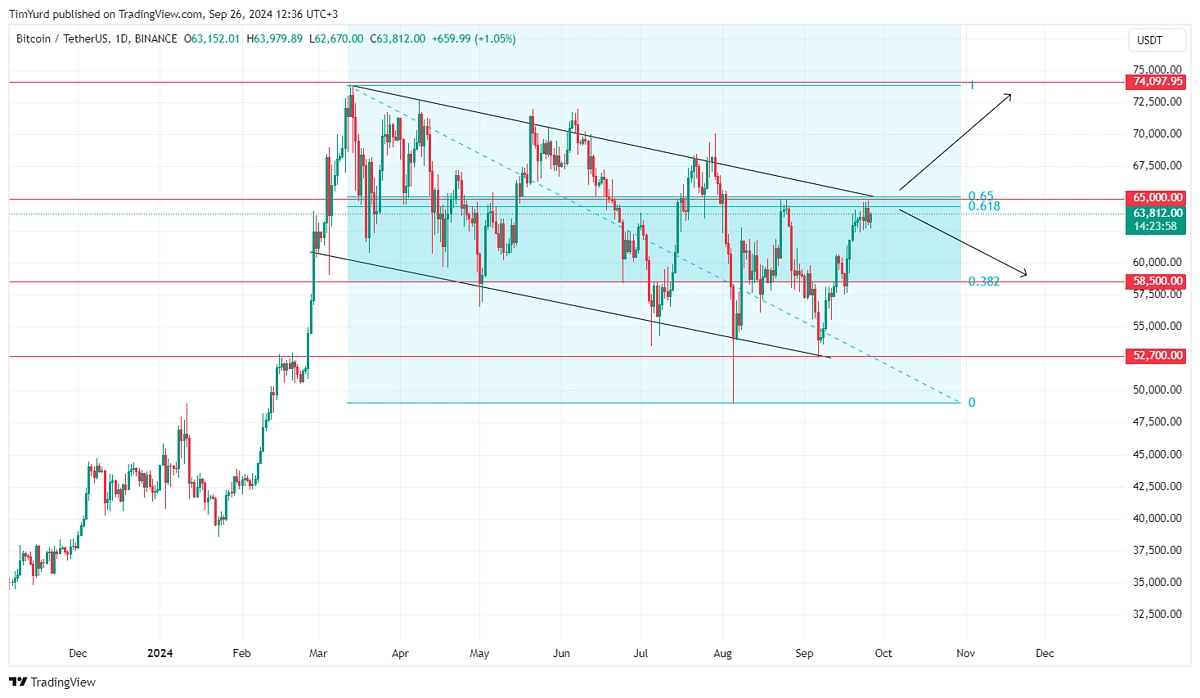
Based on the above fundamental analysis and paying attention to the technical data on the chart, we see the following picture: In the medium term, on the daily timeframe, Bitcoin has been moving in a descending channel since March 2024.
The price faces crucial resistance at the golden Fibonacci pocket, and a break above the upper border of a channel may lead to a bullish signal for the cryptocurrency market and a possible return to the previous ATH (all-time high) at 73500. However, if a corrective scenario occurs, the price could instead fall to the 58500 support, aligned with the 38.2 Fibonacci ratio.
Long-Term Impacts on Crypto
In 2024, Standard Chartered analysts repeatedly published forecasts on the movement of the Bitcoin exchange rate. In April, they hypothesized that the price of BTC would grow to $150,000 by the end of this year.
Experts of the brokerage company Bernstein also believe that the main cryptocurrency's quotes will surpass the historical maximum of $80-90,000 by the end of the fourth quarter.
Also, Anthony Scaramucci, Founder of hedge fund SkyBridge Capital, said that the Bitcoin rate may reach a record $100,000 by the end of this year.
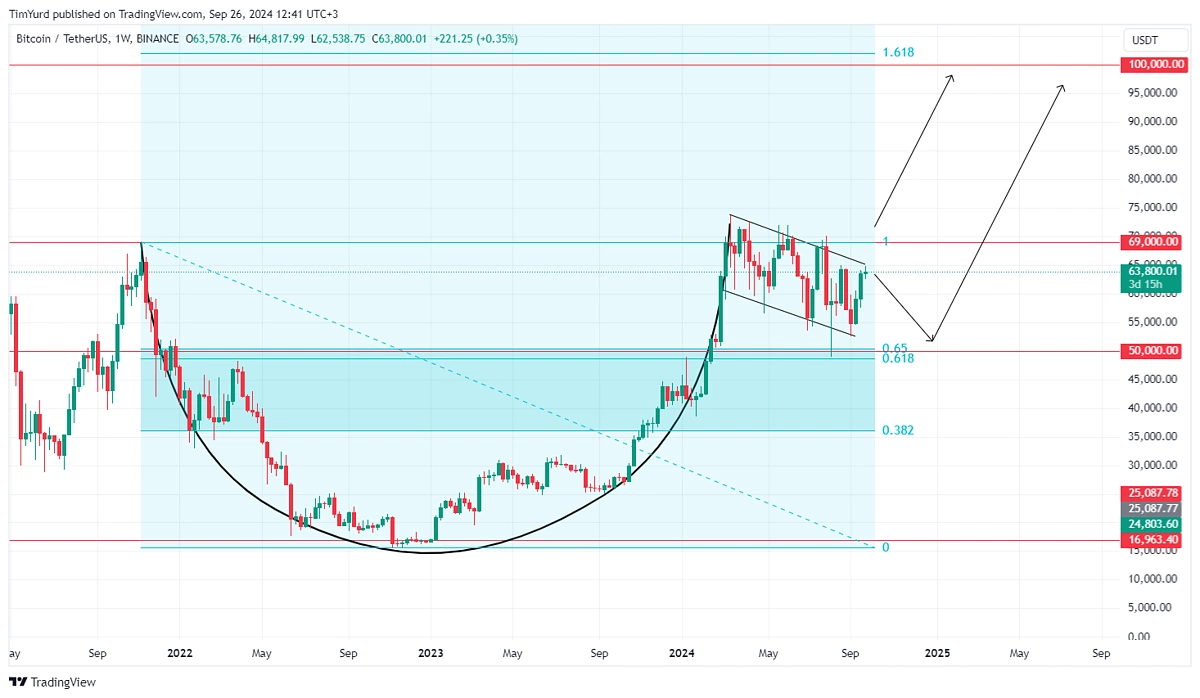
This coincides with the forecast of FBS analysts based on the technical analysis of the Weekly Bitcoin chart. The $100,000 level coincides with the 161.8 Fibonacci level at the breakout of the cup-and-handle pattern. However, a potential corrective move could first reach the 50,000 zone followed by a rise to a new ATH.
Conclusion
The US interest rate changes, particularly cuts, tend to boost Bitcoin and the broader crypto market, as lower rates encourage riskier investments. Historical data shows that Bitcoin often rallies after rate cuts, driven by investor interest in speculative assets and concerns over inflation. While rate hikes tighten liquidity and cause declines, Bitcoin's long-term potential remains strong, with analysts predicting substantial gains by the end of 2024. As both a hedge against inflation and a speculative asset, Bitcoin’s future largely depends on broader economic trends and Federal Reserve policies.
This article is for informational purpose only and should not be taken as financial advice. Always do your own research before investing in any cryptocurrency.








 Or check it out in the app stores