





 Make us preferred on Google

This article is contributed by Injective.
Perpetual markets began as a crypto-native invention. Their next phase is turning equities, commodities, currencies, indices, and private-market references into programmable markets.
Perpetual futures solved an early crypto problem: how can traders take long or short exposure in a market that never closes without constantly rolling an expiring contract? The answer was a derivative with no expiration date, anchored to an index through funding payments.
That structure is now moving well beyond crypto. Equities, commodities, foreign exchange, indices, and pre-IPO references are becoming available through the same onchain market infrastructure that traders already use for Bitcoin and other digital assets. CoinGecko found that the market for actively traded crypto representations of traditional assets expanded from $1.41 billion to $6.59 billion over the last year and a half. Trading volume reached $1.45 trillion in the first half of 2026, while open interest in traditional-asset perpetuals rose as high as $4.67 billion.
Injective offers one of the clearest examples of this expansion, with 135 active RWA perpetual markets quoted against native USDC across equities, commodities, foreign exchange, indices, and pre-IPO references. That breadth rests on an exchange, oracle, liquidity, and risk stack built directly into the network, giving new markets access to infrastructure that would otherwise have to be assembled market by market.
Key Findings
-
Perpetuals provide long and short price exposure without requiring the underlying stock, commodity, or currency to be wrapped, custodied, or pre-funded on the network.
-
Injective offers 135 active RWA perpetual markets, including 111 equity markets, 11 foreign-exchange markets, nine commodity markets, two indices, and two pre-IPO references.
-
Injective's RWA perpetual markets have generated more than $5.3 billion in cumulative onchain volume since early 2025.
-
Monthly RWA perpetual volume reached $186.5 million in July 2026 and $209.7 million in August, the two strongest full months of the year. August volume was 3.4 times May's level.
-
Selected U.S. equity markets use a unified 24/5 oracle stream that combines pre-market, regular, after-hours, and overnight pricing, with updates approximately every two seconds.
-
Injective places orderbook management, matching, settlement, margin, liquidation, oracle pricing, and insurance at the protocol level. Applications can reach the same canonical markets without rebuilding that stack.
-
Native USDC and an onchain orderbook that can be shared across applications give participating venues a common settlement asset and liquidity layer.
Snapshot
|
Metric |
Value |
|
Active RWA perpetual markets |
135, all quoted against native USDC |
|
Active markets by class |
111 equity; 11 FX; 9 commodity; 2 index; 2 pre-IPO |
|
Cumulative RWA perpetual volume since early 2025 |
More than $5.3B |
|
July 2026 RWA perpetual volume |
$186.5M |
|
August 2026 RWA perpetual volume |
$209.7M |
|
RWA perpetual volume, 2026 year to date |
$845.9M |
Source: Injective public mainnet data, compiled by Injective Research, as of September 1, 2026.
1. Perpetuals Are Becoming a Global-Market Product
A perpetual future tracks a reference price without expiring. Traders post collateral, take a long or short position, and settle profit and loss in the market's quote asset. Funding payments are periodic transfers between long and short traders. When the contract trades above its index, longs typically pay shorts; when it trades below, shorts may pay longs. This encourages the market price to stay close to the reference price.
For crypto assets, that design created a market that could operate continuously without the quarterly expirations familiar from traditional futures. For global assets, the same design brings price exposure onchain without first recreating the underlying asset as a transferable token.
An equity perpetual is designed for trading and hedging rather than shareholder ownership. Tokenized securities address issuance and ownership; perpetuals address price exposure, leverage, liquidity, and risk transfer. Each product serves a distinct financial purpose.
The addressable market is wider than equities. The same engine can support indices, metals, foreign exchange, oil, or an implied private-company valuation when an appropriate price source and risk framework exist.
2. Why Global Assets Fit the Perpetual Model
The first advantage is speed of market formation. Tokenizing an underlying security can involve custody, legal claims, transfer restrictions, corporate actions, and jurisdiction-specific distribution. Perpetuals take a different route by creating a purpose-built market for price discovery, hedging, and risk transfer without requiring the underlying security itself to be issued onchain.
The second advantage is two-sided access. The same product can express a bullish or bearish view. A portfolio with technology-stock exposure, for example, can use an index or single-name perpetual to offset part of that risk without moving the portfolio onchain.
The third advantage is capital efficiency. Perpetuals are margined products, so traders post a fraction of the position's notional value rather than paying the full value upfront. Leverage magnifies losses as well as gains, but it allows a smaller amount of collateral to support a larger exposure. Stablecoin settlement gives otherwise unrelated markets a common unit of account.
The fourth advantage is programmability. Applications can route orders, monitor margin, automate strategies, or combine exposures. Injective's iAssets framework describes these markets as programmable primitives built for position-based exposure and cross-market composability.
3. Injective Is Turning Market Breadth Into Measurable Activity
Onchain data as of September 1 shows 135 active RWA perpetual markets on Injective: 111 equity markets, 11 foreign-exchange markets, nine commodity markets, two indices, and two pre-IPO references. All were quoted against native USDC, the shared settlement asset for this market roster.
The trading history now provides evidence alongside the market count. Injective's RWA perpetual markets have generated more than $5.3 billion in cumulative onchain volume since early 2025 and $845.9 million in 2026 year to date. Monthly activity accelerated into the third quarter. Volume rose from $61.4 million in May to $95.6 million in June, $186.5 million in July, and $209.7 million in August. August was the strongest full month of 2026 and reached 3.4 times May's volume.

Figure 1. Monthly Injective RWA perpetual volume, January through August 2026. Source: Injective public mainnet data, compiled by Injective Research, as of September 1, 2026.
The July and August increase is particularly relevant because it followed the expansion of the market roster. More listings do not guarantee more trading, but this sequence shows breadth and usage moving in the same direction. Injective is progressing from an early collection of equity experiments toward a multi-asset venue with repeat activity across a much larger set of global references.
4. Why Onchain RWA Perpetuals Are Difficult
RWA perpetuals combine the demands of traditional market data with the demands of a leveraged, continuously operating onchain venue. A credible product has to solve several problems at once.
Markets follow different clocks. U.S. equities move through pre-market, regular trading, after-hours, and overnight sessions. Commodities follow futures calendars and contract rollovers. Foreign-exchange markets operate on a different weekly schedule. The blockchain continues producing blocks through every session boundary.
External prices drive onchain risk. The index price influences funding, margin, and liquidation. Feed gaps or abrupt session switches can therefore affect much more than a chart. They can change the risk state of every open position.
Liquidity can fragment quickly. A broad market roster becomes less useful if every application creates a separate pool or if liquidity providers must integrate with a different matching system for each frontend. RWA markets also need dependable quoting during extended hours, when the underlying market may be thinner.
Leverage requires coordinated safeguards. Margin rules, liquidations, insurance, settlement collateral, position parameters, and oracle behavior must work together. Building each component inside an application increases engineering complexity and makes consistency harder to maintain across markets.
Injective's architectural advantage is that these functions already operate as shared network infrastructure. A market can plug into a canonical oracle, onchain orderbook, matching engine, margin system, liquidation process, insurance module, and native settlement asset. The application layer can then focus on distribution, portfolio design, and user experience.
5. Injective Extends Equity Price Discovery Across the Trading Week
Selected U.S. equity markets on Injective use SEDA to combine four Pyth session feeds into one continuous 24/5 oracle stream. The system selects the appropriate feed for pre-market, regular trading, after-hours, or overnight activity, applies continuity checks, and publishes a unified price approximately every two seconds.
This stream becomes the canonical index price for the market. Trading interfaces, margin calculations, mark prices, and liquidation logic can reference the same value rather than managing separate session feeds independently. Injective's documentation identifies cleaner transitions, more consistent mark pricing, and better risk modeling as direct benefits of the design.
The result is an equity market that can follow price discovery across the full weekday cycle. Traders and liquidity providers do not have to wait for the regular U.S. session to see the index respond, and developers do not have to stitch four data products together inside every application.
The oracle pauses over the weekend in line with the underlying equity market structure, while iAsset trading can remain available. That creates gap risk into the next pricing session, but the behavior is explicit and shared across the venue. Injective has turned session management from an application-specific integration problem into a network-level service.
6. What Traders Need From an Onchain Global Venue
Global perpetual markets need more than broad asset coverage. Orders must be processed quickly, settlement must be predictable, and transaction costs must remain low enough for traders to adjust risk frequently.
Injective addresses those requirements through its native exchange module. Orderbook management, trade execution, matching, derivative position updates, and settlement occur onchain through protocol logic, with direct connections to the oracle and insurance modules.
Orders are matched through a frequent batch auction at the end of each block. New orders in the same batch receive a uniform clearing price, making the system MEV-resistant by limiting opportunities to exploit transaction ordering. This gives traders a fairer and more transparent matching process while retaining the familiar performance of an orderbook market.
Injective's broader performance profile matters to traders as much as its modular design. Official network specifications published in April 2026 list 650-millisecond blocks, instant finality, sustained throughput of 25,000 transactions per second, and a standard transaction fee of about $0.0003. Alongside real-time market-data streaming, those characteristics support rapid order updates, automated liquidity strategies, and other latency-sensitive activity while keeping execution and settlement onchain.
Native USDC reinforces that common foundation. Circle-issued USDC is available across Injective's EVM and Cosmos environments through the MultiVM Token Standard (MTS), without wrapping between them. It can be used as derivatives collateral and as a settlement currency, giving the 135-market RWA roster one consistent quote asset across application environments.
7. Liquidity and Risk Determine Whether Market Breadth Can Scale
Listing global assets is only the first step. A useful venue needs competitive bids and asks, usable depth, and safeguards capable of handling leverage and external price shocks.
Injective's onchain orderbook can be shared across applications. A trading frontend, automated strategy, EVM application, or WASM application can choose to access the same canonical market instead of bootstrapping a separate liquidity pool. When applications use this shared infrastructure, new distribution can reach existing orders rather than dividing liquidity into another venue.
That model is especially useful for RWA markets, where liquidity can be thinner outside the primary session. Traders see one consolidated source of bids and asks, while liquidity providers can quote once and reach users across multiple participating applications.
Risk controls sit alongside execution. Every derivative market defines initial and maintenance margin requirements. Positions that breach maintenance requirements can be reduced through liquidation, and liquidations are processed before regular order matching within the block. Market-specific insurance funds can be underwritten permissionlessly; positive-equity liquidations add to the fund, while the fund can cover missing equity when a position passes bankruptcy.
Together, these systems show what a global perpetual venue needs as its market roster expands. Injective's native financial architecture offers one implementation in which oracle pricing, orderbook liquidity, margin, liquidation, insurance, and settlement can operate as connected services.
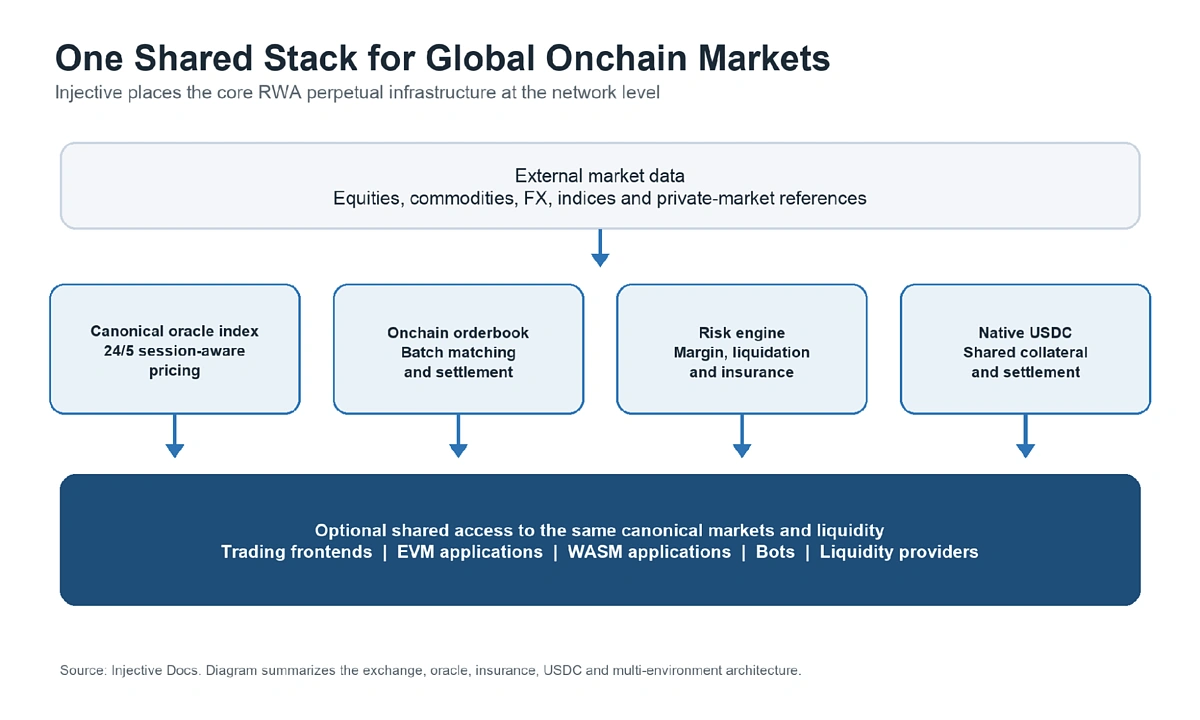
Figure 2. Injective packages the core RWA perpetual stack into shared network infrastructure. Source: Injective Docs.
8. What Global Onchain Perpetuals Make Possible
Once equities, commodities, currencies, indices, and crypto assets share an onchain trading environment, traders can manage cross-asset exposure without moving between disconnected venues. A crypto portfolio can hedge with an equity index, a commodity position can be paired with a currency view, and each exposure can settle through the same stablecoin-based system.
Programmability extends those possibilities. Applications can package several markets into portfolio interfaces, automate hedges, monitor margin across strategies, or build products around relationships between asset classes. The underlying stocks, commodities, or currencies do not have to be transferred onchain for these strategies to exist.
Injective illustrates how that model can be distributed across different application environments. Its shared infrastructure is available from both EVM and WASM on one unified chain. Solidity and Rust developers can build different experiences around the same exchange, oracle, liquidity, and settlement layer, while MTS keeps balances unified across environments.
This is the broader significance of Injective's 135-market roster. It shows how onchain perpetuals can develop from isolated crypto instruments into a reusable market layer for global price exposure.
What to Watch Next
The first signal is whether the July and August acceleration continues across several quarters. The recent data already shows usage moving higher; sustained growth would confirm that the expanded roster is attracting recurring trading rather than a short burst of activity.
The second signal is liquidity quality by market. Spread, depth, uptime, and execution consistency matter most during thinner extended-hours sessions. Injective's shared orderbook gives the network a structural way to concentrate liquidity across applications, while market-level data will show how evenly quality develops across the roster.
The third signal is distribution. Growth should appear across trading frontends, EVM and WASM applications, and automated strategies, then register in active users, fees, and protocol revenue.
The final signal is product expansion. The strongest additions will deepen existing categories or introduce useful new exposures while making full use of the same oracle, liquidity, settlement, and risk infrastructure.
Reading the Market
Perpetual futures began as a crypto-specific solution. They are becoming a general market primitive because tradable exposure can be separated from the need to move every underlying asset onchain.
Injective shows why architecture matters in that transition. Its RWA markets draw on a chain-level exchange, unified oracle pricing, a shared orderbook, native USDC settlement, margin and liquidation logic, insurance funds, and multi-environment developer access. Those components let the network add global markets without rebuilding the venue each time.
The onchain record is beginning to reflect that foundation. Injective now supports 135 active RWA perpetual markets, has processed more than $5.3 billion in cumulative RWA volume, and recorded its two strongest full months of 2026 in July and August. The combination of market breadth, accelerating activity, and purpose-built financial infrastructure positions Injective as an emerging market layer for global onchain finance.









 Or check it out in the app stores