



 Make us preferred on Google
What Is the Ethereum Treasury Strategy?
Ethereum treasuries are corporate strategies where companies hold ETH on their balance sheets to earn 3% staking rewards while gaining blockchain exposure, making ETH a "productive asset" unlike traditional cash reserves or Bitcoin.
Key Takeaways
-
An Ethereum Treasury is a corporate strategy where institutions acquire and hold ETH as part of their financial reserves.
-
This lets them generate yield while offering blockchain exposure to their shareholders.
-
Unlike Bitcoin treasuries that act as a store of value, Ethereum treasuries can earn around 3% APY through staking rewards, making ETH a “productive asset.”
-
Ethereum staking and staking management are the major differences between Ethereum and Bitcoin.
-
About 19 publicly traded companies now operate Ethereum treasury strategies, collectively holding almost 3 million ETH worth approximately $13.2 billion.
On August 12, 2025, US-based mining firm BitMine Immersion Technologies announced their plans to raise up to $20 billion through stock sales to expand its Ethereum acquisition program. This aggressive expansion highlights the growing momentum behind corporate Ethereum treasury strategies, which companies only started adopting in June 2025.
Ethereum treasuries by publicly traded companies represent a rapidly evolving investment narrative. According to CoinGecko data, about 19 publicly traded companies now hold ETH as a strategic treasury asset, with collective holdings almost 3 million ETH worth over $13.2 billion at current market prices. This represents approximately 2.47% of Ethereum's total supply.
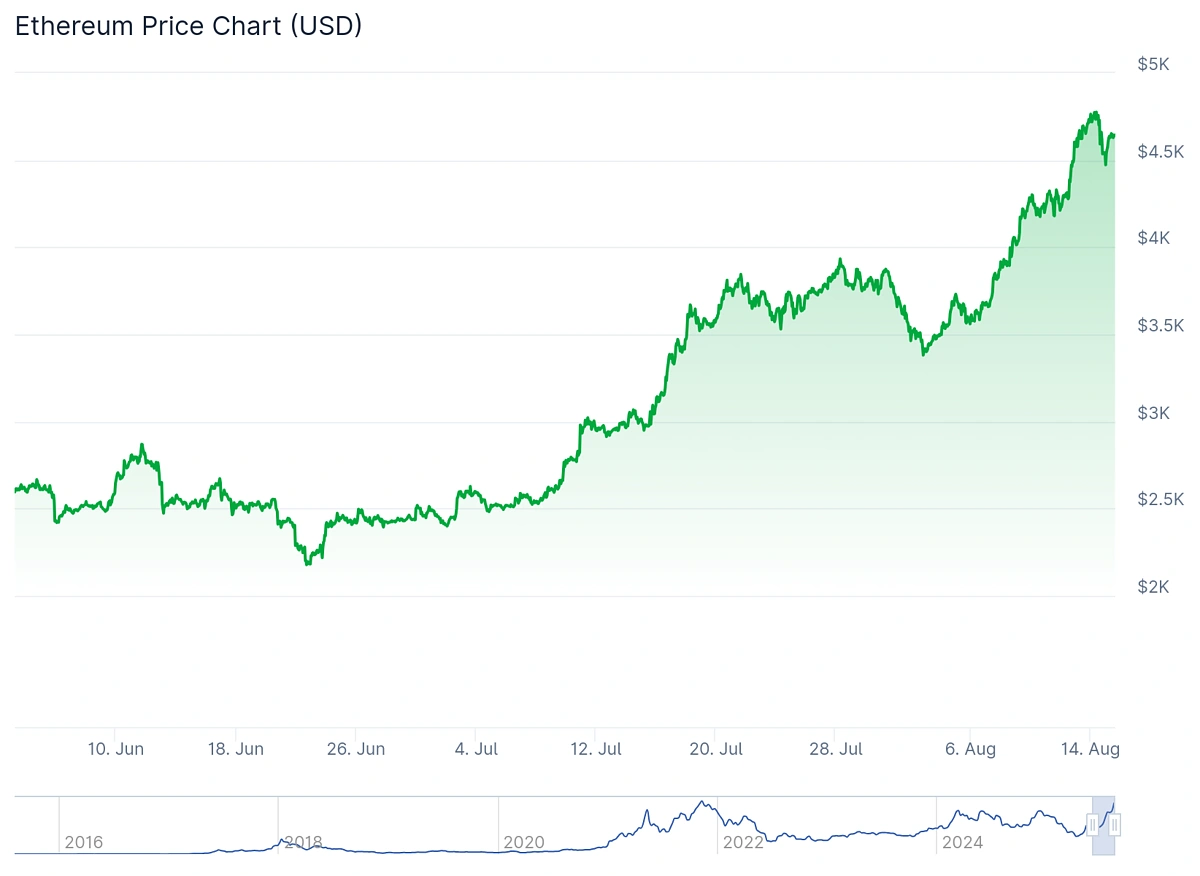
This trend has been a major catalyst for Ethereum's price surge. In the past two months, ETH has gained over 86%, trading above $4,700 for the first time since November 2021. While mainstream firms also hold Bitcoin in their treasuries, Ethereum presents unique yield-generation opportunities that constitute the key difference between BTC and ETH treasury strategies.
Understanding Ethereum Treasuries
Ethereum treasuries are corporate ETH holding strategies where publicly listed companies acquire and hold ETH as part of their balance sheet assets. Unlike traditional cash reserves, these holdings serve multiple purposes: hedging against inflation, offering shareholders exposure to blockchain technology, and most importantly, generating passive income through Ethereum's Proof of Stake mechanism.
This represents a fundamental shift from idle treasury management to active yield generation. Companies can stake their ETH holdings to earn rewards while maintaining their position in the asset, creating what analysts call a "productive treasury strategy."
How the Ethereum Treasury Strategy Works
The Ethereum treasury model follows a systematic approach that differentiates it from traditional asset holdings:
1. Capital Raising and Acquisition: Companies raise funds through At-The-Market (ATM) sales or Private Investment in Public Equity (PIPE) deals. ATM involves issuing new shares with SEC clearance and selling them publicly, while PIPE sells newly issued shares to private investors, often at a discount.
2. ETH Acquisition Process: Companies acquire ETH through over-the-counter (OTC) purchases or direct market purchases via partnerships with institutional-grade crypto exchanges. This approach minimizes market impact and ensures better execution for large orders.
3. Staking Strategy Selection: Companies choose between different staking approaches based on their liquidity needs and risk tolerance:
-
Native Staking: Running validators directly requires 32 ETH per validator and technical infrastructure but offers maximum rewards and control.
-
Liquid Staking: Using protocols like Liquid Collective or Lido allows companies to stake any amount while receiving liquid tokens (like stETH or LsETH) that can be traded or used in DeFi applications.
-
Institutional Staking Services: Platforms like Figment provide enterprise-grade staking infrastructure with slashing protection and compliance features.
4. Yield Generation and Management: Ethereum staking currently offers around 3% annual percentage yield (APY). Liquid staking solutions solve the traditional problem of locked assets by providing tradeable tokens representing staked ETH, enabling companies to maintain liquidity while earning staking rewards. This dual benefit allows treasury managers to generate yield without sacrificing operational flexibility.
5. Liquidity Management: Liquid staking tokens can be instantly traded on decentralized exchanges, restaked to secure other networks for additional yield, or used as collateral in DeFi protocols, providing companies with multiple exit strategies. Traditional staking requires a 7-day withdrawal period, but liquid staking eliminates this constraint while still capturing full staking rewards.
6. Revenue Optimization: Staking rewards create a passive income stream that companies can either reinvest to acquire more ETH or use for operational expenses, creating a compounding effect on their treasury holdings. Some companies deploy liquid staking tokens in additional yield-generating strategies, potentially increasing total returns beyond base staking yields.
Ethereum vs. Bitcoin Treasury Strategies
|
|
Ethereum Treasury |
Bitcoin Treasury |
|
Yield Generation |
Around 3% APY through staking |
No native yield capability |
|
Liquidity Options |
Liquid staking (instant) or 1-5 day withdrawals |
Instant market sales |
|
Operational Complexity |
Validator management, staking infrastructure |
Simple custody solutions |
|
Smart Contract Exposure |
High (DeFi protocols, restaking) |
Minimal technological risk |
|
Regulatory Framework |
Evolving (GENIUS Act benefits) |
More established precedent |
|
Market Precedent |
Growing institutional adoption |
Proven by MicroStrategy model |
|
Asset's Unique Proposition |
"Productive asset" generating cash flow |
"Digital gold" store of value |
The fundamental difference lies in Ethereum's ability to generate organic yield. While Bitcoin treasury pioneer Strategy's approach focuses on buy-and-hold value appreciation, Ethereum treasuries can earn consistent returns through protocol participation, making ETH a productive asset versus Bitcoin's store-of-value proposition.
Advantages of Ethereum Treasuries
Operating an Ethereum treasury strategy offers several advantages to public companies including:
Diversification
Ethereum represents a unique asset class that combines cryptocurrency characteristics with technological infrastructure exposure. By holding ETH, public companies diversify into a novel asset that has outperformed traditional assets over the past decade.
The recent 86% price surge demonstrates ETH's potential for capital appreciation while providing exposure to blockchain technology adoption. This dual benefit reduces portfolio risk while positioning companies at the forefront of digital transformation.
DeFi Access and Network Effects
Ethereum's smart contract capabilities provide treasury holders access to decentralized finance opportunities beyond simple staking. Companies can utilize lending protocols, liquidity farming, and yield optimization strategies unavailable to Bitcoin holders.
The GENIUS Act's regulatory clarity for stablecoins particularly benefits Ethereum treasuries. Since most stablecoins operate on Ethereum, increased stablecoin adoption drives transaction fees to the network, directly benefiting ETH holders through increased network value and potential fee burning mechanisms.
Passive Income Through Staking Rewards
Real-world results demonstrate the power of ETH staking for corporate treasuries. SharpLink Gaming earned 1,326 ETH through staking since launching its treasury on June 2, 2025—representing over $6 million in passive earnings in just two months.
Current ETH staking yields range around 3% APY, providing predictable cash flow that traditional treasury assets cannot match. With approximately 28% of all ETH now staked, this represents a massive institutional shift toward productive asset management.
Risks Facing Ethereum Treasuries
While Ethereum treasuries offer several financial and technological advantages, they also pose risks and challenges, including:
Slashing and Smart Contract Risks
Ethereum's Proof of Stake mechanism includes penalties called "slashing" for validator misbehavior. When validators experience extended downtime or commit protocol violations (double voting, proposing conflicting blocks), up to 10% of staked ETH can be permanently lost.
Smart contract interactions amplify risk exposure. Companies using liquid staking protocols, restaking platforms like EigenLayer, or DeFi yield strategies face additional technical vulnerabilities. Smart contract bugs, oracle manipulations, or protocol exploits could result in partial or total loss of deployed capital.
Liquidity Management Challenges
Native ETH staking creates liquidity constraints through required withdrawal periods. Traditional staking locks assets for up to 7 days during unstaking, potentially creating cash flow challenges during market stress.
Liquid staking solutions like Lido and Liquid Collective address this through tokenized representations (stETH, LsETH) that can be traded freely while earning staking rewards. However, these tokens may trade at slight discounts during market volatility, and the underlying protocols add smart contract risk layers.
Large treasury positions face additional constraints: the current stETH liquidity of approximately $274 million across DEXs may be insufficient for multi-billion dollar treasury exits during times of market stress.
Market Volatility and Regulatory Uncertainty
Ethereum's price volatility exceeds traditional treasury assets like gold and shares, creating balance sheet uncertainty. Mark-to-market accounting requirements, which values assets based on their current market price rather than historical cost, mean ETH holdings directly impact quarterly earnings through unrealized gains and losses.
Companies holding more than 40% of assets in investment securities risk triggering Investment Company Act regulations, requiring careful portfolio management to avoid unintended regulatory classification that could restrict operations and impose additional compliance burdens.
Top Ethereum Treasury Companies in 2025
Here are the top Ethereum Treasury companies to watch at the time of writing:
BitMine Immersion Technologies (BMNR): 3,032,188 ETH ($12.62 Billion)
BitMine leads the institutional ETH treasury movement with over 3 million ETH valued at approximately $12.6 billion, representing roughly 2.5% of Ethereum's total supply. Under Tom Lee's chairmanship and CEO Jonathan Bates' leadership, the company pivoted from Bitcoin mining to focus exclusively on Ethereum treasury strategy.
The company's aggressive acquisition approach includes raising $250 million through PIPE deals and filing for up to $20 billion additional stock sales capacity. BitMine's strategy centers on rapid ETH accumulation through capital markets while generating yield through institutional staking operations.
SharpLink Gaming (SBET): 838,728 ETH ($3.49 Billion)
Sports betting and online gaming marketer SharpLink Gaming ranks second globally with 838,728 ETH valued at almost $3.5 billion. The company appointed Ethereum co-founder and ConsenSys CEO Joseph Lubin as advisory committee chair, providing strategic guidance for its treasury operations.
SharpLink has demonstrated the earning potential of ETH staking, generating over 1,300 ETH in passive rewards since June 2025. The company raised over $425 million through private funding and increased its stock offering authorization from $1 billion to $6 billion to fund continued ETH acquisitions.
Bit Digital (BTBT): 150,244 ETH ($624.4 Million)
Mining firm Bit Digital executed a complete strategic pivot from Bitcoin to Ethereum, converting its entire corporate treasury from BTC to ETH by liquidating around 280 BTC to acquire additional ETH. Under CEO Sam Tabar's leadership, the company now holds over 150,000 ETH valued at around $624.4 million.
This transition exemplifies the growing institutional interest in Ethereum's yield-generating capabilities over Bitcoin's passive store-of-value model. Bit Digital's strategy focuses on becoming a pure-play ETH staking and treasury company among public firms, betting that Ethereum’s staking yield and tokenization boom will outstrip BTC’s price growth.
Coinbase Global (COIN): 136,782 ETH ($569.61Million)
Coinbase Global stands as the first major publicly traded company to hold Ethereum as a treasury asset, with around $569 million worth of ETH as of October 2025. However, the crypto exchange giant's approach differs from pure treasury plays—it integrates ETH holdings into operational functions while earning staking rewards through one of Ethereum's largest validator networks.
When Coinbase announced its multi-asset treasury strategy in 2021, it predicted that "more and more companies will hold crypto assets on their balance sheet." The company's dual-purpose approach provides both treasury yield generation and operational liquidity for its trading platform.
Final Thoughts
Ethereum treasuries represent a paradigm shift from passive to productive treasury management. While Bitcoin treasuries offer inflation hedging, Ethereum strategies provide both hedge capabilities and yield generation through staking rewards. This fundamental difference explains why almost 3 million ETH now sits in institutional wallets, creating unprecedented capital flow between traditional finance and cryptocurrency markets.
The opportunities are compelling: predictable yield generation, exposure to blockchain technology adoption, and potential for significant capital appreciation. However, success requires careful risk management around market volatility, technical complexities, and regulatory considerations.
As Standard Chartered predicts that treasury companies could eventually own 10% of all Ethereum, early adopters are positioning themselves at the forefront of a major institutional trend. For crypto enthusiasts, institutional adoption enhances Ethereum's credibility and supports long-term valuation growth, while traditional investors benefit from accessing blockchain technology exposure through established corporate structures.
Understanding Ethereum treasury fundamentals becomes crucial for investors evaluating companies pursuing this strategy, as it represents a new category of corporate financial management that could reshape how institutions approach treasury operations in the digital age.
Frequently Asked Questions
How do Ethereum treasury companies generate yield?
Companies stake their ETH holdings through validators or liquid staking protocols, earning around 3% APY from network rewards while maintaining their asset position.
What's the difference between ETH and Bitcoin treasury strategies?
Ethereum treasuries can generate organic yield through staking, while Bitcoin treasuries rely solely on price appreciation. ETH is considered a "productive asset" versus Bitcoin's "store of value" classification.
How do companies fund their ETH purchases?
Through ATM (at-the-market) stock sales or PIPE (private investment in public equity) deals, using proceeds to acquire ETH via OTC or institutional exchange purchases.
What are the main risks of ETH treasury strategies?
Key risks include market volatility, smart contract vulnerabilities, slashing penalties, liquidity constraints, and potential regulatory classification issues under the Investment Company Act.
How does the GENIUS Act impact Ethereum treasuries?
The Act provides regulatory clarity for stablecoins, most of which operate on Ethereum. This drives increased network usage and transaction fees, benefiting ETH holders.
Disclaimer: This article educates readers about Ethereum treasuries and does not constitute financial advice. Featured projects are not endorsed. Cryptocurrency investments in any form carry significant risks.









 Or check it out in the app stores