





 Make us preferred on Google
What Are Market Makers in Crypto?
Market makers serve as essential liquidity providers in cryptocurrency markets, facilitating efficient trading by continuously maintaining both buy and sell orders. In their absence, cryptocurrency trading would be significantly less efficient, requiring direct buyer-seller matches at exact price points, very similar to traditional real estate transactions.
Key Takeaways
- Market makers are essential liquidity providers, providing deep liquidity, tight spreads, and stable pricing, facilitating efficient trading by continuously and consistently maintaining buy and sell orders.
- Market makers operate independently from exchanges to prevent potential conflicts of interest.
- Market makers post orders to buy and sell assets at desired price points, while takers execute against these existing orders immediately.
The crypto market can be pretty intimidating, especially when you start diving into how trading actually works. One term you'll hear thrown around a lot is "market maker" – and understanding what these players do is crucial if you want to really get how crypto markets operate. Here's a look at their role in the crypto markets and how they operate and fuel the liquidity needed today.
The Basics: Introducing Market Makers?
Market makers are not a new concept as they are used in stocks, options, and forex or any other traditional TradFi market. Similar to TradFi, it’s crucial to verify that the market maker operates independently from the exchange to prevent any potential conflicts of interest.
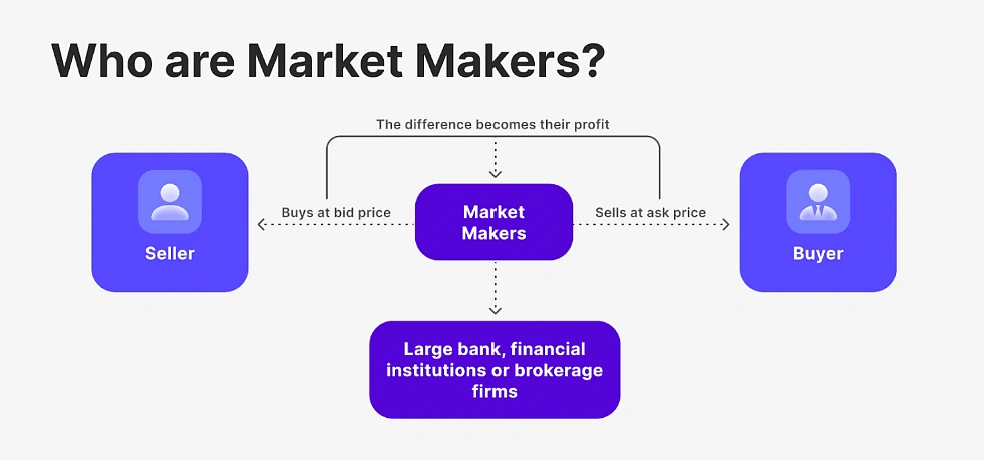
To illustrate this concept, let's say an investor wishes to purchase bitcoin (BTC) at $73,500. Without market makers, the transaction would be delayed until another participant specifically offers to sell at that precise price. That’s where market makers come in; they maintain continuous liquidity by simultaneously posting buy and sell orders across various price levels.
For example, a typical market making scenario would be:
-
A market maker posts concurrent orders to buy BTC at $73,450 and sell at $73,550.
-
The $100 difference between these prices constitutes the bid-ask spread, which represents their primary revenue mechanism.
-
This dual-sided quoting ensures continuous market liquidity for both buyers and sellers.
Market makers employ sophisticated inventory management strategies to maintain market stability. Through careful order book balancing (the balance between buy and sell orders), they hold strategic positions in both cryptocurrencies and fiat currencies. These strategies will also differ depending on the market. For instance, the way the futures market is managed will be different from the spot market, since futures are financial contracts.
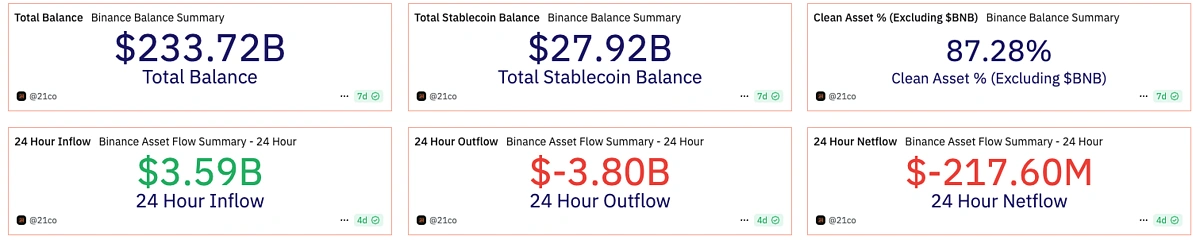
Major cryptocurrency exchanges like Binance rely heavily on market makers to ensure smooth trading operations. Market makers contribute a significant chunk to Binance’s balance (see above) which can be viewed as their “Proof-Of-Reserves”, ensuring users can withdraw their assets 24/7 with no interruption. Market makers are incentivized through programs such as Binance's Market Maker Program (this is different from the Binance VIP Program), which offers specialized fee structures and API benefits to qualified market makers who maintain substantial liquidity.
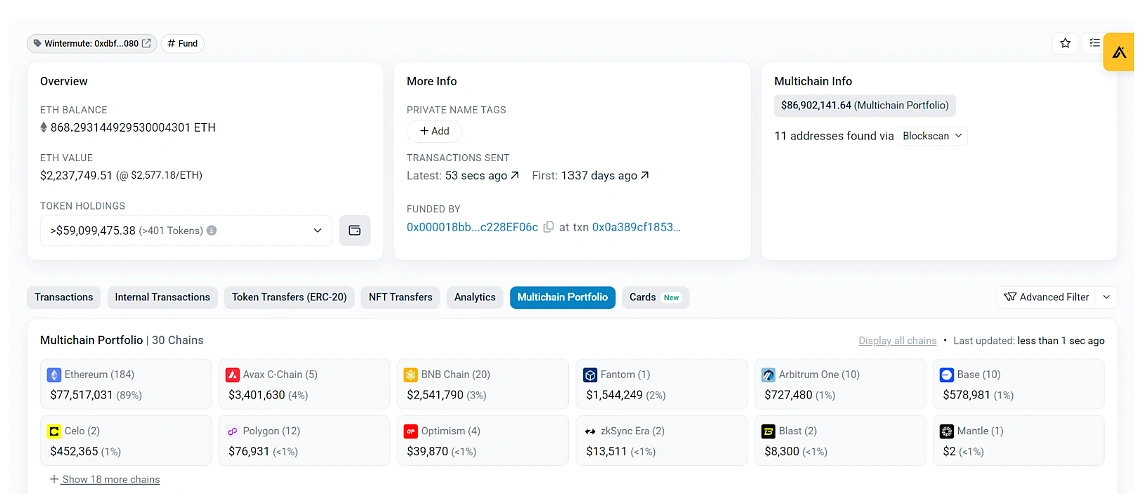
For example, Wintermute’s wallet has a good chunk of holdings on Binance which contribute to the liquidity of the exchange. These partnerships are often crucial in order for the exchange to maintain a consistent trading volume, reduce the price slippage on orders, and support new token listings or market pairs. These market makers also contribute towards Binance’s wallet reserves and holdings.
Market Makers vs. Takers
The distinction between market makers and takers is straightforward but crucial in crypto trading. Market makers post orders to buy and sell assets, setting their desired price points, while takers execute against these existing orders immediately.
Referring to the earlier example, when the market maker sets orders to buy Bitcoin at $73,450 and sell at $73,550, they capture a $100 spread when both orders fill. Takers, by accepting these prices through market orders, essentially pay this spread for the convenience of immediate execution. In fact, retail traders are considered market makers and takers too! When you submit a limit order on exchanges like Binance or a DEX, you participate as a market maker.
Traders also engage in market making and taking when using Automated Market Makers (AMMs). However, in AMMs, smart contracts rather than a centralized party or algorithm manage the spread and order flow.
In AMM-based crypto markets, trades occur within liquidity pools instead of directly between users. Each trading pair has a specific pool that adjusts its asset ratio as users buy or sell. These liquidity pools incentivize providers to deposit assets, helping to maintain continuous market liquidity.
Well-Known Institutional Maker Makers
These are some of the well-known powerhouse crypto market makers that provide the necessary liquidity for crypto markets to function 24/7 today. In 2024, several well-known TradFi firms also started to provide access to crypto due to high demand.
1. Jump Crypto
Jump Crypto is a well-established name in crypto market making, largely favored by institutional players due to its focus on security and robust risk management. This firm manages high-volume trades and operates predominantly with assets such as BTC, ETH, and other cryptocurrencies. Jump Crypto’s approach is particularly suited to large-scale trading environments, although it may prove costlier for projects that fall outside the realm of traditional, high-stability crypto assets.
2. Amber Group
Amber Group focuses mainly on the Asia-Pacific region, offering a range of market-making and other financial services. With a deep understanding of the regional market and access to assets popular in the APAC, Amber Group typically assists projects that wish to enter the Asian crypto markets due to expertise in market making and its localized regulatory knowledge, making it a strategic choice for projects seeking geographical reach in Asia.
3. Wintermute
Wintermute is primarily known as a global algorithmic market maker and high-frequency trading (HFT) firm that specializes in digital assets, particularly cryptocurrencies. They are well-regarded for providing liquidity across both centralized and decentralized exchanges, actively supporting new listings and maintaining deep order books, which is especially important for exchanges such as Binance and Crypto.com that want low slippage and minimal price volatility on smaller tokens.
4. Cumberland
Cumberland, a subsidiary of the renowned trading firm DRW, has established itself as a leading player in the cryptocurrency market-making arena since its inception in 2014. With a strong focus on providing deep liquidity for institutional clients, Cumberland specializes in major cryptocurrencies like BTC and ETH, ensuring minimal market impact during large trades. Their global presence, with offices in key financial hubs, allows them to cater to a diverse clientele while leveraging advanced trading technology for efficient operations.
5. Virtu Financial
Virtu Financial is a major electronic NASDAQ listed trading firm that has recently expanded its operations into the cryptocurrency space, utilizing its vast experience from TradFi to enhance liquidity provision in crypto. Founded in 2008, Virtu employs sophisticated algorithms and high-frequency trading strategies to ensure efficient execution across various crypto exchanges. Their entry into the crypto sector reflects a growing trend among TradFi’s recognizing the importance of crypto in modern investment portfolios.
Conclusion
Market makers play an indispensable role in the crypto ecosystem by providing the liquidity that keeps trading efficient and markets stable. By bridging the gap between buyers and sellers, they reduce price slippage, support order flow, and ensure that trades can occur smoothly at almost any time.
As the industry matures, the integration of both traditional and algorithmic market-making approaches helps meet the demands of increasingly complex and global trading environments. Whether through CEXs or decentralized AMMs, these liquidity providers continue to shape how crypto markets operate, making them essential players in the future of digital finance.
This article is only for informational purposes and should not be taken as financial advice.






 Or check it out in the app stores