





 Make us preferred on Google
What Is Ostium?
Ostium is a leveraged trading platform where users can long or short exposure to Real World Assets like stocks, commodities, indices, and currencies. It uses synthetic perpetuals to enable on-chain trading to eliminate the need for wrapped or tokenized versions.
Key Takeaways
-
Ostium Protocol on Arbitrum offers traders a platform to long or short Real World Assets on-chain without the use of wrapped or tokenized versions.
-
It was founded by Kaledora Kiernan-Linn and Marco Antonio Ribeiro and is backed by notable investors like General Catalyst, LocalGlobe, and more.
-
Ostium has rolled out the Ostium Points Program to incentivize and reward users for trading, providing liquidity, and referring new users.
For a long time, Real World Assets (RWAs) like real estate, financial instruments, and commodities existed outside of the blockchain ecosystem. Crypto enthusiasts would still need to go the long-established and accepted route just to invest.
Then came the tokenization process that introduced RWAs as digital tokens on the blockchain. High-value assets are now available to investors around the world and concepts such as fractional ownership have made it even more accessible.
However, tokenized RWAs are mainly designed to let investors own assets, trade tokens, and earn yield. The team at Ostium Labs identified the lack of additional utility on RWAs and started building the Ostium Protocol.
Ostium Brings New Trading Opportunities
The Ostium Protocol is a decentralized exchange (DEX) on Ethereum Layer 2 (L2) Arbitrum that offers investors the opportunity to gain exposure to both crypto and traditional financial markets on-chain. Unlike other DEXs, users on Ostium can long or short indices like S&P500, commodities like gold, or forex like EUR, with up to 200x leverage.
Ostium uses synthetic perpetuals to make assets tradable on-chain rather than utilizing tokenized or wrapped versions. These assets are tracked by oracles instead of being backed by actual collateral which means that holders do not have the ability to redeem the physical asset at any point of time. This method is more ideal for traders who are keen on leveraged, flexible, and quick exposure to RWAs without having to go through the hassle of asset custody.
How Ostium Tracks Assets
Ostium has two separate oracle systems in place to pull and deliver price feeds for its perpetual trading platform. The purpose of having two distinct systems is to cater to the unique demands of RWAs and crypto assets.
RWAs have more complex factors to consider such as out-of-market hours, price gaps at market opens, and contract expirations. Ostium has built a custom-made pull-based oracle system specifically for RWAs to address these challenges by aggregating data from multiple sources, handling market hours, and processing asset-specific logic. Prices are then pushed on-chain when required for trade execution to help reduce on-chain costs and improve efficiency.
For crypto assets, Ostium employs Chainlink Data Streams, a popular pull-based, low-latency oracle solution that is used across decentralized finance (DeFi) applications. Chainlink Data Streams provide sub-second price resolutions for heavy trading, pulls data from interest-free sources, and improves risk management parameters.
The Team Building Ostium
Leading the Ostium team are co-founders Kaledora Kiernan-Linn and Marco Antonio Ribeiro who started the project in 2022. They met at Harvard before both worked briefly at Bridgewater Associates. Together with the team, they successfully raised $3.5 million on October 6, 2023, and are supported by investors like General Catalyst, LocalGlobe, Susquehanna (SIG), GSR, Balaji Srinivasan, Shiliang Tang from LedgerPrime, and more.
On top of that, Ostium is one of the recipients of the Arbitrum Foundation grant, which will be used to fund development and distribution initiatives.
Participating In The Ostium Points Program
Anyone interested in using Ostium can now take the opportunity to earn points through the Ostium Points Program. It is a system that tracks user activity and engagement to incentivize trading, referrals, and liquidity provisioning.
The program allocates a minimum of 500,000 points per week and will reset at the start of each week. Now is a good chance to engage with the Ostium platform to earn points for a potential future airdrop.
However, do note that at the time of writing, the Ostium team have not made any official announcements regarding a token launch. Therefore, participating in the Ostium Points Program by following the steps below does not guarantee a future token airdrop allocation.
Step 1: Connect Wallet
Head to https://ostium.app/trade and Connect your wallet in the top right corner.
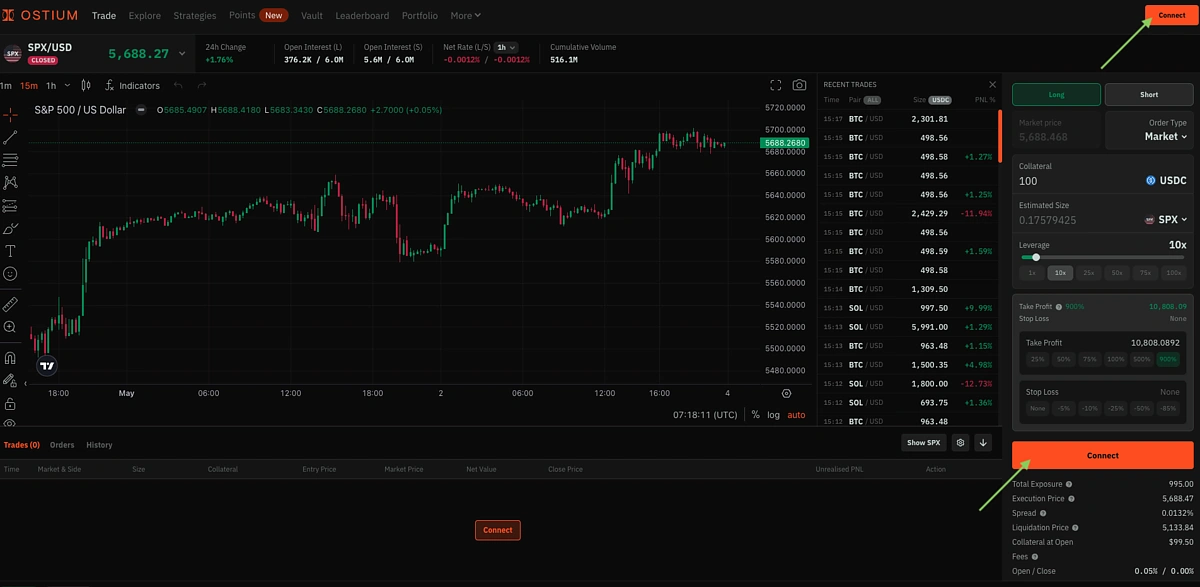
You can choose to create your account using an email address, Google account, or connect a wallet. In this guide we will be connecting a wallet.
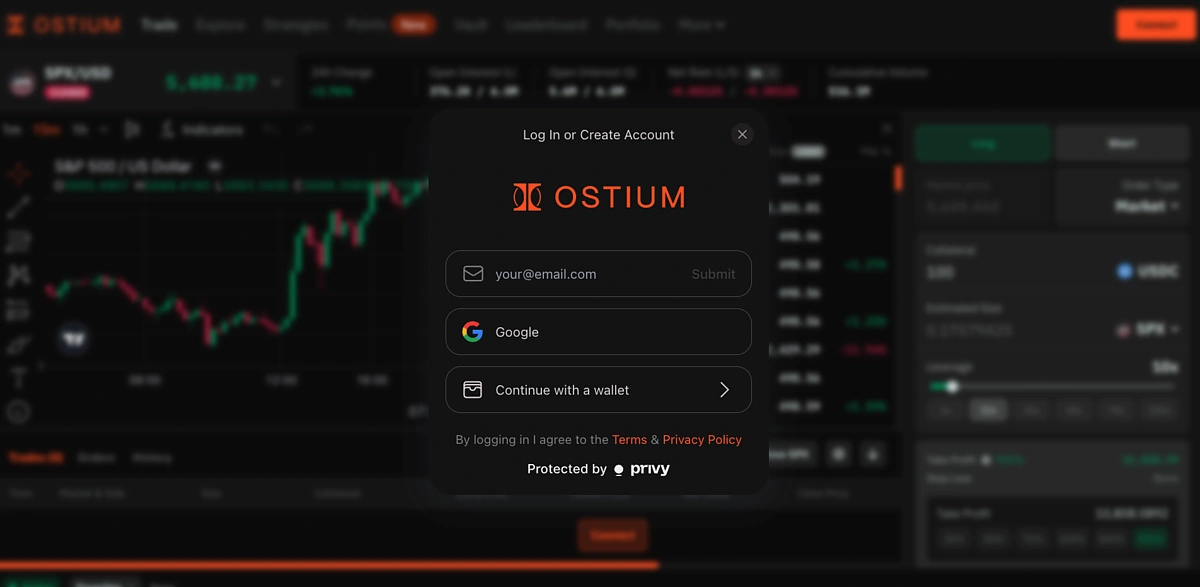
Choose from the list of available wallet options. We will be using Rabby Wallet.

Then Agree to Ostium’s terms of use.
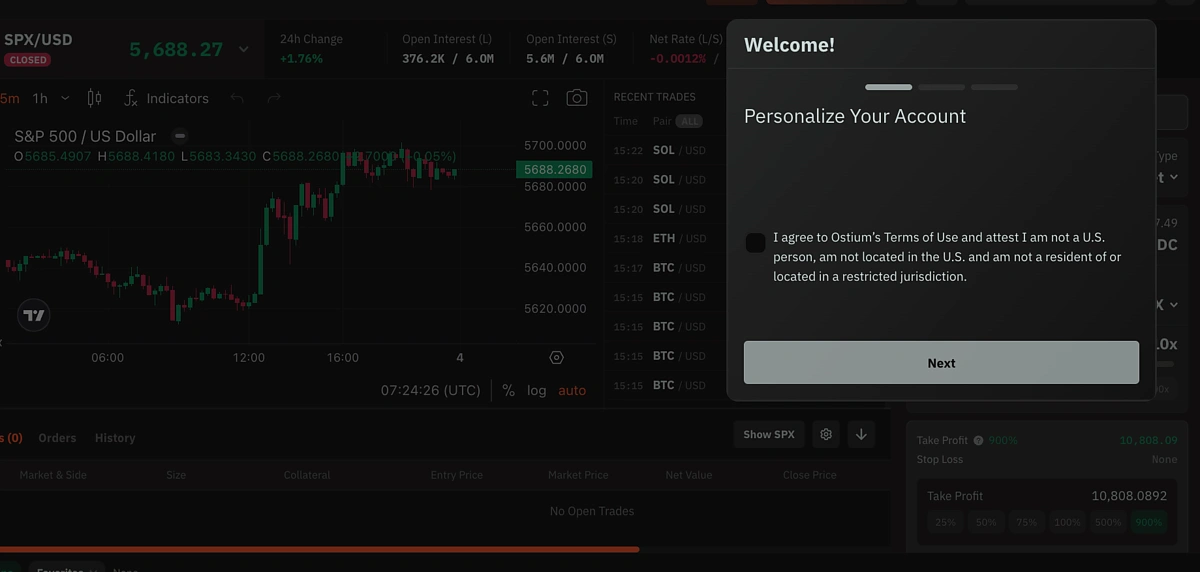
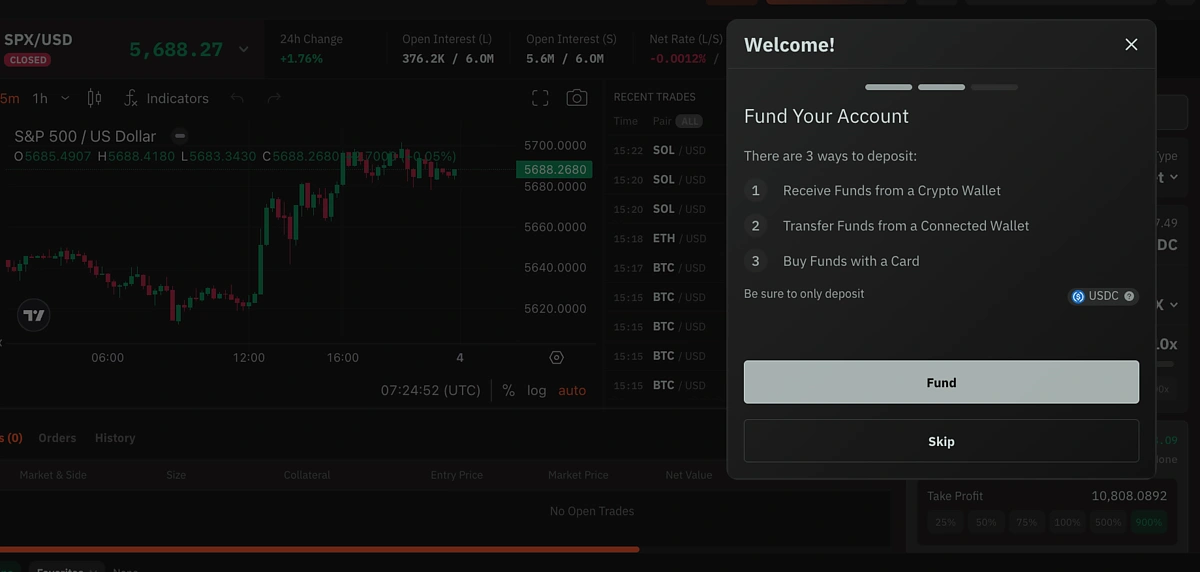
After that, you can choose to fund your account through the three options. However, since we have connected our wallet, the funds will be automatically available in our Ostium account.
Do note that you will need to have USDC on the Arbitrum mainnet.
Step 2: Trade
Now that your wallet is connected, it’s time to perform some trades.
In the left panel, you can view a list of trading options which include Dow Jones (DJI), U.S. Dollars (USD), gold (XAU), and bitcoin (BTC).
Do keep in mind that the traditional finance assets adhere to the market hours and will be unavailable for trading when the market is closed.

Once you have chosen your asset, you can choose to Long it. Input the amount in USDC then choose your leverage, take profit, and stop loss.
As you decide on these details, practice caution do take into account your liquidation price and margin required for your order as being liquidated will result in loss of funds. Learn more about leverage trading here.
Then Approve & Buy by confirming the transactions in your wallet.

The same concept applies if you want to Short instead.

Step 3: Provide Liquidity
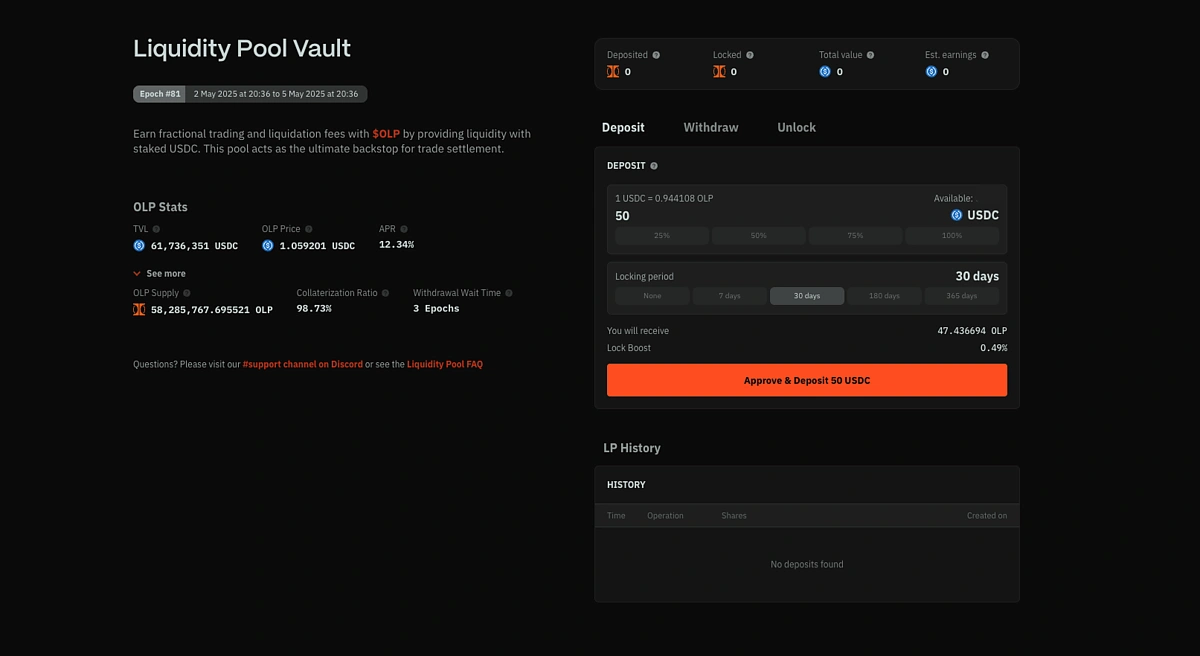
In the top bar, proceed to the Vault.

On this page you will be able to add liquidity to the pool vault. Applying a locking period will earn you an additional boost in the OLP you receive.
Input the amount you want to deposit and then Approve & Deposit the USDC by confirming the transactions in your wallet.
Step 4: Refer Others
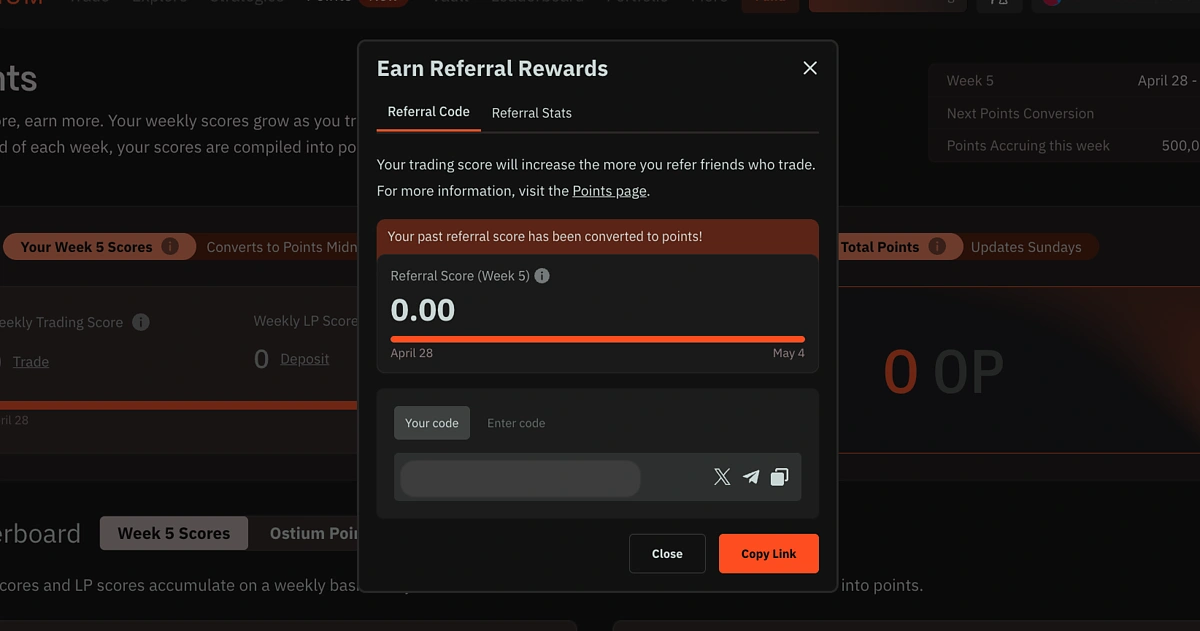
In the right corner of the top menu, you can find the profile icon next to your wallet information.

Click on the icon to see your referral details. Copy your referral link and share this with others to earn points for every successful referral.
Conclusion
Ostium is taking a step forward in bridging real world assets such as commodities and stocks with decentralized finance through synthetic perpetuals. It offers a platform for users to trade and manage traditional assets on-chain by employing two separate oracle systems. As part of its incentive program, users can now earn points for trading, providing liquidity, and referring others.
This article is only for informational purposes and should not be taken as investment or financial advice. Always do your own research before connecting your wallet to any protocol, and note that following the above steps is no guarantee of receiving an airdrop.






 Or check it out in the app stores