





 Make us preferred on Google
What Is XRP (Ripple)?
XRP is a cryptocurrency created by Ripple, with the purpose of enabling fast, low-cost international money transfers between financial institutions. Founded in 2012, Ripple was one of the earliest blockchain technology companies, and XRP was issued in the same year. The token was fully pre-mined, and exists on Ripple’s own blockchain, XRP Ledger.
Key Takeaways
-
XRP is the native token of XRP Ledger, a blockchain developed by Ripple to enable fast and low-cost money transfers. The token and chain were both launched back in 2012.
-
XRP was embroiled in a lawsuit between the SEC and Ripple Labs in 2020, with the SEC alleging that XRP was an unregistered security. The case was settled in 2025, with Ripple and XRP claiming a partial victory.
-
XRP is listed on almost all exchanges, and has support from a wide range of hot and cold wallets.

Ripple vs XRP vs XRP Ledger: What’s the Difference?
Ripple: The Company
Ripple is the blockchain technology company co-founded by Jed McCaleb and Chirstian Larsen in 2012. The company was initially named NewCoin, then quickly renamed to OpenCoin, then renamed again to Ripple Labs, before finally rebranding to just “Ripple”. Its current CEO is Bradley Garlinghouse, who joined the company in 2015.
Ripple was founded to provide a faster, cheaper and more sustainable alternative to Bitcoin, with the aim to create a financial infrastructure and digital asset built specifically for payments. It was also targeted specifically at financial institutions and enterprises, instead of retail users. This led to the creation of the XRP Ledger blockchain, and its native token XRP.
XRP Ledger: The Blockchain
The XRP Ledger blockchain differs from most other blockchains because it doesn’t utilize a typical Proof-of-Work or Proof-of-Stake consensus mechanism. Instead it uses a novel algorithm where there is an open validator set, and each server within the network maintains a Unique Node List (UNL) to indicate its trusted validators. Consensus requires a supermajority of chosen validators to agree on a set of candidate transactions to be added to the ledger.
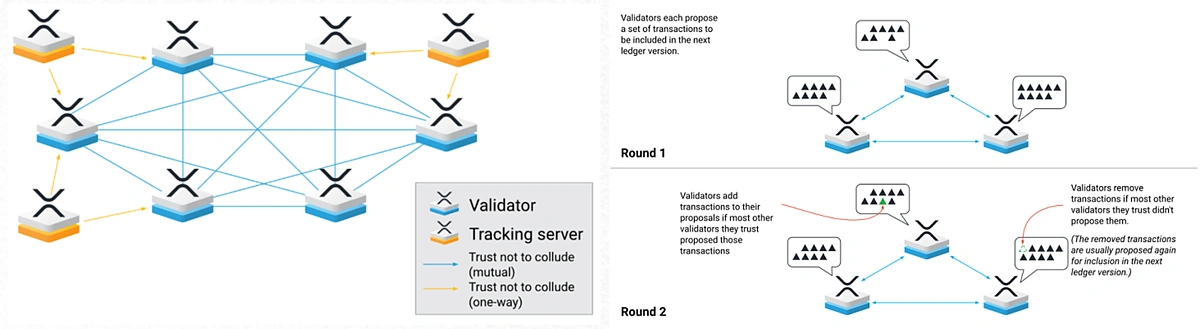
This concept of UNLs rely on a certain degree of “trust”, whereby servers must trust that the validators on their UNL will not collude to introduce false transactions to the network. However it also speeds up the consensus process, with average consensus times on XRP Ledger ranging from 3 - 5 seconds.
XRP: The Asset
Finally, XRP is the native currency of the XRP Ledger blockchain, playing a role similar to BTC for the Bitcoin network and ETH for the Ethereum blockchain. We will discuss more on how XRP works in the next section.
How Does XRP Work?
The total supply of XRP is 100 billion, which was pre-mined at launch. Today ~58.4 billion of these tokens are circulating, with the remainder mostly being held in escrow by Ripple. A portion is released each month, and some XRP may enter circulation depending if Ripple sells them for business use.
XRP, as the native currency of the XRP Ledger blockchain, is firstly used to pay transaction fees on the network. The minimum standard transaction fee is 0.00001 XRP, though this may go higher during periods of network congestion. However a slight difference between XRP and other gas tokens is that instead of the transaction fee being distributed to the miner or validator, it is instead burnt. This burn mechanism introduces (a very small) deflationary element to the XRP supply.
As the native currency on XRP Ledger, XRP is also the de facto settlement currency on the XRP Ledger decentralized exchange (DEX). The vast majority of trading pools created on the DEX are paired with XRP.
Besides that, XRP also serves as the auto-bridging asset for the XRP Ledger DEX. For example, a user may want to swap GBP for BRL on the DEX, but there is limited direct liquidity available for GBP/BRL. XRP Ledger’s DEX will automatically bridge order books between GBP/XRP and XRP/BRL to offer the best price execution for the user. Having XRP serve as such a bridging asset helps improve liquidity across all assets on XRP Ledger.
XRP’s Use Cases
XRP, and XRP Ledger’s mission is to provide faster and cheaper payment services, and the main use case of this is RippleNet, Ripple’s commercial platform that aims to be an alternative to traditional cross-border payments networks such as SWIFT. RippleNet connects financial institutions, payment providers, and banks worldwide, and is built on top of XRP Ledger, utilizing the blockchain to route and settle payments between network participants. Besides international remittances, Ripple has also partnered with financial institutions for domestic payments services.
More recently, improvements to XRP Ledger have allowed the blockchain to be used for extended use cases beyond just payments. This includes use cases such as decentralized finance (DeFi), real-world asset tokenization, gaming, and NFTs. Recently, Ripple issued its own USD stablecoin, RLUSD, on the network.
XRP and the SEC Lawsuit
In 2020 December, the U.S. Securities and Exchange Commission (SEC) filed a lawsuit against Ripple Labs, co-founder Chris Larsen, and CEO Brad Garlinghouse, alleging that they raised over $1.3 billion through an unregistered, ongoing digital asset securities through the sale of XRP. The suit also alleges that XRP was an unregistered security.
In 2023 July after a long legal battle, a district court judge ruled that Ripple's XRP token was an investment contract (and therefore subject to the SEC's registration requirements) when Ripple sold them to institutional investors, but that they were not investment contracts when Ripple sold them to retail investors. This was a partial victory for Ripple and XRP, as the judge still ordered Ripple to pay a $125 million fine to the SEC, though this was a small amount compared to the $2 billion penalty sought by the regulator.
Both Ripple and the SEC eventually decided to appeal the court decision, but ultimately reached a settlement in 2025 March as the SEC decided to drop the appeal and return $50 million of the earlier $125 million fine. As part of this settlement Ripple also agreed to drop its cross-appeal. The legal battle with the SEC reportedly cost Ripple $150 million in legal fees.
Following the settlement of the lawsuit, as well as a broader shift towards more pro-crypto policies by the US Federal Government, XRP is now on several proposals to be integrated into TradFi products. In 2025 May, the CME will debut XRP futures contracts, and there are several spot XRP ETF filings pending review by the SEC, including by prominent fund managers such as Franklin Templeton, Grayscale, Bitwise, and 21Shares.
Where to Buy XRP
As XRP is one of the oldest tokens in existence, it is listed on almost all centralized exchanges (CEXes) worldwide. Users can buy and trade XRP on major exchanges such as Binance, Coinbase, OKX, and Bybit.
How to Store XRP Safely
As XRP exists on the XRP Ledger, it requires users to use a wallet which supports the blockchain. The good news is that there are multiple options available out there for Hot Wallets and Cold Wallets that support XRP Ledger, some of which are listed below.
Hot Wallets: Trust Wallet, Exodus, GateHub, Xaman, Edge
Cold Wallets: Ledger, Trezor, Tangem
Risks to Consider
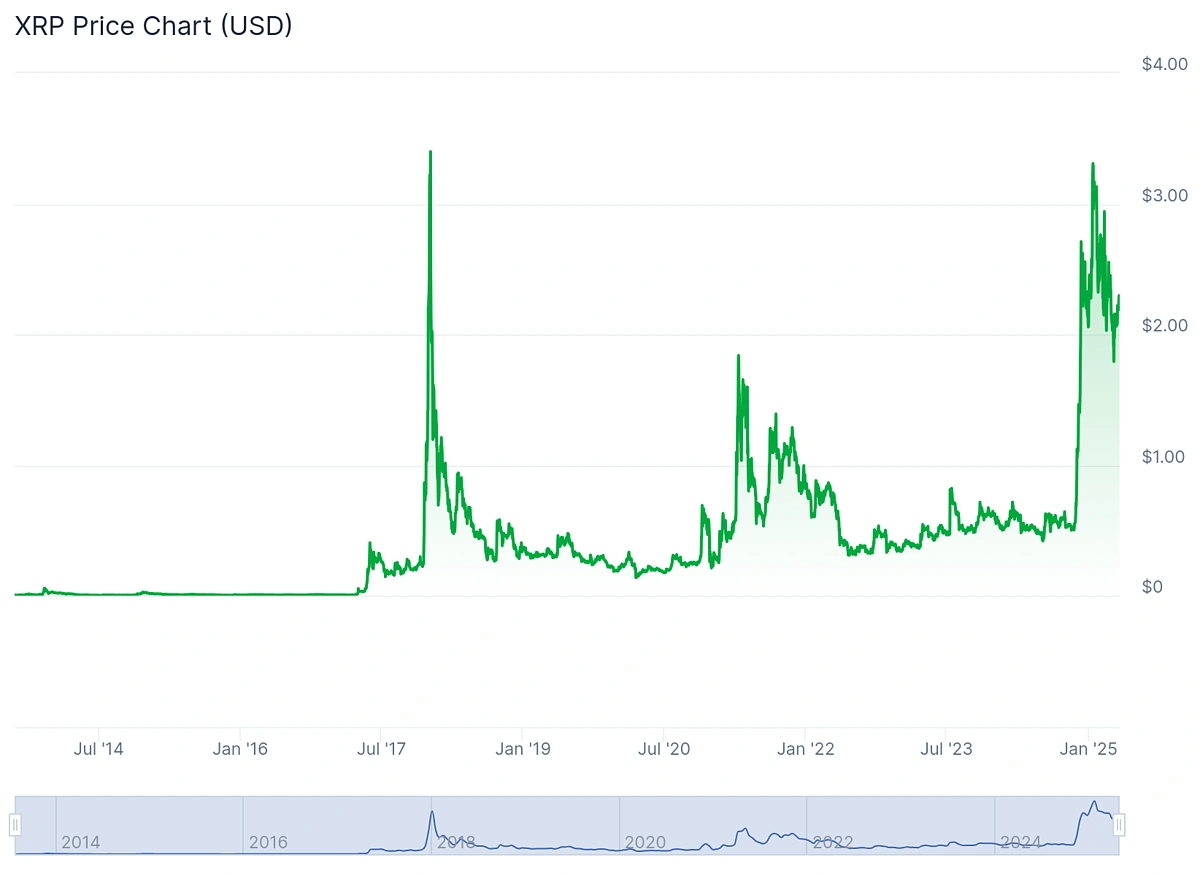
XRP has gone through its share of ups and downs since its inception. It reached its all-time-high of $3.40 in 2018 January, but has also plummeted to as low as $0.14 since then. More recently it has seen a resurgence as its lawsuit with the SEC ended in its favor. Price volatility should be expected for buyers and holders of XRP.
Another factor to consider is also the concentration of supply in the hands of Ripple, though most of it is held in escrow. This means that Ripple could have significant influence over the price of XRP should they decide to sell large amounts of XRP in a short period of time.
As XRP exists on its own Layer 1 blockchain, developments on the XRP Ledger could have an influence on its price. Fundamentally holders are reliant on XRP Ledger to remain secure. XRP Ledger’s entire codebase is open source, and has been audited by different auditors over the years.
Final Thoughts
While one of the oldest cryptocurrencies, XRP retains a large following due to its unique focus on institutional payments. With its speed, low cost, and growing legal clarity, XRP is worth understanding—especially for those interested in blockchain's role in reshaping global finance.
Always do your own research before investing, and consider storing your XRP securely if you decide to participate.






 Or check it out in the app stores