


Geodnet (GEOD) Token Page Revamped, Reports Significant Monthly Token Burn
2 sources





Geodnet Token Page Revamp Shows 3.6M GEO Burned in a Month
| 1h | 24h | 7d | 14d | 30d | 1y |
|---|---|---|---|---|---|
| 0.2% | 3.9% | 8.4% | 24.4% | 20.1% | 51.0% |
| Market Cap | $124.078M |
|---|---|
| Market Cap / FDV | 0.48 |
| Fully Diluted Valuation | $257.998M |
| 24 Hour Trading Vol | $4.689M |
| Circulating Supply | 462.37M |
| Total Supply | 961.413M |
| Max Supply | 1B |
 Sponsored
Sponsored
Sponsored
Sponsored
Sponsored
| 24h Range | $0.2560 – $0.2779 |
|---|---|
| 7d Range | $0.2402 – $0.2779 |
| All-Time High |
$0.3743 28.3%
|
| All-Time Low |
$0.03417 684.9%
|
Geodnet is a decentralized physical infrastructure network providing high-precision location and space weather data for autonomous systems.
Geodnet, short for Global Earth Observation Decentralized Network, is a decentralized infrastructure layer designed to improve the accuracy of Global Navigation Satellite Systems (GNSS) like GPS. While standard GNSS signals typically provide accuracy within several meters, Geodnet enables centimeter-level precision through a process known as Real-Time Kinematics (RTK).
The network functions by collecting real-time data on how solar winds and atmospheric conditions influence satellite signals. This data is processed to provide corrections that are essential for the operation of autonomous drones, precision farming equipment, and robotic systems. The GEOD token acts as the primary utility asset within this ecosystem, used to reward station operators (miners) for providing high-quality data and to facilitate access to the network's specialized data streams. As the ecosystem grows, the demand for precise location services drives the utility and circulation of the token throughout the infrastructure.
Geodnet operates through a network of Satellite Reference Stations, often referred to as space weather miners. These stations are installed by individuals at fixed locations with clear sky visibility. Each station tracks multiple satellite constellations—including GPS, GLONASS, Galileo, and BeiDou—and transmits signal observations to the network.
To ensure the integrity of the data, the protocol employs Proof of Location (POL) and Proof of Accuracy (POA). POL verifies that the data is consistent with the station's reported location and prevents the use of simulated signals. POA evaluates the quality of the data based on factors like uptime, signal-to-noise ratio, and the number of satellites tracked. High-performing stations are rewarded with GEOD tokens. The network originally launched on Polygon and has introduced migration programs to Solana to leverage higher transaction throughput. Users of the data pay protocol service fees in GEOD to access the RTK correction streams.
Geodnet was initiated by a team of experts in GNSS and photonics, including Mike Horton, David Chen, and Yudan Yi. Mike Horton, the lead author of the whitepaper, has a background in high-performance sensing through his work with ANELLO Photonics and VectorNav. The project is governed by the GeoDAO Foundation, a Decentralized Autonomous Organization. It has received institutional backing from notable investors, including Pantera Capital.
GEOD tokens can be traded on centralized crypto exchanges and decentralized exchanges. The most popular exchange to buy and trade Geodnet is Gate, where the most active trading pair GEOD/USDT has a trading volume of $252,500.30 in the last 24 hours. Other popular options include Upbit and Raydium (CLMM).
The trading volume of Geodnet (GEOD) is $4,689,073.49 in the last 24 hours, representing a 21.80% increase from one day ago and signalling a recent rise in market activity. Check out CoinGecko’s list of highest volume cryptocurrencies.
Geodnet (GEOD) reached an all-time high of $0.3743 and an all-time low of $0.03417. It’s now trading -28.30% below that peak and 684.90% above its lowest price.
Market capitalization of Geodnet (GEOD) is $124,078,483 and is ranked #257 on CoinGecko today. Market cap is measured by multiplying token price with the circulating supply of GEOD tokens (460 Million tokens are tradable on the market today).
The fully diluted valuation (FDV) of Geodnet (GEOD) is $257,998,077. This is a statistical representation of the maximum market cap, assuming the maximum number of 1 Billion GEOD tokens are in circulation today. Depending on how the emission schedule of GEOD tokens are designed, it might take multiple years before FDV is realized.
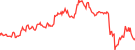
With a price increase of 8.40% in the last 7 days, Geodnet (GEOD) is outperforming the global cryptocurrency market which is up 4.20%, while underperforming when compared to similar DePIN cryptocurrencies which are up 16.10%.
Adding Geodnet (GEOD) to MetaMask allows you to view your token holdings, trade on decentralized exchanges, and more. To add them, you’ll need to import GEOD as a token. You can copy GEOD’s contract address (0xac0f66379a6d7801d7726d5a943356a172549adb) and import it manually, or if you've installed MetaMask's chrome extension, add GEOD to MetaMask with one click on CoinGecko.
Add GEOD to MetaMask.

| # | Exchange | Pair | Price | Spread | +2% Depth | -2% Depth | 24h Volume | Volume % | Last Updated | |
|---|---|---|---|---|---|---|---|---|---|---|
| 1 |
CEX
|
$0.2700 | 0.27% | $45,596.94 | $62,072.38 | $2,254,698 | 40.41% |
Recently
|
||
| 2 |
CEX
|
$0.2700 | 0.11% | $637.46 | $2,832.76 | $355,269 | 6.37% |
Recently
|
||
| 3 |
CEX
|
$0.2700 | 0.22% | $1,890.03 | $2,525.90 | $256,491 | 4.6% |
Recently
|
||
| 4 |
DEX
|

|
$0.2700 | 0.60% | $7,058.64 | $7,037.43 | $294,601 | 5.28% |
Recently
|
|
| 5 |
DEX
|
|
$0.2700 | 0.60% | $10,369.59 | $10,338.44 | $148,266 | 2.66% |
Recently
|
|
| 6 |
CEX
|
$0.2700 | 0.67% | $1,167.11 | $6,051.74 | $271,102 | 4.86% |
Recently
|
||
| 7 |
DEX
|
|
$0.2700 | 0.60% | $6,570.06 | $6,550.32 | $118,173 | 2.12% |
Recently
|
|
| 8 |
DEX
|
|
$0.2700 | 0.60% | $4,238.46 | $4,225.72 | $273,862 | 4.91% |
Recently
|
|
| 9 |
CEX
|
$0.2700 | 0.04% | $3,879.86 | $2,607.11 | $53,109.62 | 0.95% |
Recently
|
||
| 10 |
DEX
|
|
$0.2700 | 0.60% | $8,810.25 | $8,783.78 | $123,732 | 2.22% |
Recently
|
|







 GeckoAI


 Or check it out in the app stores