





Turtle
TURTLE Price
How is the price of Turtle (TURTLE) calculated?
The price of Turtle (TURTLE) is calculated in real-time by aggregating the latest data across 15 exchanges and 18 markets, using a global volume-weighted average formula. Learn more about how crypto prices are calculated on CoinGecko.



Turtle Jumps 2.15% Following Acquisition of Lunar Strategy
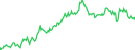
Turtle Price Chart (TURTLE)
Switch & Compare
| 1h | 24h | 7d | 14d | 30d | 1y |
|---|---|---|---|---|---|
| 0.8% | 0.8% | 6.2% | 16.9% | 33.4% | 0.0% |
TURTLE Converter
Turtle Statistics
|
Market Cap
Market Cap = Current Price x Circulating Supply
Refers to the total market value of a cryptocurrency’s circulating supply. It is similar to the stock market’s measurement of multiplying price per share by shares readily available in the market (not held & locked by insiders, governments) Read More |
$6.975M |
|---|---|
|
Market Cap / FDV
The proportion of current market capitalization compares to market capitalization when meeting max supply.
The closer the Mkt Cap/FDV to 1, the closer the current market capitalization to its fully diluted valuation and vice versa. Learn more about Mkt Cap/FDV here. |
0.15 |
|
Market Cap / TVL Ratio
Ratio of market capitalization over total value locked of this asset. A ratio of more than 1.0 refers to its market cap being greater than its total value locked.
MC/TVL is used to approximate a protocol’s market value vs. the amount in assets it has staked/locked. |
9.05 |
|
Fully Diluted Valuation
Fully Diluted Valuation (FDV) = Current Price x Total Supply
Fully Diluted Valuation (FDV) is the theoretical market capitalization of a coin if the entirety of its supply is in circulation, based on its current market price. The FDV value is theoretical as increasing the circulating supply of a coin may impact its market price. Also depending on the tokenomics, emission schedule or lock-up period of a coin's supply, it may take a significant time before its entire supply is released into circulation. Learn more about FDV here. |
$45.09M |
|
Fully Diluted Valuation / TVL Ratio
Ratio of fully diluted valuation (FDV) over total value locked (TVL) of this asset. A ratio of more than 1.0 means that the FDV is greater than its TVL.
FDV/TVL is used to approximate a protocol’s fully diluted market value vs. the amount in assets it has staked/locked. |
58.53 |
|
24 Hour Trading Vol
A measure of a cryptocurrency trading volume across all tracked platforms in the last 24 hours. This is tracked on a rolling 24-hour basis with no open/closing times.
Read More |
$993,034 |
|
Total Value Locked (TVL)
Capital deposited into the platform in the form of loan collateral or liquidity trading pool.
Data provided by Defi Llama |
$768,420 |
|
Circulating Supply
The amount of coins that are circulating in the market and are tradeable by the public. It is comparable to looking at shares readily available in the market (not held & locked by insiders, governments).
Read More |
154.7M |
|
Total Supply
The amount of coins that have already been created, minus any coins that have been burned (removed from circulation). It is comparable to issued shares in the stock market.
Total Supply = Onchain supply - burned tokens |
1B |
|
Max Supply
The maximum number of coins coded to exist in the lifetime of the cryptocurrency. It is comparable to the maximum number of issuable shares in the stock market.
Max Supply = Theoretical maximum as coded |
1B |
 Sponsored
Sponsored
Sponsored
Sponsored
Sponsored



TURTLE Historical Price
| 24h Range | $0.04391 – $0.04660 |
|---|---|
| 7d Range | $0.04056 – $0.04761 |
| All-Time High |
$0.2820 84.0%
Oct 22, 2025 (10 months)
|
| All-Time Low |
$0.03227 39.8%
Jul 13, 2026 (29 days)
|
How do you feel about TURTLE today?
About Turtle (TURTLE)
Turtle is a distribution protocol for DeFi yield that connects liquidity providers, yield opportunities, and distribution platforms through a non-custodial, attribution-based marketplace.
- Non-custodial architecture: Users retain full control of their assets at all times, with Turtle generating transactions that users sign and submit from their own wallets.
- On-chain attribution: Every deposit is automatically linked to the distributor that sourced it, enabling transparent revenue sharing and performance-based billing for protocols.
- Structured diligence review: Each vault undergoes review by the Turtle Due Diligence Council across technical risk, smart contract exposure, operational risk, and curator assessment before reaching the catalog.
What Is Turtle
Turtle operates as infrastructure between DeFi yield opportunities and the platforms that distribute them. Launched in April 2024 by a remote global team, the protocol sits at the center of a three-sided marketplace.
On one side are yield opportunities: a curated catalog of vaults across major EVM chains, each reviewed before listing. On the second side are distributors—wallets, exchanges, neobanks, and other platforms that integrate once and route their users into vaults. On the third side are protocols seeking liquidity and willing to fund incentives to attract it.
Value flows through attribution. Every deposit carries the distributor's embedded ID in the transaction calldata. Turtle monitors supported chains and links deposits to their source distributors automatically. This attribution enables distributors to earn recurring revenue share on the TVL they bring, while protocols pay only for liquidity that Turtle actually delivered. The system is completely non-custodial, integrating with APIs and audited smart contracts to track liquidity flows and rewards.
What Makes Turtle Unique
-
Attribution-native design: Unlike traditional yield aggregators, Turtle's core innovation is on-chain attribution that automatically links every deposit to its source distributor, eliminating manual reporting and enabling transparent revenue sharing.
-
Diligence-first listing: Opportunities are not self-listed. The Turtle Due Diligence Council conducts structured reviews covering technical risk, smart contract exposure, operational risk, and curator assessment before vaults reach the catalog.
-
Three-sided marketplace: Turtle uniquely serves three distinct parties—liquidity providers seeking yield, distributors seeking revenue share, and protocols seeking liquidity—creating network effects between these groups.
-
Independent solvency verification: Featured vaults are verified by Accountable, an on-chain solvency verification provider, confirming that reported TVL matches actual on-chain holdings.
-
Multi-chain presence: The protocol operates across Ethereum, BNB Chain, and Linea, with the TURTLE token available on all three networks.
What Can You Use TURTLE for?
-
Governance participation: TURTLE serves as the governance token for the Turtle DAO, enabling holders to participate in protocol decisions.
-
Staking for leaderboard boosts: Users can stake TURTLE to earn a boost on points accrued in the Liquidity Leaderboard. The boost applies linearly based on the ratio of staked TURTLE (sTURTLE) value to position value for each liquidity campaign.
-
Ecosystem incentives: The token is used to incentivize participation across the Turtle ecosystem, including liquidity campaigns and partner protocols.
-
Airdrop rewards: TURTLE was distributed through a Genesis Airdrop to wallets that contributed value to the Turtle DAO through liquidity campaigns, partner referrals, and other value-added activities.
How Does Turtle Work?
Turtle operates through a coordinated flow that maintains non-custody throughout. When a distributor surfaces an opportunity, they link users to deposit pages through either no-code share links or full API integration, with each link carrying the distributor's ID. The liquidity provider then deposits into their chosen vault from their own wallet—Turtle generates the unsigned transaction, but the user signs and submits it themselves.
The distributor's ID is embedded in the deposit calldata. Turtle monitors every supported chain and attributes the deposit to the sourcing distributor automatically. The LP earns the vault's base yield, plus any additional token emissions from featured opportunities. Because attribution happens on-chain, distributors earn recurring revenue share on the TVL they originated.
The protocol runs through several integrated products. Earn provides distributors access to the full vault catalog through a single integration, generating deposit and withdrawal transactions while tracking attributed activity. Streams allow protocols to attach self-serve reward campaigns to vaults, paying LPs in proportion to their TVL. Liquidity Campaigns are Turtle-selected opportunities that pass diligence review and include additional incentives. Ecosystem Campaigns coordinate multiple vaults and incentives to bootstrap entire chains.
Turtle's smart contracts have been audited by independent security firms including Cantina. The protocol service fees and revenue models are structured around attributed TVL, with protocols billed based on actual delivered liquidity rather than estimates or projections.
Team Info and Investors
Turtle was launched in April 2024 by a remote team distributed across the globe. The source material does not specify detailed information about individual team members, founders, or specific investors.
According to the tokenomics documentation, private rounds (investors) received 27.50% of the total supply with a 6-month cliff and 36-month linear vesting. Team, advisors, and contributors hold 23.10% with a 12-month cliff and 36-month linear vesting. The protocol maintains a GitHub repository at github.com/turtle-dao and engages with the community through Discord and X (Twitter).
Where can you buy Turtle?
TURTLE tokens can be traded on centralized crypto exchanges. The most popular exchange to buy and trade Turtle is Binance, where the most active trading pair TURTLE/USDT has a trading volume of $221,031.10 in the last 24 hours. Other popular options include Gate and MEXC.
What is the daily trading volume of Turtle (TURTLE)?
The trading volume of Turtle (TURTLE) is $971,936.75 in the last 24 hours, representing a 24.10% increase from one day ago and signalling a recent rise in market activity. Check out CoinGecko’s list of highest volume cryptocurrencies.
What is the highest and lowest price for Turtle (TURTLE)?
Turtle (TURTLE) reached an all-time high of $0.2820 and an all-time low of $0.03228. It’s now trading -84.00% below that peak and 39.80% above its lowest price.
What is the market cap of Turtle (TURTLE)?
Market capitalization of Turtle (TURTLE) is $6,957,795 and is ranked #1333 on CoinGecko today. Market cap is measured by multiplying token price with the circulating supply of TURTLE tokens (150 Million tokens are tradable on the market today).
What is the fully diluted valuation of Turtle (TURTLE)?
The fully diluted valuation (FDV) of Turtle (TURTLE) is $44,976,049. This is a statistical representation of the maximum market cap, assuming the maximum number of 1 Billion TURTLE tokens are in circulation today. Depending on how the emission schedule of TURTLE tokens are designed, it might take multiple years before FDV is realized.
How does the price performance of Turtle compare against its peers?
With a price increase of 5.10% in the last 7 days, Turtle (TURTLE) is outperforming the global cryptocurrency market which is up 0.20%, while outperforming when compared to similar BNB Chain Ecosystem cryptocurrencies which are up 0.00%.
How to add Turtle (TURTLE) to MetaMask?
Adding Turtle (TURTLE) to MetaMask allows you to view your token holdings, trade on decentralized exchanges, and more. To add them, you’ll need to import TURTLE as a token. You can copy TURTLE’s contract address (0x66fd8de541c0594b4dccdfc13bf3a390e50d3afd) and import it manually, or if you've installed MetaMask's chrome extension, add TURTLE to MetaMask with one click on CoinGecko.
Add TURTLE to MetaMask.
Turtle Markets
| # | Exchange | Pair | Price | Spread | +2% Depth | -2% Depth | 24h Volume | Volume % | Last Updated | |
|---|---|---|---|---|---|---|---|---|---|---|
| 1 |
CEX
|
$0.05000 | 0.44% | $71,291.13 | $73,167.87 | $218,716 | 9.44% |
Recently
|
||
| 2 |
CEX
|
$0.05000 | 0.02% | $30,712.98 | $24,097.43 | $154,623 | 6.67% |
Recently
|
||
| 3 |
DEX
|

|
$0.05000 | 0.60% | $30,355.46 | $30,264.25 | $136,714 | 5.9% |
Recently
|
|
| 4 |
CEX
|
$0.04000 | 0.20% | $42,331.99 | $39,736.84 | $93,864.63 | 4.05% |
Recently
|
||
| 5 |
CEX
|
$0.04000 | 0.67% | $65,039.30 | $100,852 | $91,302.78 | 3.94% |
Recently
|
||
| 6 |
CEX
|
$0.04000 | 0.15% | $85,745.09 | $56,910.12 | $66,100.31 | 2.85% |
Recently
|
||
| 7 |
CEX
|
$0.05000 | 0.46% | $16,271.46 | $8,544.78 | $59,893.27 | 2.58% |
Recently
|
||
| 8 |
CEX
|
$0.05000 | 0.49% | $28,240.68 | $28,364.79 | $53,062.20 | 2.29% |
Recently
|
||
| 9 |
CEX
|
$0.04000 | 0.22% | $265.54 | $233.20 | $45,478.89 | 1.96% |
Recently
|
||
| 10 |
CEX
|
$0.05000 | 0.22% | $23,229.30 | $71,445.03 | $29,032.58 | 1.25% |
Recently
|
||


You may be interested in these latest crypto news


You may be interested in these crypto articles


Global Turtle Prices
Related Coins You May Like
















 GeckoAI



 Or check it out in the app stores