





 Make us preferred on Google
What Are Stablecoins?
Stablecoins are crypto assets designed to maintain a stable value. They are usually pegged to the value of another asset –most commonly a fiat currency. Some popular stablecoins include USDT, USDC, USDS, USDe and FDUSD.
Key Takeaways
-
Stablecoins are cryptocurrencies designed to maintain a stable value, using strategies that handle market fluctuations and ensure little or no impact on value. These can range from collateralization to algorithms and rebasing.
-
Stablecoins contribute to general liquidity and serve as a means of preserving value in a volatile market like crypto.
-
Stablecoins control a cumulative market capitalization of over $233 billion.
This article was edited in February by Joel Agbo.
Stablecoins account for about 7% of the total valuation of the crypto market, with a total market cap of over $232 billion at time of writing. Since 2014, stablecoins have played an important role in the crypto market by providing traders with a means to preserve value and profits in the volatile crypto market. While there are different types of stablecoins,
Understanding Stablecoins
Stablecoins are digital tokens whose value is tied to another asset, like a commodity or fiat currency, to maintain a stable price. Stablecoins are usually pegged to the value of a specific fiat currency, most popularly the US dollar, although there are stablecoins that are pegged to other fiat currencies as well, such as the euro. They can also be pegged to a commodity like gold or silver, where digital tokens represent the underlying collateral.
As stablecoins maintain a 1:1 peg to a specific fiat currency or commodity, they bridge real-world assets and digital currencies by representing these assets as digital tokens on the blockchain. Since stablecoins are pegged to relatively stable assets, they offer crypto users a way to transfer value (and take profits) without exposing themselves to price volatility, while also allowing users to keep their capital on-chain even as they stay out of the market.
Stablecoins also offer users an insight into liquidity moving into the crypto market, as a rise in stablecoin issuance suggests an influx of capital.
Beyond the crypto space, stablecoins are gaining relevance in mainstream finance, with digital payments network Visa launching the Visa Tokenized Asset Platform (VTAP) to help banks issue stablecoins and other fiat-backed tokens internationally.
Why Are Stablecoins Important?
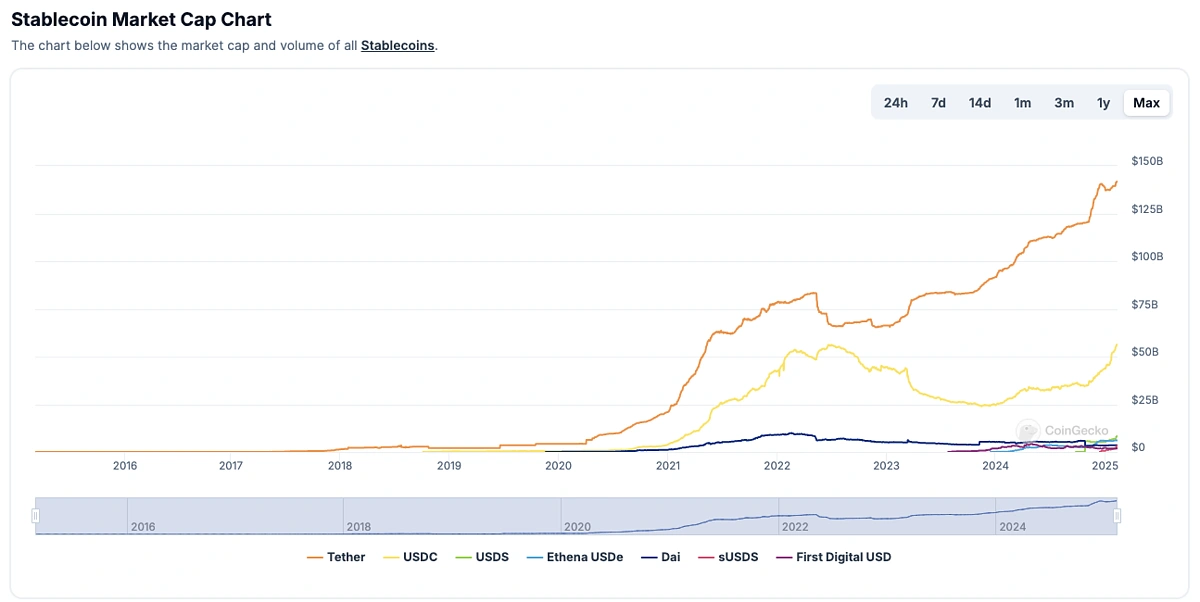
In January 2016, the market cap of stablecoins was around $1.5 million. At time of writing, in February 2025, this has grown to over $233 billion, highlighting the importance of stablecoins in crypto and beyond.
Value Preservation On-Chain
Crypto assets are notoriously volatile, with drastic price changes within a short period of time. As stablecoins maintain a stable value, they enable value preservation on-chain, where users don’t have to worry about their stablecoin holdings declining in value due to market volatility.
Retain Liquidity On-Chain
Stablecoins help to retain liquidity on chain, as users can exit positions while keeping profits and remaining on-chain. Instead of liquidity moving off-chain as users offramp into fiat money when exiting profitable trades, liquidity remains on-chain as users can exit positions while staying on chain by swapping to a stablecoin.
Alternative Medium of Exchange
Stablecoins like USDT and USDC are backed by cash and cash equivalents, and these can act as an alternative medium of exchange or a substitute for fiat money. For regions that face local monetary instability like Latin America and Sub-Saharan Africa, stablecoins also act as a more reliable means of financial security. Stablecoins also allow overseas citizens to circumvent the inefficiencies and high costs associated with traditional remittance services.
Liquidity Provision In DeFi
DeFi projects employ stablecoins in several ways. On platforms like decentralized exchanges and lending protocols, stablecoins contribute significantly to the platform’s general liquidity via holders who commit them (stablecoins) to the liquidity pool. In turn, they receive passive income from transaction fees, liquidity-farming programs, and interests from borrowers on crypto lending platforms. Stablecoins are known to have the highest APR on lending protocols, due to demand.
How Do Stablecoins Maintain Their Value?
The appeal of stablecoins lies in how they maintain their value, although different types of stablecoins do so differently. Now, let’s look at some common types of stablecoins and how they maintain their peg.
Fiat-Collateralized (Custodial)
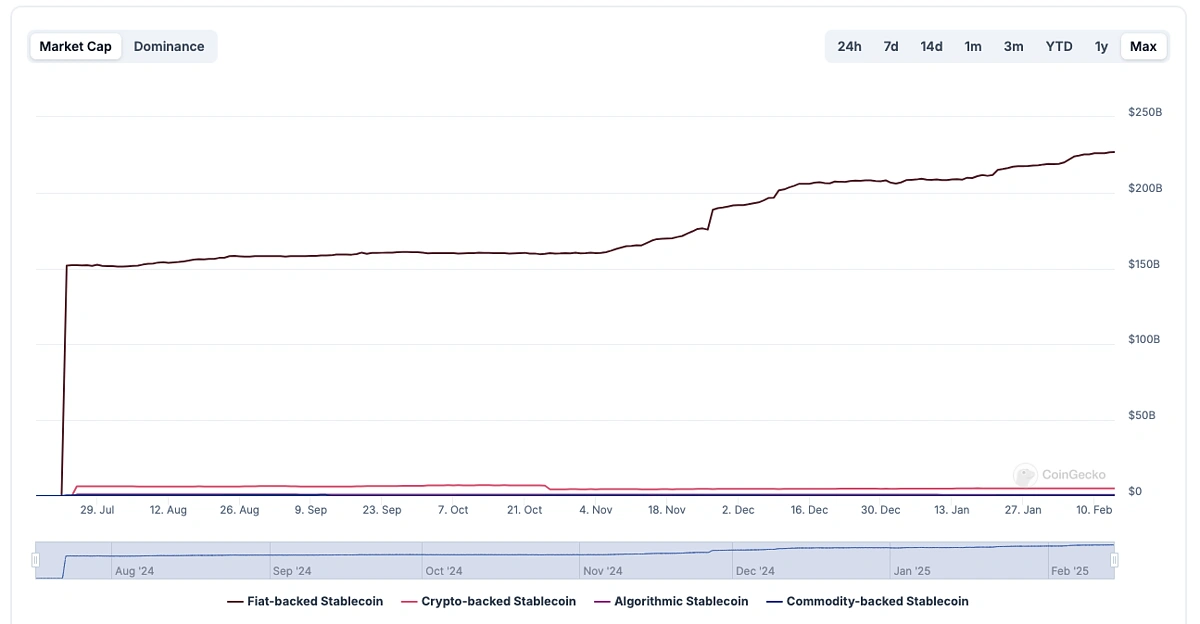
Fiat-collateralized stablecoins are also known as fiat-backed stablecoins. As the name implies, the value and stability of these stablecoins are sustained by cash and cash equivalents held by the stablecoin issuer. In most cases, the backing ratio for fiat-collateralized stablecoins is 1:1. This is the most popular type of stablecoin, with Tether (USDT) and USDC making up about 84% of the total stablecoin market cap.
How this works; the fiat currency is locked in an agreement between the client and the issuer, and an equivalent amount of stablecoin is minted on a smart contract blockchain. The minted stablecoins can be redeemed for fiat money through the issuer, where the redeemed tokens are burnt. While there may be barriers to physical redemption – Tether requires users to undergo money-laundering checks and KYC procedures, along with minimum redemption requirements – the widespread adoption of these fiat-collateralized stablecoins by centralized crypto exchanges means users can easily offramp their USDT.
In the event a fiat-collateralized stablecoin is trading at a discount (e.g. $0.95), arbitrageurs will swoop in to purchase them and redeem them through the issuer for $1, driving the price back to $1 and subsequently maintaining the stable value of the coin.
Crypto-Collateralized (Decentralized)
Crypto-collateralized stablecoins are backed by crypto assets, this includes other stablecoins and other eligible crypto assets (usually ETH and BTC). Crypto-collateralized stablecoins are built on self-custody solutions; they are permissionless and decentralized and are perceived as a more transparent and inclusive approach to stablecoins. Crypto-collateralized stablecoins adopt different strategies to control the generation, distribution, and redemption of the stablecoin. Some of these strategies include an overcollateralized money market and minting procedures controlled by pre-programmed algorithms.
A crypto-collateralized stablecoin is GHO, a decentralized stablecoin developed by Aave, backed by basket of assets selected by the DAO. To mitigate the volatility of cryptocurrencies, Aave operates an overcollateralized loan system for GHO, where the value of the collateral supplied is greater than the value of stablecoins issued, where overcollateralization acts as a buffer for market volatility.
Another crypto-collateralized stablecoin that doesn't require overcollateralization is Ethena's USDe, which accepts BTC, ETH, ETH LSTs, and SOL as collateral (along with stablecoins). In the case of USDe, they take offsetting equivalent short positions in derivatives markets to neutralize price movements of the backing assets.
Algorithmic Stablecoins (Decentralized)
Algorithmic stablecoins adopt the mint-and-burn strategy to regulate the stablecoin’s supply. This system pairs the stablecoin with a conventional crypto asset and enables holders to mint the stablecoin by burning an equivalent of the volatile asset.
One example of an algorithmic stablecoins is Tron’s USDD, where the stablecoin protocol mints an equivalent amount of USDD when a user burns TRON (TRX) on the platform. On the other hand, it mints an equivalent value of TRX when a USDD holder burns their stablecoin on the platform.
Rebasing Stablecoins (Decentralized)
In rebasing, the supply of the stablecoin is adjusted according to market demand. In normal situations, the asset is expected to trade around $1; when the demand for the asset increases and the value rises above $1, the protocol mints more tokens and automatically increases the number of tokens held by every holder to bring the price back down to $1. However, when the value of the asset decreases below $1, the protocol decreases the total supply, including the assets held by holders.
One example of a rebasing stablecoin is AMPL by Ampleforth, which targets the CPI adjusted US dollar and increases or decreases the quantity of tokens in user wallets based on price. According to the protocol, “AMPL cannot break by natural market forces and does not require any collateral, treasury, market-maker, or buyer-of-last-resort to return to its long-run target.”
Now, let’s look at some of the most popular stablecoins.
Tether USD (USDT)
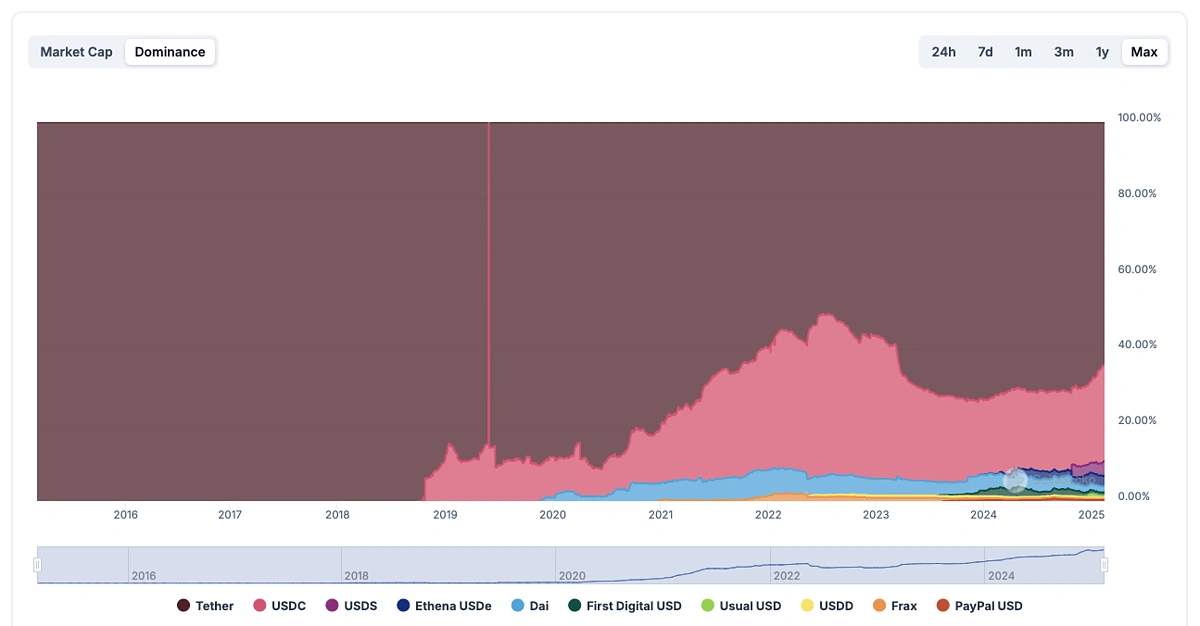
USDT is the biggest stablecoin in terms of market cap, controlling nearly 70% of the total stablecoin market and consistently maintaining its lead.
USDT is a centralized fiat-backed stablecoin pegged to the USD and is issued and managed by Tether Holdings Inc. According to Tether, the USDT is backed by a basket of assets held in off-chain reserves, consisting of cash and cash equivalents, precious metals, and other investments including Bitcoin.
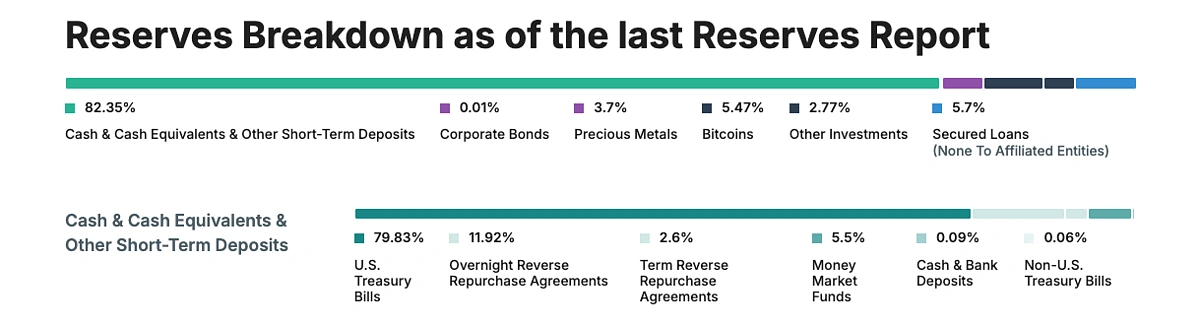
To issue USDT, the verified client deposits fiat currency into Tether’s physical world account, and Tether tokens are then issued from the Tether treasury to the user’s specified wallet address, after which it can be used for on-chain activities. According to Tether, every USDT issued to date can be exchanged for fiat money once KYC requirements are met (along with other conditions like minimum redemption of $100,000).
Circle USD (USDC)
USDC is the second-biggest stablecoin in terms of market cap, after Tether’s USDT. Like USDT, USDC is a centralized fiat-backed stablecoin pegged to the US dollar. USDC is issued and managed by Circle. Since 2018, over $50 billion worth of USDC has been issued by the firm. USDC operates similarly to USDT; however, major differences can be seen in their reserves structure. According to a recent audit report, Circle’s collateralization for USDC is limited to U.S. Treasury Securities and cash.
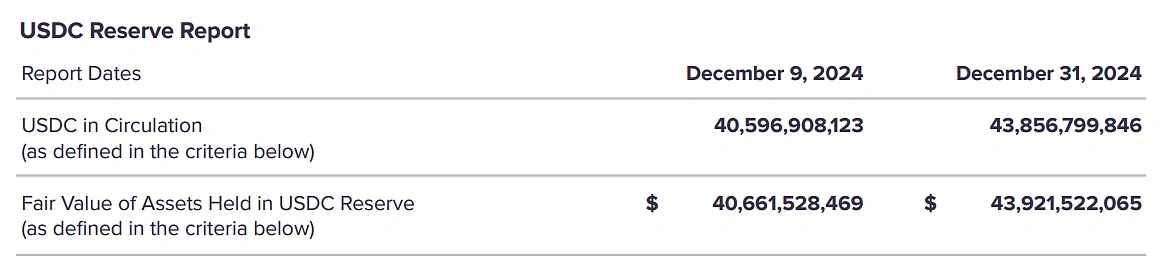
While anyone who meets Tether’s requirements can redeem USDT, only wholesale providers like exchanges, institutional traders, wallet providers, banks, and large financial institutions are eligible for Circle Mint, which lets them redeem USDC from Circle. Individual users are not eligible for Circle Mint.
Sky USD (USDS) / DAI
USDS is the official stablecoin of Sky (previously known as Maker). According to the project, it is an upgrade to the DAI stablecoin, which used an overcollateralized loan system to maintain its peg to the US dollar. Now, with Sky, users can trade USDC, USDT, ETH, DAI, MKR and SKY for USDS. Old DAI holders can convert their tokens to USDS through the Sky protocol. USDS can also be purchased directly on decentralized and centralized exchanges where they are supported.
USDS’s issuance and management structure is undertaken by the Sky protocol through the Sky DAO. SKY token holders vote on aspects of the stablecoin including ones related to passive income programs where the asset is supported. At the time of writing, Sky protocol offers up to 8.75% APR to USDS holders through the Sky Savings Rate (SSR) and the Sky Token Reward program.
Ethena USDe (USDE)
Despite being launched in 2024, USDE has grown into 4th biggest stablecoin in terms of market cap. Over $6 billion worth of the stablecoin has been minted at the time of writing. USDe is a decentralized stablecoin managed by Ethena, backed by assets including ETH, stETH, BTC, and USDT. USDe can be minted by whitelisted market makers, while individuals can swap stablecoins for USDe through the dApp.
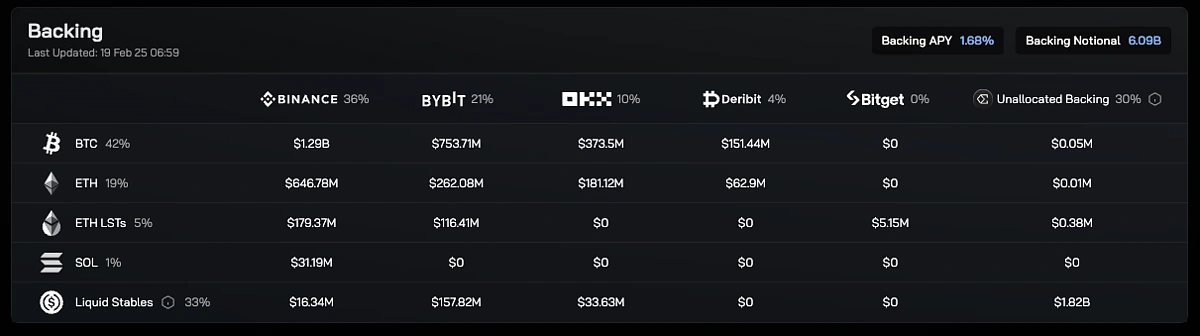
It doesn’t rely on traditional financial infrastructure like fiat-collateralized stablecoins, nor does it require overcollateralization. Instead, Ethena Protocol protects USDe from market price fluctuation through delta-hedging, taking offsetting positions in derivatives markets to neutralize price movements of USDe’s backing assets.
Ethena also provides a share of protocol yield to USDe stakers, who receive sUSDe. At time of writing, sUSDe APY is at 6.39%.
First Digital USD (FDUSD)
Established by First Digital, FDUSD was created to improve the efficiency of financial transactions. According to the team, FDUSD provides an alternative to Tether’s USDT and Circle’s USDC, as Tether is notoriously opaque around its reserves, while Circle, as a US-centric company, is restricted by US regulators. Meanwhile, FDUSD is developed in Asia and enjoys a friendlier regulatory environment.
Every FDUSD is backed by cash or assets of equivalent value held in reserves with its appointed custodian, First Digital Trust Limited. These reserve assets are held separately from the custodian’s other assets. Unlike other fiat-collateralized stablecoins, FDUSD offers zero fee unlimited minting and redemption, offering a more cost-efficient option without extra fees. FDUSD is available on Ethereum, BNB Chain, Sui, and Solana networks.

Like many other stablecoins in this list, FDUSD can only be purchased from First Digital Labs by whitelisted parties; key industry players, financial intermediaries, or professional investors of a certain stature that meet the requisite criteria. Individuals can obtain FDUSD from supported centralized or decentralized exchanges.
Final Thoughts
Stablecoins play an important role in the crypto space, by providing a stable asset in a volatile market. Since its inception, stablecoins have matured over time, improving in terms of technology and transparency, and even expanding its reach beyond the crypto space by offering an alternative to traditional remittance platforms. The popularity of stablecoins also translate to appealing earn programs on DeFi platforms that offer an attractive alternative to traditional fiat deposits with banks.
However, stablecoins also suffer from limitations including regulatory uncertainties, along with a risk of depegging for novel stablecoin approaches.
Finally, note that this article is only for educational and informational purposes, and should not be taken as investment or financial advice. Always do your own research before investing any capital in cryptocurrencies.







 Or check it out in the app stores